
The most important positive of India's stealth bull market is earnings growth across different sectors, explains Debashis Basu.

Domestic equity markets are likely to see volatility in a range-bound trade this week amid geopolitical worries and growing expectations of a sharp hike in interest rates, analysts said. Global trends, inflation data and the last batch of quarterly earnings will drive the markets this week, they said. Besides, the rupee movement, FII investment pattern and Brent crude trends would also be watched by investors.
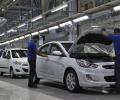
An analysis of past 20 years' demand cycles done by Edelweiss Securities indicates that the auto sector is currently in the middle of a down cycle. Volume recovery, they say, is unlikely to be as sharp as in the past, unless there is strong fiscal support.

Increased truck sales, new models push Leyland's share to 34%, from 30.2% in the same quarter a year before.

The Fed interest rate decision, domestic macroeconomic data announcements and quarterly earnings will be the major sentiment drivers for the equity market in a holiday-shortened week ahead, analysts said. Investors will also take cues from the monthly auto sales numbers to be announced on Monday. Equity markets will remain closed on Thursday for Diwali Laxmi Pujan and on Friday for Diwali Balipratipada.

The recurrent increases in fuel prices over the past 10 days are eating into the margins of transporters, who will be forced to pass on the hikes to their customers. This, in turn, is set to make the prices of daily consumables and other goods dearer, affect consumption, and slow economic growth, said transporters and analysts. Freight rates on grand trunk routes have shot up 3-4 per cent month-on-month in the past few days, according to the Indian Foundation of Transport Research & Training (IFTRT).

'The correction could take two to three months and traders need to be careful.' 'For investors, this could be a good time to nibble in.'

Consumer stocks remain the biggest laggard on the bourses. The Nify50 weighting of FMCG stocks declined to a decade low of 9.9 per cent at the end of March this year, down 150 basis points from 11.4 per cent a year ago. At their peak in March 2013, major FMCG stocks, such as Hindustan Unilever, ITC, and Asian Paints, together accounted for 15 per cent of the Nifty50. But now together with automobile stocks, the consumer goods sector accounts for only 14.7 per cent of the index, down 200 basis points in the past 12 months and 37 per cent from the record high weighting of 23.4 per cent at the end of March 2014.

Apart from a pavilion of vintage cars, there will be a Bollywood corner

Ajit Mishra, vice president, Research, Religare Broking, answers your queries.

Combined sales at top four manufacturers - Tata Motors, Ashok Leyland, Volvo Eicher Commercial Vehicles, and Mahindra and Mahindra - dropped 20 per cent to 20,324 units in November

The company sold about 1,000 trucks last year in special segments like mining, registering a growth of about 20-25 per cent.
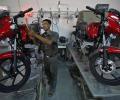
After selling brands like Pulsar, Boxer, Platina and RE in over 70 countries, Bajaj Auto plans to enter Thailand this year followed by Brazil next year.

These were the fastest and most consistent wealth creators over the past 5 years.

TCS, Eicher Motors and Kotak Mahindra Bank have turned out be the fastest and most consistent wealth creators.

Swedish behemoth Volvo has charted out an aggressive strategy to become a leader in the country's heavy commercial vehicle sector, following its alliance with the Delhi-based Eicher Motors.
Cochin Shipyard, BASF India, Ingersoll Rand, Eicher Motors, Federal Bank, and Timken India are some of the firms where voting could have got affected, sources said.

Can the Bajaj-Triumph tie up overtake the beloved Royal Enfield?

Reliance Industries accounted for Rs 6.3 trillion in wealth created since 1995; closest rival was Hindustan Unilever which was at Rs 4.9 trillion.

The S&P BSE Sensex has rallied about 28 per cent in 2014, after formation of a stable government at the Centre.
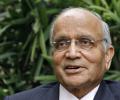
Company managements need to "curtail the kind of expenditures on themselves personally" with the COVID-19 pandemic highlighting the need to build internal resources with a frugal style of functioning, Maruti Suzuki India chairman R C Bhargava said on Tuesday. Addressing shareholders in the company's annual general meeting held virtually, he also termed as "a good development for the whole of industry" recent shareholder actions that did not approve expenditures by management on themselves, without specifying details. In the wake of the pandemic, building internal resources has to become a priority of industry and companies.

Ajit Mishra, vice president, research, Religare Broking, answers your queries.

The Mumbai-based firm has lost almost 10 percentage points in market share since 2009-10, even as other brands have fought hard to wrest share away.

Once the upcoming plant at Oragadam is operational, the company will have an annual manufacturing capacity of 150,000 bikes.

The growth momentum that started during the festival season is likely to sustain in the new year, reports Arindam Majumder.

The reason is believed to be a 19% increase in interest cost.

The Volvo Group, one of the world's leading heavy-duty commercial vehicle (CV) and diesel engine makers, is engineering a fresh push in India, one of the world's biggest growth markets for commercial vehicles.

Ajit Mishra, vice president, research, Religare Broking, answers your queries.

Leading tyre maker Apollo also saw a production loss of 450 tonnes till December 2.

Pawan Munjal, chairman and managing director of Hero MotoCorp, the country's biggest two-wheeler maker, leads the pack among automobile CEOs.

The Nifty after shuttling between 9,776.20 and 9,892.65, ended the day lower by 87.80 points or 0.89 per cent at 9,820.25.

Earlier this month, Sobha Kapoor and Ekta Kapoor, part of the promoter group of Balaji Telefilms, faced shareholder ire when they failed to obtain the requisite votes on resolutions proposing pay increases for them. In recent months, several promoter-directors, including Siddharth Lal of Eicher Motors and Pawan Munjal of Hero MotoCorp, have faced similar situations. Clearly, large institutional shareholders - and public shareholders - are not taking kindly to promoter-directors upping their remuneration takeaways at a time when the prospects of business recovery are clouded by the anticipated third wave of the Covid-19 pandemic.

Industry lobbies have begun pre-budget consultations with the Union finance ministry for 2010-11.

Royal Enfield sees its scale and dominant market share as adequate buffers against Bajaj's recent challenges, says Ajay Modi.
The company has today grown into a full fledged advertising and marketing solutions company with revenues of over Rs 28 crore (Rs 280 million).

The first spending item on the chopping block is capital expenditure, followed by operating costs and overheads, including sales and marketing expenses.
With automotive sales entering into a sluggish period, leading commercial vehicle makers are enticing buyers by doling out discounts and lucrative finance options. Tata Motors, for instance, recently run a scheme wherein commercial vehicle buyers would get three months' waiver on equated monthly installments on the vehicle loan. The response, according to the company, was very positive.

The total dividend income for seven firms grows 25%.

Sales of commercial vehicles, which were on a decline for over a year, are showing signs of a recovery. Two out of the three CV makers reported an increase in sales last month.

Ajit Mishra, vice president, Research, Religare Broking, answers your queries.
