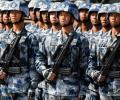
Rawat had said there was a major reduction of Chinese troops in the Doklam area.

The External Affairs Minister said the Wuhan informal summit was held without any agenda and without having any objective to discuss any specific issue.

Modi will meet Xi at 12.30 pm (10 am IST).
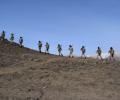
He praised the Indian media for handling the issue in a "responsible" manner.

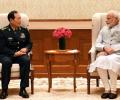
The prime minister, accompanied by senior officials including National Security Advisor Ajit Doval and Foreign Secretary S Jaishankar, met the Chinese leader just before his travel to Myanmar from this port city.

China has started the construction of at least 13 entirely new military positions including three air bases, five permanent air defence positions and five heliports near the Line of Actual Control (LAC) in the aftermath of the Doklam standoff in 2017, according to a report by global security consultancy Stratfor.

Jaitley assured the Lok Sabha amid the ongoing standoff between Indian and Chinese military in the Doklam area.
'China's military is expected to deploy full throttle its new equipment including J-20 stealth fighters, drones, medium range missile systems, surveillance and others to continue to put psychological pressure on India,' warns Srikanth Kondapalli, Professor in Chinese Studies, JNU.
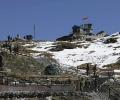
She provided no evidence for the claim, which is at the complete variance with Bhutan's stated position.
Hua also said China is ready to hold talks with India to resolve differences on CPEC.

He also said that the India-China standoff at Doklam is "not a very serious" issue
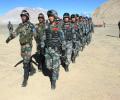
Indian and Chinese troops remained engaged in an eyeball-to-eyeball situation in several disputed areas.

'Even if such a thing happens, it will not prolong for many days like Doklam did.' 'That is because both the leaders do not want it.'

External affairs ministry spokesperson Gopal Baglay, however, refused to comment whether there was reduction of Indian troops at the tri-junction between India-China-Bhuta.

The defence minister said Prime Minister Narendra Modi and Chinese President Xi Jinping had an informal summit meeting at Wuhan where it was decided that peace and tranquillity will be maintained at the border.

In underlining the role of border villages as custodians of India's frontiers, New Delhi is following China's example in Tibet.
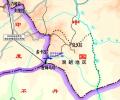
Chinese foreign ministry spokesman displayed the photographs of the alleged Indian "incursion" into the area during a media briefing.
He called for delineation of the 3,488-km Line of Actual Control (LAC) which China has refused earlier.

Singh also said that Indian security forces were capable of defending the country's territories.

'That the two sides allowed such a situation to arise exposed the level of inaction and inefficiency in China-India border management.' 'The Modi-Xi meeting in Xiamen initiated a process to to avert such contingencies in the future.'
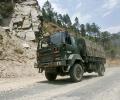
In 2005, the Border Road Organisation was asked to construct 73 roads in the strategically important regions along the Sino-India border but there has been huge delay in implementation of the project which has apparently left the army unhappy.

The official cited it as an example of 'how the Chinese military is trying to resolve issues through dialogue mechanisms'.
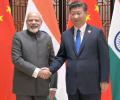
The Chinese and the Indian troops were engaged in a standoff for 73 days in Doklam.
'Little did those in India's strategic community realise that any wise adversary in China's place and circumstances would only take the land route to disturb and trouble India.' 'It is along the land border that all of India's post-Cold War allies would be of little or no political and diplomatic, and least of all, military help,' says N Sathiya Moorthy.

China, however, remained ambiguous about the status of its own troops.

Dispelling the notion that India-China are rivals, Bambawale also said there is no "anti-China mentality" in India.


The envoy said Japan has been watching the situation "very closely" as it "can affect the stability of the entire region."

The army chief said that radicalisation in Kashmir was being addressed with a "lot of seriousness"

Sitharaman said keeping morale of forces at the highest level was among the priorities of the government.
Beijing should remember the advice of its celebrated military strategist Sun Tzu: 'Fight not unless the position is critical.'
Some organisational changes are likely in some of the key army formations.

India and China on Monday ended their standoff in Dokalam by withdrawing their troops from the area, just days before Prime Minister Narendra Modi's visit to China to attend the BRICS summit next week.

During the session, General Dwivedi was asked about the overall challenges for the India Army going forward and learning from the border row in eastern Ladakh.
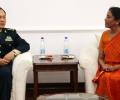
'In the case of an India-Pakistan confrontation, the Chinese may undertake more than just posturing, thereby constraining us from deploying adequate forces for decisive results,' warns Brigadier S K Chatterji (retd).
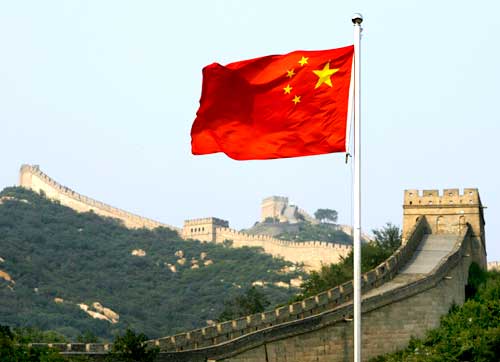
Bhutan firmly abides by the one-China principle meaning Taiwan and Tibet are part of China and stands ready to work with China for an early settlement of the boundary issue and advance the political process of establishing diplomatic relations, it said.
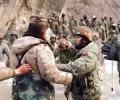
According to the 'Military and Security Developments involving the People's Republic of China' report 2023: "Since early May 2020, sustained tensions along the India-China border have dominated the Western Theater Command's attention."
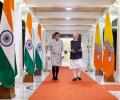
Although the special relationship might compel Bhutan to be considerate of Indian interests, new challenges will likely arise. An emerging new phase of relations will also call for fresh redlines between India and Bhutan, observe Harsh V Pant and Aditya Gowdara Shivamurthy.

Had it not been for the slow but sure emergence of China as a threat to the western order, would India have been accepted as a near-equal partner by individual western nations, jointly and severally, questions N Sathiya Moorthy.

This may be in line with Russia's private military company, Wagner Group, which was controlled until 2023 by Yevgeny Prigozhin, a former close ally of Russia's president Vladimir Putin. The group used the infrastructure of the Russian Armed Forces.
