
Former Nepal speaker Krishna Bahadur Mahara has been arrested for his alleged involvement in a gold smuggling case dating back three years. He is accused of assisting criminal gangs in selling smuggled gold.

In a sudden U-turn that could break the lingering political deadlock in Nepal, Maoists on Thursday decided to give up their claim on the post of president, paving the way for formation of a new government. Following its Central Secretariat meeting in Kathmandu, the Communist Party of Nepal-Maoist party also announced that it has withheld its decision to quit the interim multi-party government by Thursday.
The Communist Party of Nepal Maoist, which emerged victorious in the recent Constituent Assembly polls, decided on Wednesday that the next government should be under its leadership and that party chairman Prachanda' would head the government. The meeting reaffirmed the abolition of monarchy and implementation of republic in the country and concluded to form a coalition government and continue consensus with other parties.
A senior Nepalese Maoist leader has taken exception to the banning of Indian Maoists who he said are 'fighting for social transformation' in the country.
Nepal's most powerful politician and Maoist supremo Prachanda was on Friday left shaken after a young activist, believed to be a supporter of his own party, slapped him in full public view. The incident took place during a tea reception hosted by Prachanda's Unified Communist Party of Nepal - Maoist to mark the festivals of Deepawali, Chhath and Nepalese New Year in Kathmandu.
After months of being in denial mode, Nepalese Maoists have come out openly extending "full support and cooperation" to the Naxalites in India, days after Home Minister P Chidambram mentioned about a possible arms supply from them.
In a major policy shift, Nepal's ruling Maoists will adopt a new path to socialism through capitalism and they may also give up their anti-India stance at the upcoming national convention of the party.
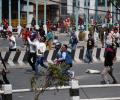
Nepal police used tear gas and water cannons to disperse pro-monarchy demonstrators who torched a house and tried to break security barricades in Kathmandu. The protesters chanted slogans demanding the restoration of the monarchy in Nepal. One person was injured in the clash.
Two Nepalese expeditions to the Mt. Everest will be carrying the red flag of the Communist Party of Nepal (Maoist) to plant on the peak if they are able to make it to the top.
Nepal political parties on Friday night agreed to extend the term of Constituent Assembly by one year as part of a crucial deal under which Prime Minister Madhav Kumar Nepal agreed to step down.

A day after premier K P Oli resigned, Nepal President called on all the political parties to elect a new prime minister within a week
The interrogation of top Maoist leader Kobad Ghandy, who is currently in the custody of Delhi police's Special Cell, has confirmed Nepal's link to the Maoist movement. According to sources, the interrogation of Ghandy has revealed the close ties the Maoist leadership has developed with their powerful counterparts in Nepal. In his statement, Ghandy talks of four visits he made to Nepal along with some other Communist Party of India - Maoist leaders, between 2002 and 2006.

Maoist supremo Prachanda had a narrow escape when his vehicle was targeted with a roadside bomb in western Nepal on Wednesday.

Nepal's Unified Communist Party of Nepal-Maoist on Thursday demanded a suspension of the vote counting, alleging conspiracy after initial results showed the party trailing at third position in the constituent assembly elections.

Prachanda took the oath of office and secrecy from President Bhandari at an official ceremony at Shital Niwas.

The JSP has made an electoral alliance with main opposition Communist Party of Nepal-Unified Marxist Leninist headed by K P Sharma Oli.
The Nepal Maoists on Tuesday began a process for fresh recruitment to its guerrilla force to counter the move of the national army to fill vacancies, a decision that threatens to derail the fragile peace process in the Himalayan nation.
The Communist Party of Nepal-Maoist, the breakaway faction of Nepal's ruling Maoists, has issued a warning against screening of Hindi films and operation of vehicles bearing Indian number plates in 10 districts, saying that anybody defying its ban will face consequences.

As Nepal's Prime Minister Baburam Bhattarai prepares to undertake his maiden visit to India, his party -- the Unified Communist Party of Nepal-Maoist -- asks him not to sign a treaty with New Delhi and avoid discussing controversial issues. So is this visit simply a goodwill call or will Bhattarai defy his party. Shubha Singh analyses
The Communist Party of Nepal-Maoist, Nepali Congress, CPN-UML and Madhesi People's Rights Forum (MPRF) at a meeting held Monday night agreed in principle to form a coalition government under the leadership of former rebels, NC spokesman Arjun Narsingh Khatri Chhetri said.
Three Madhesi leaders have supported Prachanda's candidacy.
The students, all below the age of 18, were abducted from different schools in eastern Nepal.
In an interactive programme at Rajbiraj, an eastern Nepal town, Prachanda claimed that his party Communist Party of Nepal - Maoist would get 150 seats out of a total of 300 seats in the direct election, and that he will become the first president of the Himalayan nation after the polls. He also sounded a note of apprehension over elections taking place on the scheduled date. "I am not confident that the CA elections will be held on the stipulated date," he said.
The United States is considering removing the Communist Party of Nepal-Maoist from the list of terrorist organisations after its stunning performance in the constituent assembly elections. Earlier, the US ambassador to Nepal had met Maoist chairman Prachanda, where the Maoist chief suggested that the US should remove the Maoists from its terrorist list. The US is also likely to pull out a negative travel advisory about Nepal that lies posted on the State Department's website.
Two senior Maoist leaders on Wednesday met Indian Ambassador Shiv Shanker Mukherjee in Kathmandu and discussed the current political situation and the peace process in Nepal.
There are two possible scenarios -- these fears turn out to be baseless and Prachanda turns out to be a genuine democrat and a genuine friend of India or Prachanda after the elections turns out to be different from Prachanda before the elections and takes Nepal on a road, which would be detrimental to our national interests. While hoping for the first scenario, we must be prepared for the second.
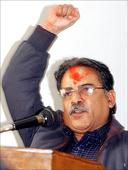
An image of Maoist leader Prachanda speaking at a public function.
The Maoists in Nepal spearheaded by Prachanda today surged ahead in the landmark constituent assembly polls, winning 14 seats and leading in 65 of the remaining 240 constituencies. Prachanda, 53, chairman of the Communist Party of Nepal-Maoist who led a decade-long insurgency in the country to overthrow the monarchy, defeated his closest rival Rajendra Kumar K.C of the Nepali Congress in Kathmandu.

Maoist chief Prachanda was on Wednesday elected by lawmakers as Nepal's Prime Minister for a second time.
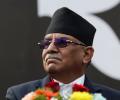
In a dramatic turn of events, Communist Party of Nepal-Maoist Centre chairman Pushpa Kamal Dahal 'Prachanda' was appointed as the new prime minister of Nepal by President Bidya Devi Bhandari on Sunday.

With the support from eight political parties, 78-year-old Poudel's victory was certain. His rival Subas Chandra Nebmang had support of former prime minister KP Sharma-led CPN-UML.

Nepal witnessed political turbulence in 2022 that dramatically turned rivals into allies and throned former guerrilla leader Pushpa Kamal Dahal 'Prachanda' as the prime minister for a third time, as Kathmandu made efforts to balance ties with immediate neighbours India and China with high-profile talks and visits.

Bhattarai said his party 'Naya Shakti Nepal' would bear the "historic responsibility" of making Nepal prosperous and developed.

Nepali prime ministers traditionally choose New Delhi for their first foreign visit after being sworn-in.

The pact was to run the government on a rotational basis until elections to the parliament are held.

The 75-year-old veteran politician and Nepali Congress President took the oath of office and secrecy from President Bidya Devi Bhandari during a swearing-in ceremony which was delayed by over two hours.
 © 2026 Rediff.com - Advertise with us - Disclaimer - Privacy Policy - Sitemap - Feedback - About us - Terms of use - Grievances