
'Open conflict would be a disaster for both China and India.'

Playing down the continuing standoff at the Ladakh border region, China's military on Thursday said such incidents are "sometimes inevitable" but the situation is under "effective control" with the joint efforts of the two sides.

'It doesn't look as if any sensible, worldly wise, person is in charge in China.' 'If at all anybody is in charge, it can only be a bunch of bumpkins of whom Xi has become a puppet,' observes B S Raghavan, the veteran civil servant.

The Congress president spoke of how Modi had hosted Xi in his home state Gujarat and the Chinese troops made an incursion into Indian territory.
'A hotline between the Chinese and Indian military establishments is essential if the possibility of conflict is to be minimised.' 'When relations are uneasy, even minor incidents can spiral out of control,' warns former senior RA&W officer Jayadeva Ranade.

When China protested strongly over the August decision on J&K -- not once but twice -- we ignored it. And to compound matters, we simply turned our back and walked over to the 'Quad' alliance with the US, upgrading it to ministerial level, and thereafter began following the American footfalls on Taiwan and COVID-19 to taunt and humiliate Beijing, observes Ambassador M K Bhadrakumar.
'This Chinese behaviour we have not seen for a very long time.' 'This sort of build up on the border, this pattern in Chinese behaviour, and especially the aggression and brutality with which our people were attacked on the 15th of June, this is not something we have seen before.'
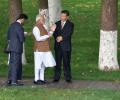
'The meeting marks the first tentative step in the effort to understand whether the two largest Asian nations can co-exist peacefully while realising their aspirations.' 'Caution and watchful wariness will dominate the effort of both sides,' says Jayadeva Ranade, former RA&W officer and China expert.
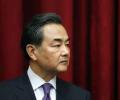
Carrying a message of "peaceful cooperation" from his President for the new Prime Minister, Chinese Foreign Minister Wang Yi on Monday exuded confidence that both the countries have the capabilities to deal properly with the contentious issues such as boundary dispute.

India looks less equal to China than 5 years ago, the strategic alliance with the US is hobbled by trade, and Pakistan is looking anything but chastened by Balakot. What has gone wrong? asks Shekhar Gupta.

The Border Defence Cooperation Agreement with China needs closer scrutiny, says Rup Narayan Das.

India and China are trying to develop effective mechanisms to prevent the "embarrassing" face-offs between their troops along the "disputed" points of the Line of Actual Control, Defence Minister A K Antony said in New Delhi on Friday.

'The border standoff, if not properly addressed by both sides, could escalate to a conventional or sub-conventional conflict between India and China,' predicts Srikanth Kondapalli, one of India's leading China experts.

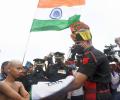
India and China on Monday admitted to intrusion by Chinese herdsmen into Ladakh last week but both the sides sought to play it down saying the issue was resolved amicably through a flag meeting.

'All the political parties, should in order to deal with China, come together and formulate strategies to safeguard every single inch of Bharat.' RSS leader Indresh Kumar tells Prasanna D Zore/Rediff.com why the Sangh wants the Modi government to convene an all-party meeting on the Chinese incursions into Indian territory.

'When Modi was having his maiden meeting with Donald Trump, China is up to its old tricks again, by causing a distraction on the Doklam plateau,' says B S Raghavan, the distinguished civil servant.
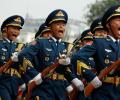
'The Chinese media was beside itself with rage that how can a country with one-fifth of its economic power and maybe one-third of its military power stand up to them.'

'Does the Indian army's new assertiveness risk a clash escalating into shooting and possibly skirmishes?' asks Ajai Shukla.

'The Chinese mindset and approach to India is far different from that in Pakistan.' 'This reality makes it possible for us to follow an engagement policy with one, while militating against engagement with the other.'
Nevertheless, border dispute will feature prominently on Modi's agenda but the matter won't be discussed at length. Nayanima Basu reports

'China refuses to talk to India on nuclear or ballistic missile issues and conclude any de-targeting agreement as Beijing did with Russia or a non-targeting agreement with the US.'

'The focus on countering terrorism brings to the issue Beijing's non-serious approach in this regard. India's permanent representative at the UN has raised in vain the issue of funding and the release of 26/11 suspect Zaki-ur Rehman Lakhvi. But China has blocked these objections since December 2014 at the UN even after 'highest levels' in India intervened,' notes Srikanth Kondapalli, reviewing the India-China military exercises in Kunming.

Unlike in the past, Modi made candid, frank and direct remarks on his hosts by suggesting that the Chinese side is holding back on further improving relations, says Srikanth Kondapalli.
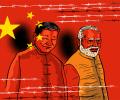
'As China rises and India grows to reclaim their earlier positions on the world stage as two of the largest economies and most important countries, there will indeed be some contention between these two powers.' 'There will also be plenty of space and room for cooperation amongst the two of us.' 'As our economic size increases to match the fact that we are the two most populous nations on earth, it will be all the more important for us to keep the interests of our peoples as well as those of the rest of the world in mind.' 'We shall have to grow together rather than as separate and disparate entities,' points out Ambassador Gautam Bambawale -- who served as India's ambassador to China -- in the 7th annual lecture of the Indian Association of Foreign Affairs Correspondents on March 1, 2019.

'India's military posture has become significantly stronger than China's on the 3,500-kilometre Line of Actual Control.' 'This is enhancing confrontation between the two sides,' points out Ajai Shukla.
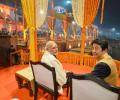
'Modi and Abe are working seriously for India-Japan bonhomie to grow stronger.' 'It is a win-win situation for both countries and the future look promising,' says Rajaram Panda, the Indian Council for Cultural Relations India Chair Visiting Professor at Reitaku University, Japan.

Once again an Indian prime minister has realised that with Pakistan and China, things will not move as he wishes.
