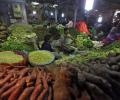
Retail inflation increased to four-month high of 5.08 per cent in June as food items, including vegetables became dearer, according to government data released on Friday. The Consumer Price Index (CPI) based retail inflation was on a decline since January, before rising again in June. The CPI-based retail inflation was 4.8 per cent in May 2024 and 4.87 per cent in June 2023.

'While criticising India's high tariffs, Mr Trump stated he would impose reciprocal taxes on Indian products if re-elected.' 'However, since India's tariffs follow WTO rules, Mr Trump's actions would violate these rules,' Ajay Srivastava points out.

Wholesale inflation fell to a 3-month low of 2.04 per cent in July on decline in prices of food items especially vegetables, government data released on Wednesday showed. The decline in wholesale price index (WPI) based inflation in July came after it rose for four months in a row till June, when it was 3.36 per cent. It was (-) 1.23 per cent in July last year. In April wholesale inflation stood at 1.19 per cent.

The entire census and NPR exercise is likely to cost the government over Rs 12,000 crore, the officials said.

With rising incomes, education, and health awareness in India, especially in the big cities, droves of people are saying no to sugar.

Reserve Bank on Thursday retained the growth and inflation projection at 7.2 per cent and 4.5 per cent respectively for the current fiscal amid expectations of a normal monsoon. In its last bi-monthly monetary policy review in June, RBI had projected real GDP growth and retail inflation at the same.

Excessive sugar intake has been linked to brain inflammation, which can affect cognitive functions such as memory, learning, and decision-making, warns Pankaj Prakash Sharma, founder, Happa Foods.
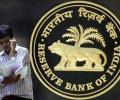
With concern on food inflation ebbing with the monsoon progressing well, the Reserve Bank of India (RBI) is warming up to the idea of a change in stance to "neutral" from "withdrawal of accommodation", according to economists. In his speech on Thursday during the annual event of the Federation of Indian Chambers of Commerce and Industry-Indian Banks' Association, RBI Governor Shaktikanta Das said: "The balance between inflation and growth is well-poised."
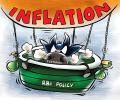
The Reserve Bank of India on Friday retained its projection for retail inflation at 4.5 per cent for the current fiscal assuming a normal monsoon, while emphasising that uncertainties related to food price outlook warrant a close monitoring. Consumer Price Index (CPI)-based retail inflation has been projected at 4.5 per cent with quarter-wise projections at 4.9 per cent in Q1 (April-June), 3.8 per cent in Q2, 4.6 per cent in Q3, and 4.5 per cent in Q4.

Renewed inflationary pressures, led by a spike in prices of vegetables and cereals, have cast a spell on the equity markets in the past month. The BSE Sensex and Nifty50 have declined up to 2 per cent each during the period, clipping the 13 per cent rally from the March lows, shows data from ACE Equity. Investors typically consider shares of fast-moving consumer goods (FMCG) companies as defensive bets, putting their weight behind them in a falling market.

Snapping its declining trend, retail inflation rose to a three-month high of 5.55 per cent in November on firming food prices, including vegetables and cereals, though it remains within the RBI's comfort zone of less than 6 per cent. Inflation based on the Consumer Price Index (CPI) was 4.87 per cent in October and 5.88 per cent in November 2022, the government data released on Tuesday showed. The previous high was 6.83 per cent in August and inflation had been on a decline since then.

Regular consumption of fried, junk and packaged food will have minor to severe health implications, warns dietician Bhakti Adkar.

The Reserve Bank of India's (RBI's) state of the economy report observed that any durable alignment of headline retail inflation with the target of 4 per cent could recommence in the second half of FY25 and sustain until numbers closer to the target are seen during the course of FY26, dashing hopes of any reduction in the policy repo rate in the current financial year. The report, authored by RBI staffers, including Deputy Governor in charge of monetary policy Michael Patra, said though headline numbers may fall in July and August due to base effect, it is likely to reverse in September.
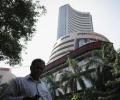
Among the Sensex firms, NTPC, Power Grid, Mahindra & Mahindra, Larsen & Toubro, Sun Pharma, State Bank of India, Titan and Tata Steel were the major gainers. Tata Consultancy Services, Infosys, Axis Bank, Bajaj Finserv, UltraTech Cement and Bajaj Finance were the major laggards.

Holidays turn into horror, Bhansali brand of razzmatazz and tons more on OTT this week.

India is likely to grow by 7.5 per cent in the first quarter of the current financial year, driven by rising aggregate demand and non-food spending in the rural economy, according to an article in the RBI's May Bulletin released on Tuesday. The Indian economy has demonstrated marked resilience in the face of geopolitical headwinds impacting the supply chain, said an article on the state of the economy published in the May Bulletin.

Apart from the human body, human food will bear direct repercussions. From staples such as wheat, to coffee, dairy, and even the great Hilsa face the threat of reduced supply due to the extreme heat.
Retail inflation eased to an 11-month low of 4.83 per cent in April as prices of some kitchen items declined though overall food basket firmed up marginally, according to a government data released on Monday. The Consumer Price Index (CPI)-based retail inflation was 4.85 per cent in March. It was 4.7 per cent in April 2023.

Nearly a third of an average Indian citizen's consumption budget is spent on food.

Could the MPCE survey results be used as a basis of reconstructing the Consumer Price Index with new weights, asks Madan Sabnavis.

Mondelez, Coca-Cola, PepsiCo and Nestle India have been working on bringing down the sugar, salt, and sodium content.

Area under paddy has gone up nearly 3 per cent so far in the ongoing kharif sowing season to 411.52 lakh hectare, while pulses acreage declined 5 per cent, according to the agriculture ministry data. Paddy acreage stood at 400.72 lakh hectare (LH) in the same period last year. As per the data released on Friday, area under pulses declined 5 per cent to 122.57 LH from 128.49 LH in the year-ago period.

India's industrial production growth slowed to 3.8 per cent in January, while the February retail inflation at 5.09 per cent remained within the Reserve Bank's comfort zone for the sixth straight month, according to the latest government data. Growth in factory output, based on the Index of Industrial Production (IIP), slowed to 3.8 per cent in January 2024, mainly due to poor performance of manufacturing, mining and power sectors, according to the data released by the Ministry of Statistics & Programme Implementation.
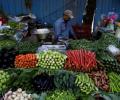
The wholesale price-based inflation eased to a 29-month low of 1.34 per cent in March on easing prices of manufactured products and fuel items, even though food articles turned expensive.
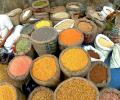
The Centre recently released the first advance estimates of kharif crops that, barring tur dal, showed a dip in production due to uneven monsoon and other natural calamities including pest attacks in cotton. The first Advance Estimates, released a few weeks back, are usually initial projections on the crop size and, more often than not, are revised as more inputs come from the fields. But, the findings have rung alarm bells in several quarters. The Centre, along with many others, is confident that as more details come, the estimates will be revised upwards.
Retail inflation declined to a three-month low of 5.1 per cent in January, mainly due to subdued prices of vegetables, fruits and other food items, according to government data released on Monday. The fall indicates that retail inflation is inching towards the Reserve Bank's comfort level of 4 per cent. The Consumer Price Index (CPI) based inflation was on the rise for two straight months after touching a trough of 4.9 per cent in October 2023. In December, it stood at 5.69 per cent.
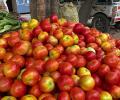
'We are engaging in substantial open market sales of both wheat and rice to control food inflation; special measures of market intervention in vegetables, pulses and oil seeds were also taken to cushion the impact.'
The finance ministry has cautioned that global and regional uncertainties and domestic disruptions may keep inflationary pressures elevated in the coming months, warranting "greater vigilance" by the government and the Reserve Bank of India (RBI). "Russia's decision to terminate the Black Sea grain deal, along with dry conditions in major wheat-growing areas, caused a price spike in cereals. Domestic factors like white fly disease and an uneven distribution of monsoon exerted pressure on vegetable prices in India," the ministry said in its latest Monthly Economic Report for July, released on Tuesday. However, the report maintained, the recent price surge in certain food items "is expected to be transitory". "Tomato prices are likely to decline with the arrival of fresh stocks by the end of August or early September.

The interim budget 2024-24 on Thursday allocated Rs 1,277.80 crore for census, a significant reduction from 2021-22 when Rs 3,768 crore was allocated and an indication that the exercise may not be carried out even after three years of delay.

A summer drink for combatting the heat.

Shares of Avenue Supermarts, which owns and operates the DMart stores, hit a two-year high of Rs 4,710.15 as they surged nearly 6 per cent on the BSE in Thursday's (April 4) intraday trade after reporting strong revenue growth in the January-March quarter (Q4) of the previous financial year (FY24). DMart, in the Q4FY24 pre-quarter update, said the company reported 20 per cent growth in standalone revenue from operations at Rs 12,393 crore, as against Rs 10,337 crore in the third quarter (Q3) of 2022-23 (FY23), driven by a 7 per cent growth in revenue per store and a robust 13 per cent year-on-year (Y-o-Y) increase in store additions. In Q3 of 2021-22, the company reported revenue of Rs 8,606 crore and in Q3 of 2020-21, it posted revenue of Rs 7,303 crore.
Retail inflation breached the RBI's comfort zone and rose to a three-month high of 6.52 per cent in January, mainly on account of a spike in food prices, as per government data released on Monday. The inflation rate based on the Consumer Price Index (CPI) stood at 5.72 per cent December and 6.01 per cent in January 2022.
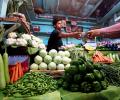
Retail inflation rose to three-month high of 4.81 per cent in June, mainly on account of hardening prices of food, according to the government data. Inflation based on the Consumer Price Index (CPI) stood at 4.31 per per (revised upward from 4.25 per cent) in May and 7 per cent in June 2022. The inflation, however, remains within the RBI's comfort level of below 6 per cent.

Are you looking to transform your health game? Dr Chetan Savaliya, director, Satvam Nutrition, has some tips for you.

The rise in consumer price index (CPI) inflation could see the Reserve Bank of India (RBI) in an extended pause mode as regards interest rates, and in turn, keep the market rally in check, believe analysts. Signs of inflation cooling off in the US, however, is likely to provide some cushion as the expectations of a change in stance by the US Fed as regards interest rates is likely to aid sentiment. Back home, CPI inflation surged for the first time in five months to 4.81 per cent in June 2023, and was higher than the street's expectations of 4.58 per cent.


A 5 per cent GST rate kicked in on Monday on pre-packed and labelled food items such as cereals, pulses and flour weighing less than 25 kg.
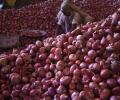
Onion prices are likely to start shooting up in the retail market towards the end of August before going up further to around Rs 60-70 per kg next month due to tightened supplies, a report said on Friday. However, the prices will remain below the highs of 2020, it said. "The supply-demand imbalance is expected to reflect in onion prices towards end-August. "As per our ground interactions, prices are expected to show significant increase from early September in the retail market, reaching up to Rs 60-70 per kg during the lean patch.

Starting your day with breakfast cereals or granola bars is something diabetic patients should totally avoid.
Higher growth in vegetable demand relative to supply in the recent past has led to an upward trend in inflation, with spikes becoming more frequent. A study by rating agency Crisil found that vegetable inflation has been the most volatile in the food category, in fact. Inflation volatility is detrimental for both consumers and farmers and also sidetracks policymakers in the short term, necessitating frequent and repeated price-smoothing measures.
