
The unemployment rate shot up to a record 10.9 per cent in the week that ended on December 18, points out Mahesh Vyas.

'Some people even boldly ask for a 100% increase in the salary.'

'By November 2020, men recovered most of their lost jobs, but women were less fortunate: 49 per cent of the job losses by November were of women.' 'The recovery has benefited all, but it benefited women less than it did men,' notes Mahesh Vyas.

Unemployment was worse only in the pre-demonetisation period, according to the data, at 9.6 per cent in August 2016.

These companies provide better quality jobs and so it is particularly reassuring to see these jobs grow faster than the overall growth of jobs in India, says Mahesh Vyas.

The elections held in April-May 2019 will be an important determinant of future growth and investment.

The research firm also expects sales growth of Indian companies in the quarter under consideration to remain muted. According to the CMIE, sales growth is expected to fall to 20 per cent from 34 per cent in the quarter ending September 2008.
Clocking its highest growth in the last two years, the services sector has recorded a nine per cent increase in sales during the quarter-ended June 2003, a leading economic think-tank said on Monday.

'The pipeline of new industrial projects is the best I've seen in the last 10 years, and it looks solid enough to sustain for at least a few quarters,' points out Naushad Forbes, adding, 'It is only when we get back to the same labour force participation we saw before Covid that the economy will have truly recovered.'
The delay in the current year's monsoon rains has heightened uncertainty over India's economic growth and pushed up the risks of a drought, according to a leading independent forecaster.\n\n\n\n

'The FY2023 inflation outcome is likely to exceed the RBI's current forecast by a wide margin.'

Indian economy is expected to grow by 10 per cent or more in the current fiscal, and 8 per cent plus in the next fiscal year, Niti Aayog Vice-Chairman Rajiv Kumar said on Tuesday. Addressing a book launch event, Kumar further said that seven years of the Modi government has laid a strong economic foundation for businesses to thrive in India. "There was a hiccup (in economic growth) for two years due to COVID-19 pandemic.
The country's economic growth in the second quarter this fiscal is expected to be slightly lower than in preceding two quarters due to a slowdown in industrial growth, the Centre for Monitoring Indian Economy said on Monday. "We expect the Indian economy to have grown by 8.8 per cent in the September 2007 quarter. Although healthy, this growth is considerably lower than the 9.3 per cent growth in real gross domestic product clocked in the June 2007 quarter," CMIE said.

The biggest worry is not the shrinking of the labour market, but the collapse of good jobs.

Of these 8.5 million additional people employed in September, 6.5 million were in rural India, reveals Mahesh Vyas.

India's central bank has however, forecast an 8.2 per cent economic growth in FY 11.

New projects fell 6.3 per cent in the December quarter compared with the September quarter. The value of new projects in the just-concluded quarter was Rs 2.1 trillion, according to the data from Centre for Monitoring Indian Economy (CMIE), which was lower than the Rs 2.2 trillion seen in the September quarter. It is, however, higher than Rs 1.5 trillion recorded for the quarter ended December 2020, the first year of the Covid-19 pandemic. This data ties in with the November data for core sector growth, an index of eight core industries, which grew at its slowest pace since early 2021.

It's high time we now turn the popular question on its head -- when there is no growth in jobs for several years, how can the real GDP grow at 7 per cent per annum, says Mahesh Vyas.

The report said that weak global growth prospects have kept company prices in check in the international market and the same sentiments were being reflected in the domestic market. According to CMIE, prices of basic metal and metal products are projected to decline by 10.5 per cent in the current fiscal.

'The impact of economic shocks on the labour markets is usually on the young who delay their entry in response to a fall in job opportunities,' says Mahesh Vyas.

ASK Wealth Advisors says 5 million, CMIE's estimate is 2 million and Ghosh & Ghosh said it was 7 million!
The recent government decision to restrict supply of subsidised cooking gas cylinders to six per year to each household will see consumption for fuel decline to 4.1 per cent in second half of the fiscal, a report by think-tank CMIE said.

In his address after more than 75,000 people were given appointment letters for various government jobs in the first tranche, Modi acknowledged the challenges facing the economy the world over with many countries hit by a record inflation and unemployment and said India is making every effort to come out of the situation unscathed.

Recovery of the Indian economy depends to a great extent on acceleration in the spending of these relatively richer households, explains Mahesh Vyas.

For FY 12 when growth is expected to slow down, "the downside risks relate mainly to the poor rainfall and to the performance of the global economy," the Centre for Monitoring Indian Economy (CMIE) said in its latest review of the country's economy.

As voting begins in Bihar in the first phase of assembly elections on Wednesday, the fate of political leaders depends on how the electorate perceives they can solve ground-level issues from reverse migration to tackling the COVID-19 pandemic.

Gautambhai has shown that he has ability to withstand payment delays or vexatious court cases. That is where he is on a more comfortable wicket than many others. A revealing excerpt from R N Bhaskar's Gautam Adani: Reimagining Business in India and the World.

'One cannot take it that the economy has recovered, and the GST payment has increased because of that, or that production is back to January 2020 level.'

The thing is that unemployment and joblessness are a personally felt shame. It is not easy to mobilise a set of people who identify with others as a group that cannot get work, asserts Aakar Patel.

Indian women have education, inspiration and perspiration -- but not enough employment, points out Mahesh Vyas.

'Loss of these urban salaried jobs is, therefore, likely to have a particularly debilitating impact on the economy, besides causing immediate hardship to middle-class households,' points out Mahesh Vyas.

Agnipath offers jobs to youngsters between 17.5 years and 23 years of age. The unemployment rate in this age group has risen from around 23% in 2017 to over 50% since 2020. Every second person who is looking for employment in this age group is unemployed, explains Mahesh Vyas.

India's GDP is expected to grow at 9.2 per cent in FY11 on the back of spurt in economic activities, Centre of Monitoring Indian Economy (CMIE) said in its monthly review.

It is important to increase employment in general. It is even better to increase good quality jobs. Strategically, it is important to move people from farms to factories to improve overall labour productivity. It is important to improve job opportunities for women, for urbanites and for the educated. The Budget does not contain ideas to do any of this, points out Mahesh Vyas.

It keeps getting harder every day for the government to drive its narrative that ample jobs are being created. They sound increasingly silly as they try to defend the indefensible, says Mahesh Vyas.

What the labour market statistics of March 2022 show is India's biggest sign of economic distress, points out Mahesh Vyas.

Net job creation in the economy fell by 16.9 lakh in FY21 over the previous fiscal, shows an SBI Research analysis of EPFO payroll data. However, the FY21 numbers are better than the FY20 net job creation, which had declined by 28.9 lakh, further cementing the view that the economy is not creating new employment opportunities. The latest EPFO data shows that net new EPF subscribers stood at 94.5 lakh in FY21, and NPS added 5.82 lakh, taking the cumulative net addition to 100.4 lakh, which is marginally down from 102.3 lakh in FY20.
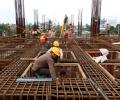
It would be larger than even in the pandemic year of 2020-2021, notes Mahesh Vyas.

Companies announce Rs 768 bn worth investments in Dec quarter versus Rs 1.15 trn in Sep quarter
Buoyed by the surge in India's exports for April-December 2002 despite global slowdown, the Centre for Monitoring Indian Economy on Monday revised the export growth forecast for 2002-03 from 10 per cent to 18.7 per cent.
