
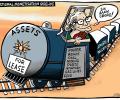
Finance Minister Nirmala Sitharaman on Monday announced a Rs 6 lakh crore National Monetisation Pipeline (NMP) that will look to unlock value in infrastructure assets across sectors ranging from power to road and railways. She also said the asset monetisation does not involve selling of land and it is about monetising brownfield assets. Projects have been identified across sectors, with roads, railways and power being the top segments.

The government has developed an asset monetisation dashboard for monitoring real-time progress of its ambitious Rs 2.5 trillion-plus pipeline, and providing visibility to investors. The portal has been prepared as the government tries to provide a one-stop shop to investors keen on taking over assets of government departments and ministries.

'Inter-ministerial coordination, information on the proposed PSUs, and due diligence are taking longer than expected to conclude the process.'

Since its results, the stock of bottling and beverage distribution company Varun Beverages (VBL) is up 7 per cent on the back of a strong 2022-23 January-March quarter performance, robust outlook, and revision in profit estimates. Given the sharp uptick, it is now part of the trillion-rupee club, with its market capitalisation at Rs 1.01 trillion. The stock is one of the best performers in the consumer space as well as the S&P BSE 200, of which it is a constituent.

'It has taken 7-and-a-half years for this government to understand the fundamentals of economics.' 'If the prime minister wants to leave an imprint, he has to see to it that this succeeds.'

The ministry of railways has dropped its proposal for monetisation of stations on public-private partnership mode, and projects are now being taken up under engineering, procurement and construction (EPC) mode, a source said. The source also told PTI that the ministry of railways has been asked to expedite monetisation of other assets, including trains, goodsheds, hill rail, stadiums, railway colonies and railway land parcels among others. "Largest asset class (stations) dropped. Stations earlier proposed on PPP mode are now being taken up under EPC mode," the source said.

'They are also sitting on huge public sector assets without many returns.'
On June 30, mining and metals giant Vedanta, announced that it had decided to initiate a strategic review of its steel and steel-making raw material businesses. The review would begin immediately and evaluate a broad range of options, including but not limited to a potential strategic sale of some or all of the steel businesses, the company said in its stock exchange filing. The signs have been there - approaches had been made to steel players over the past year. Last December, Anil Agarwal, chairman Vedanta group, told Business Standard that the steel plant capacity was about 3 million tonnes (mt).
The government expects to realise Rs 35,100 crore from the partial sale of Bharatnet fibre assets and around 13,500 mobile towers owned by state-run telecom firms as part of its national monetisation pipeline released on Monday. Government think tank Niti Aayog has valued over 2.86 lakh kilometre of optical fibre assets laid by BBNL and BSNL under rural broadband project Bharatnet at Rs 26,300 crore, according to the National Monetisation Pipeline (NMP) document. According to the document, BSNL's 13,567 mobile tower assets and MTNL's 1,350 towers have been valued at Rs 8,800 crore.
'When the government wants to sell these assets, even if one set of assets gets caught in any quagmire, the whole process will fail.' 'The entire world is watching us.'

Bharti Airtel and Tata Group on Monday announced a strategic partnership for implementing 5G network solutions for India. Tata Group has developed "O-RAN (Open Radio Access Network) based Radio and NSA/SA (Non-Standalone/standalone) Core and has integrated a totally indigenous telecom stack, leveraging the Group capabilities and that of its partners", according to a joint statement. This will be available for commercial development starting January 2022.

The Centre's capital expenditure (capex) outlay for the April-June quarter (first quarter, or Q1) of 2022-23 (FY23) could be close to Rs 1.5 trillion, Business Standard has learnt. As a percentage of full-year capex Budget Estimates (BE) of Rs 7.5 trillion, this could be at similar levels to the trends in the past few fiscal years. It is in the July-September quarter (Q2) of FY23 that capex is expected to pick up, when a bulk of the long-term capex loans to states are expected to be expended.

During his first Union Budget in July 2014, former finance minister Arun Jaitley announced the setting up of an institution called 3P India, with an allocation of Rs 500 crore. The intention was to mainstream public-private partnerships (PPPs) in India. The plan was to bring together the capacities of the government and private sector to push PPP projects.

Finance Minister Nirmala Sitharaman on Tuesday said monetisation of Central Public Sector Enterprises (CPSE) assets is based on the principle of value creation for the government and investors and would bring about a paradigm shift in infrastructure augmentation and maintenance. Chairing the National Workshop with the states/UTs on Asset Monetisation organised by Niti Aayog, the minister sought the collaboration of states for the holistic development of infrastructure. She said India can become a $5 trillion economy, while striking the right balance between fiscal imperatives and socio-economic welfare, through active collaboration between the public and private sector.

'67 per cent of our transactions happen digitally and about 93 per cent of transactions happen outside the branch.' 'Despite that, there is ample scope for promoting banking-related activities in branches.' 'So, for some time, we will have to, probably, live with the same structure.'

The Centre's ambitious Rs 6-trillion National Monetisation Pipeline (NMP) could fall short of yearly targets for the current fiscal year (FY22) and the next one as well (FY23), partly due to the long gestation period in monetising big-ticket railway infrastructure, Business Standard has learnt from sources in the finance and rail ministries. Officials say the major chunk of railway monetisation will happen from FY24 onwards because leasing some of the infrastructure, like stadiums and dedicated freight corridor, will not happen anytime soon. Rail infra is expected to be the second-biggest contributor to the NMP, with about Rs 1.52 trillion worth of assets to be monetised.

'There will be political opposition, and this monetisation will require continued political will.'

'Dharavi will be completely slum free by 2040'

In a major relaxation of foreign investment rules in the pharma sector, a special group set up under the finance ministry has suggested it could consider permitting up to 49 per cent FDI (foreign direct investment) in the automatic route for brownfield investments in case the company's control remained in Indian hands.

Four proposals by foreign firms deferred; half a dozen others waiting in the wings.

Currently, 100 per cent FDI is permitted in brownfield pharma firms through clearance from the Foreign Investment Promotion Board.

How can we compare say an upcoming Munjal University to an IIT-Mumbai?
The Union Cabinet on Wednesday approved a Rs 76,000 crore policy boost for semiconductor and display manufacturing ecosystem in the country in an bid to position India as a global hub for hi-tech production. Announcing the decision of the Cabinet, IT and Telecom Minister Ashwini Vaishnaw observed that electronics plays an important role in everyday life, and semiconductor chips forms a crucial part of electronics. Outlining the details of the scheme, he said the Rs 76,000 crore programme has been approved for the development of semiconductors and display manufacturing ecosystem.
The Department of Investment and Public Asset Management (Dipam) has asked ministries, government departments, and public sector undertakings (PSUs) to send a list of assets that can be monetised under the proposed National Monetisation Pipeline. The list will be used for creation of an asset monetisation dashboard, which will keep a track of such assets. The government, meanwhile, has asked CRISIL to prepare a road map for monetising assets of PSUs and government departments.

Hemant Shivsaran lists the number of projects the Modi government has announced since August to woo Gujarat voters.


However, that could only be for sectors where 100 per cent FDI is allowed under the automatic route and pose no risk to national security.

The government has used four methods to value the assets that it is looking to monetise under its Rs 6-trillion National Monetisation Pipeline (NMP). The value of the assets on the block is indicative that the government is expected to realise either in the form of upfront accruals or by the way of private sector investment, NITI Aayog said in its report. Valuations are essentially estimates, so multiple methodologies are useful to get a range, said Manish Agarwal, infrastructure expert and co-founder of AskHowIndia.org. Different valuation methodologies depend on the different assumptions that are being considered for valuing a business, he said.

Changing tracks helps. But, not taking the beaten path isn't always helpful. This is the story of two of India's biggest privatisations - Air India and Bharat Petroleum (BPCL). Nearly two decades after the last privatisation, a landmark divestment concluded this year when the loss-making national carrier Air India was sold to the Tatas.
'This will have a multiplier effect in generating more jobs.'

Retailers can buy existing facilities if they spend $50 mn to create additional infra.
The government would try to minimise layers in FDI ceilings.

Expressing commitment to augment the country's infrastructure, Finance Minister Nirmala Sitharaman on Monday proposed to significantly enhance capital expenditure to Rs 5.54 lakh crore in the next fiscal, besides creating institutional structures and giving a big thrust to monetizing assets to achieve the goals of the National Infrastructure Pipeline (NIP). Sitharaman said NIP, that was launched in December 2019 with 6,835 projects, has now been expanded to 7,400 projects and around 217 projects worth Rs 1.10 lakh crore under some key infrastructure ministries have been completed. "For 2021-22, I propose a sharp increase in capital expenditure and thus have provided Rs 5.54 lakh crores which is 34.5% more than the BE of 2020-21," the finance minister said.

AAI holds a minimum of 26 per cent equity in any of the joint venture in the form of assets, and the balance is with private sector/financial institution/state government for city-side development of viable non-metro airports.
The Comptroller and Auditor-General's report on the Delhi International Airport Ltd (DIAL) as a public-private partnership (PPP) project makes several valid points, but presents a seemingly factual but fundamentally misleading picture of the total financial outcome.

The Bilateral Aviation Safety Agreement, the civil nuclear technology transfer, telecom infrastructure security and business jet landing rights are among other "policy accomplishments in 2011" listed on the US chamber's website.

Finance Minister Nirmala Sitharaman's Rs 30,600 crore government guarantee for the bad bank has changed the body language of bankers for the better, observes Tamal Bandyopadhyay.

With Kona catering for the high-end market, the South Korean automobile conglomerate wants to introduce a product in the EV segment to address the mass segment.

India already allows 100 per cent ownership of greenfield pharma businesses.

New products being designed mainly for auto, oil & gas sectors; firm is raising Kalinganagar plant capacity from three mtpa to eight mtpa
 © 2026 Rediff.com - Advertise with us - Disclaimer - Privacy Policy - Sitemap - Feedback - About us - Terms of use - Grievances