
Rapper-turned-politician Balendra Shah's Rastriya Swatantra Party (RSP) is poised to form the next government in Nepal after a decisive victory in the general election, significantly impacting established political parties.

'Nepal today is far more aware, self-confident, aspirational, and assertive.' 'India's policy so far has not been geared to this shift. It is time to redraw our Nepal strategy.'

Rapper-turned-politician Balendra Shah's Rastriya Swatantra Party (RSP) is on track for a significant victory in Nepal's general elections, potentially reshaping the country's political landscape.

The devastating flash floods wreaked havoc across Nepal, with the ministry of external affairs on Thursday stating that 84 Indian nationals have been rescued while 290 remain uncontactable as the Himalayan nation stepped up search, rescue and relief operations following the disaster that has claimed more than 390 lives.

The boundary mess between India and Nepal needs a solution in a manner as mentioned by Nepal's Foreign Minister Shishir Khanal: 'On evidence not emotions', counsels Lieutenant General Shakti Gurung (retd).

With the Rastriya Swatantra Party likely to win a two thirds majority, rapper-turned-politician Balendra Shah will be Nepal's next prime minister.

Nepal's Rastriya Swatantra Party is surging ahead in the general elections after Gen Z protests ousted the previous government, signaling a potential new era in Nepali politics.

The Nepali Army and heads of security agencies have jointly appealed for restraint and dialogue as protests escalate following the Prime Minister's resignation. Demonstrations have turned violent, with protesters targeting government buildings, political figures' homes, and private property.
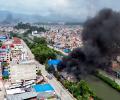
'9 September saw Kathmandu and other key cities under the control of goons.' 'There was no authority, the police was nowhere.' 'The crowds torched all three centres of the state -- the supreme court, parliament and the Singha Durbar government headquarters.' 'The army stayed aloof from the complete destruction of these edifices, which is less than a kilometre from its headquarters.'

'Discontent is deepest among young people.' 'They are weary of inequality, exclusion, and empty promises.'

The GenZ violence that engulfed Nepal is not only against nepo-babies -- its anger is broader and riddled with contradictions, making it difficult for interim PM Sushila Karki, points out Aditi Phadnis.

The protesters shouted slogans such as KP Chor, Desh Chhod (K P Sharma Oli is a thief, quit the country), "Take action against corrupt leaders".
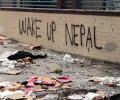
As anti-establishment protests led by Nepal's Gen Z continue across the country, youth leaders at the forefront of the demonstrations have stated that the widespread corruption and political stagnation were the core reasons behind their mass mobilisation against the government.
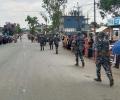
The Kuki-Zo Council called for a 13-hour shutdown in Manipur's hill areas on Tuesday, demanding an investigation into the death of 11 people in a clash with security forces in Jiribam. The shutdown, which began at 5 am, saw schools, markets, and public transport remain closed. Various Kuki-Zo organizations, including the Kuki Students' Organisation, the Zomi Students' Federation, and the Hmar Students' Association, demanded a probe into the incident, accusing the Central Reserve Police Force of "treacherous murder." The Hmar Village Volunteers, who were identified by the Kuki-Zo groups as the victims, condemned the incident and called for intervention from the Ministry of Home Affairs.
