
A Congress spokesperson, quoted in media reports, summed up the party's thinking by saying, 'Whenever BJP is in trouble on the ground, a new 'apolitical' or 'alternative' party appears with the same ideology and the same backers.'

'This survey, done on the basis of feedback from BJP-RSS workers at the booth level, has given Narendra Modi the confidence to start packing his bags in Gandhinagar. on Tuesday, he has done photo shoots with his colleagues and staff.' Sheela Bhatt/Rediff.com presents the Sangh Parivar's assessment of how many seats the BJP will win in this election.

The scale and nature of Modi's election victory mean the higher tiers of the Sangh Parivar feel no need for restraint, says Sreenivasan Jain
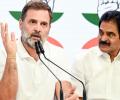
Congress leader Rahul Gandhi and other UDF MPs protest the arrest of Catholic nuns in Chhattisgarh, alleging religious persecution by the BJP government and demanding their immediate release.

He also exhorted party workers to regularly visit their constituencies and carry out development work.

The prolonged delay over electing J P Nadda's successor possibly stems from the RSS leadership wanting a person who is at least equidistant from the Sangh as well as the Modi/BJP edifice, observes BJP-RSS watcher Nilanjan Mukhopadhyay.

Shiv Sena-Uddhav Balasaheb Thackeray chief Uddhav Thackeray on Sunday claimed a "Godhra-like" incident may take place during the "return journey" of the large number of people expected to converge at Ayodhya in Uttar Pradesh from across the nation for the inauguration of the Ram temple.
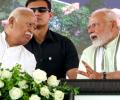
BJP and RSS leaders are once again pushing to remove the words 'secular' and 'socialist' from the Constitution's Preamble, showing a deeper effort to change India's identity from a diverse, multi-religious republic to a Hindu-first nation, even though they don't have the numbers in Parliament to officially change the Constitution, observes N Sathiya Moorthy.
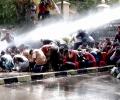
The Bharat Mata controversy in Kerala shows how political and symbolic fights between the state and the Centre have taken attention away from education, throwing the state's oldest university into confusion and disorder, observes Shyam G Menon.

Narendra Modi has proved through execution of this event in Ayodhya that amongst all his contemporaries in politics he knows ordinary Indians like none other, notes Sheela Bhatt.
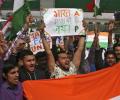
'This country is not of one culture. We must live together and we must respect each other.'

The Congress in Kerala on Friday approached the Election Commission of India (ECI) against the decision of Doordarshan to telecast the controversial movie The Kerala Story, saying it was a 'tacit effort' to divide society on religious grounds to further the electoral prospects of the ruling Bharatiya Janata Party.

'Must every believing Hindu automatically be assumed to subscribe to the Hindutva project?' asks Shashi Tharoor.

Sasikala, said she was not allowed to undertake the trek to the shrine and sent back by the police, official sources said that she entered the sanctum sanctorum and offered prayers.
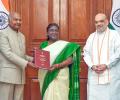
Deriving from Narendra Modi's continuing charisma, the proposed scheme, if and when implemented, can cut both ways. That is to say, if Modi can win, he can lose. Or, someone else in his place, later on, could lose as much as he could win in his time, points out N Sathiya Moorthy.

If Kerala wants to sustain its room for independent thinking and talk back to Delhi when needed, it should put its finances in order. Or - if one takes the North East example - Kerala's political posturing may end up commensurate with its financial dependence on others, suggests Shyam G Menon.

The attacks, which disrupted normal life, marked return of political violence on large-scale after a gap of over a year in Kannur.
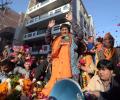
support for the AAP notwithstanding, the BJP is convinced it will win Delhi.

What kind of chowkidari is Narendra Modi doing, asks Rahul.

'According to the survey, ideological issues like Article 370 and Ayodhya received only 14 and 12 per cent voter-backing, respectively.' 'It could well imply that hardline Hindutva issues have only that much voter-purchase, compared to Modi's overall popularity of 52 per cent -- putting the man way above the mission,' points out N Sathiya Moorthy.
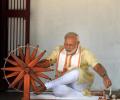
'Rather than 'consolidate' the Hindu majority votes, as the BJP-RSS combine has been known and wont to try, this time round PM Modi has himself taken the party to the next step, by seeking to create a new divide within the majority community, a la V P Singh in his time.'
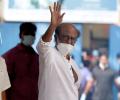
It looked as if the BJP was hoping to use Rajinikanth to press their seat-bargain with the AIADMK. Now with the Rajini bait gone, the question now is not how much the BJP would settle for, but how much the AIADMK would be ready to offer, notes N Sathiya Moorthy.

A new Congress leader may make an electoral impact by his very presence. Congress voters who had moved away from the party, after being influenced by the BJP's 'family rule' campaign, can now return with a certain moral satisfaction, observes N Sathiya Moorthy.
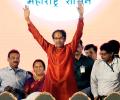
'For the Shiv Sena, Hindutva is like a shawl which can be put on and discarded at will.'

'The BJP has latched on to the idea of nationalism, but the nationalism they advocate is not nationalism as we have understood it since the time of the freedom movement.' 'This is not secular nationalism, it is Hindu nationalism.' 'It is a form of nationalism that is exclusionary and it tends to conflate national interest with the government.' 'So, if you disagree with the government, for example, on surgical strikes or demonetisation, you are anti-national or holder of black money.'

'Hindu voters in coastal Karnataka lean more towards Hindutva than Hinduism which explains why the Siddaramaiah government's perception as anti-Hindu worked wonders for the BJP in coastal Karnataka.'

An economist from J&K and a popular face from the RSS/BJP sat together to craftily weave an alliance in what is one of the most difficult agenda-setting exercises in recent history.
