
The Bharat Mata controversy in Kerala shows how political and symbolic fights between the state and the Centre have taken attention away from education, throwing the state's oldest university into confusion and disorder, observes Shyam G Menon.
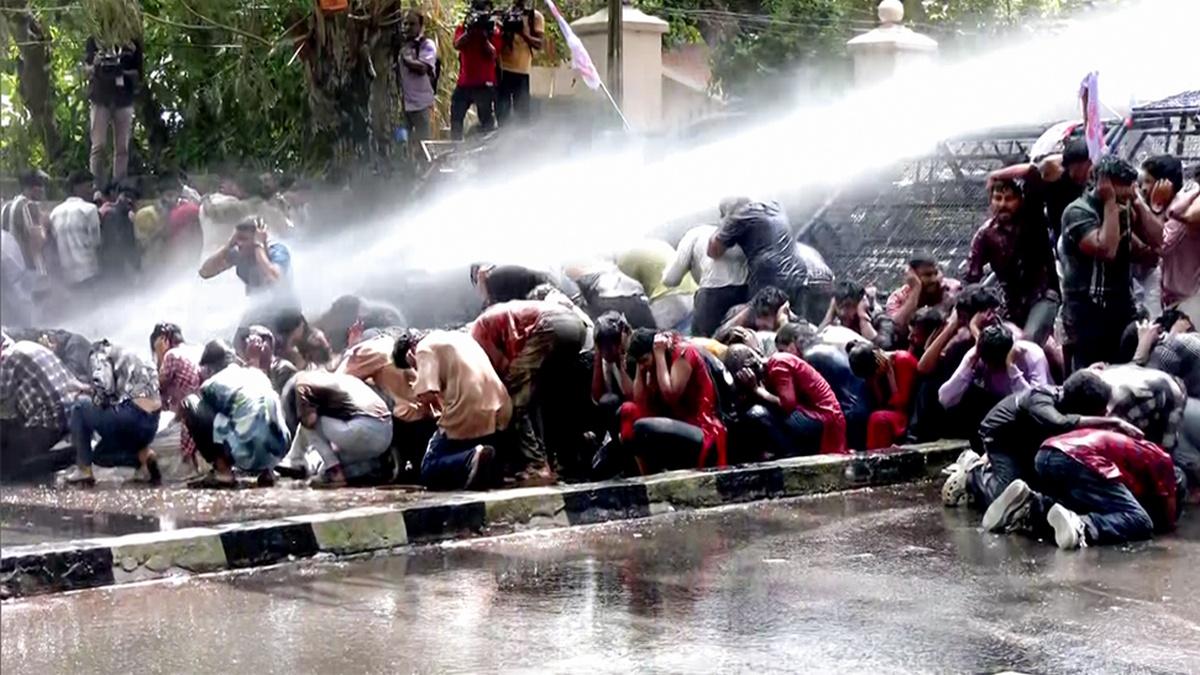
A series of controversial incidents have provoked trouble at Kerala's oldest university.
The first of these incidents was reported on June 6, 2025. The news was: State minister for Agriculture P Prasad shifted the venue of a meeting originally scheduled at Raj Bhavan, the official resident of the state's governor, due to a specific picture of Bharat Mata alongside a lion, included in the proceedings.
In its report on the incident, The Hindu newspaper noted that the minister justified his decision by saying that the picture, unlike the Tricolour, was not a national symbol.
On June 5, the Kerala unit of the Communist Party of India, to which Prasad belongs, posted a video of the minister explaining what happened.
According to it, the meeting in connection with Environment Day was organised by Prasad's ministry; it was therefore a state government function.
Given its venue was to be Raj Bhavan, there was back and forth discussion, ironing out details of the proceedings.
Raj Bhavan informed that instead of a prayer, there would be the lighting of a lamp and a floral tribute to Bharat Mata.
Upon the minister seeking more information, an imprint of the image assigned for floral tribute was shared.
It was identical to the version of Bharat Mata featuring a lion and a saffron flag, usually used by the RSS.
The minister informed that the image was unacceptable at a function organised by the state government. The governor was informed.
Raj Bhavan declined to change the image. It is understood that the ministry then decided to relocate the function to the state secretariat, where state protocol could prevail.
The Hindu report cited earlier, said: 'Governor Rajendra Vishwanath Arlekar took strong exception to the government's stance. "We cannot do away with a national symbol we are living for," he said later at a private function.'
Governors are appointed by the central government. A senior politician from Goa, Arlekar's website, said: 'Not many people know that Mr. Arlekar was associated with the RSS (Rashtriya Swayamsevak Sangh) since childhood. Later on, as he discovered his interest in politics, he thought of joining BJP (Bharatiya Janata Party) in 1989.'
Thirteen days after the incident involving Prasad was reported, on June 19, it was the turn of the state's General Education Minister V Sivankutty to walk out of a meeting at Raj Bhavan, owing to the presence of the Bharat Mata-picture.
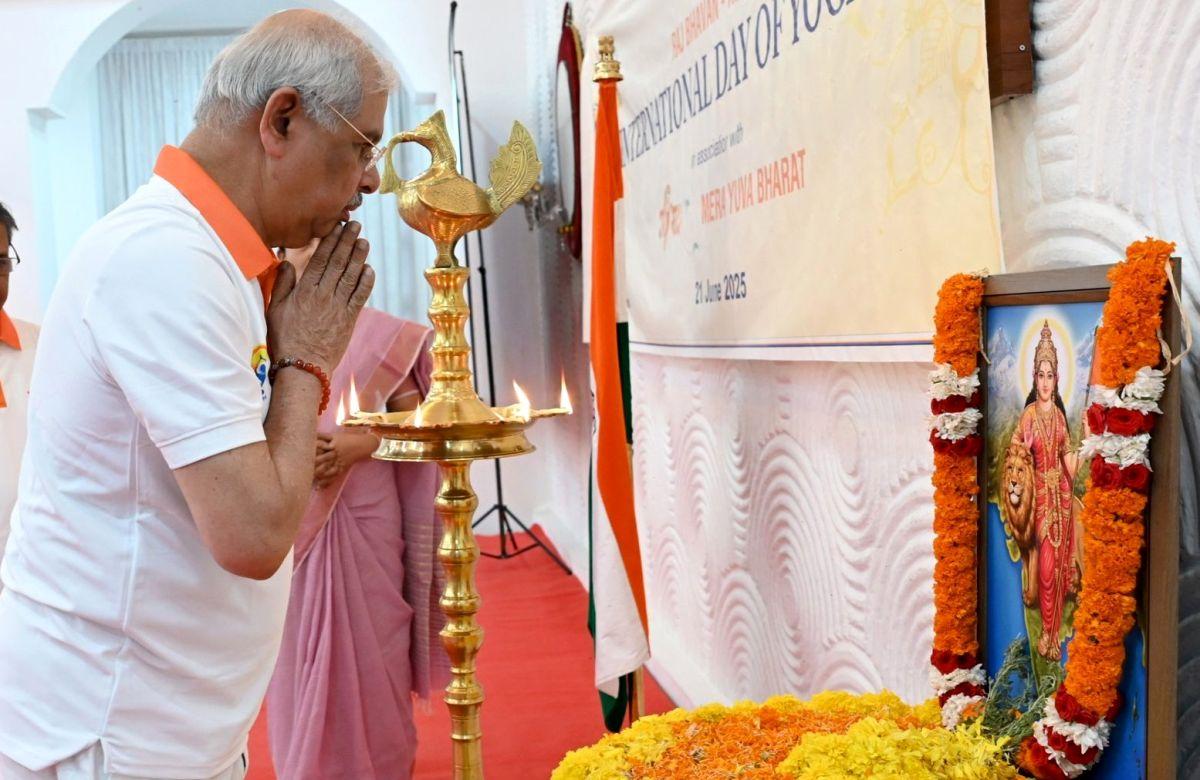
On June 25, a picture of Bharat Mata surfaced in Thiruvananthapuram's Senate Hall building, which houses the headquarters of Kerala's oldest university -- University of Kerala.
The auditorium there was hired -- as reported in The Times of India newspaper -- by 'Sree Padmanabha Seva Samithi, a pro-BJP organisation' for a function to observe the 50th anniversary of the Emergency.
Governor Arlekar was scheduled to attend the event. The picture of Bharat Mata provoked members of the Students Federation of India, the dominant students' union at the University of Kerala. They protested.
The governor proceeded to the stage nonetheless. This fetched support from those supportive of the BJP. Amidst this, the university's registrar cancelled permission for the meeting.
The vice chancellor suspended the registrar and appointed another person in his place. The original registrar decided to move court.
Meanwhile, the registrar's suspension was overturned by the university's syndicate (the chief executive body of the university).
As the vice chancellor was out of town, the person acting in his capacity appointed another official as registrar replacing the person who had replaced the original registrar.
With the syndicate reinstating the original registrar, he returned to take charge of his office.
The embarrassing instances in this episode include the university at one point having multiple names spoken of as registrar and even if things are clarified to formally accept only one, the official suffering from too much of churn over the post for anyone to feel there is clarity.
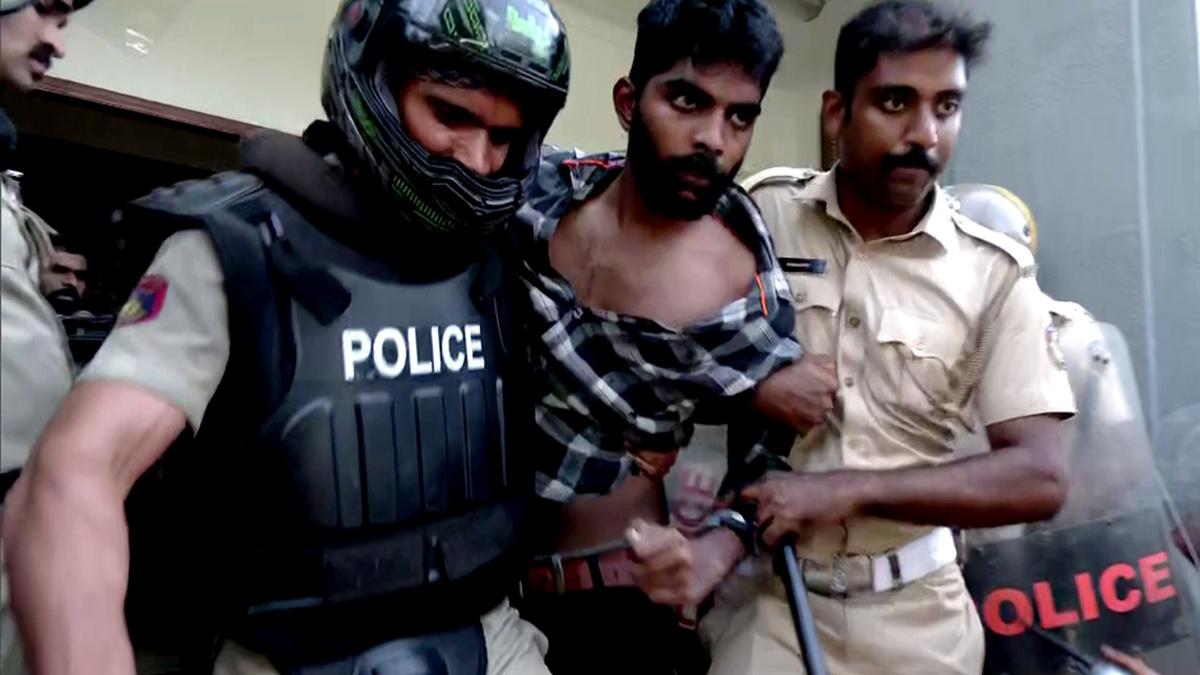
On July 8, the Senate Hall premises witnessed an invasion by the SFI.
Television images showed a large number of students rushing towards Senate Hall, climbing the parapet and entering the majestic building to scenes of confrontation with the police.
That day's edition of The New Indian Express newspaper observed in an article on the state's higher education sector: 'As the tussle between the governor and the LDF government intensifies, BJP-RSS has emerged as the main player in the Opposition, leaving Congress in a spectator's role.
'The issues that began after the appointment of Arif Mohammad Khan as governor in 2019 continue even after Rajendra Arlekar took charge at Raj Bhavan. The simmering issues have taken a toll on higher education sector.'
The article pointed out that although members of the Akhil Bharatiya Vidyarthi Parishad (ABVP) had been elected to university senates before, this was the first time academics 'close to the Sangh Parivar are getting visibility and say in the higher education sector.'
According to the report, an estimated ten universities in the state were without a permanent vice chancellor.
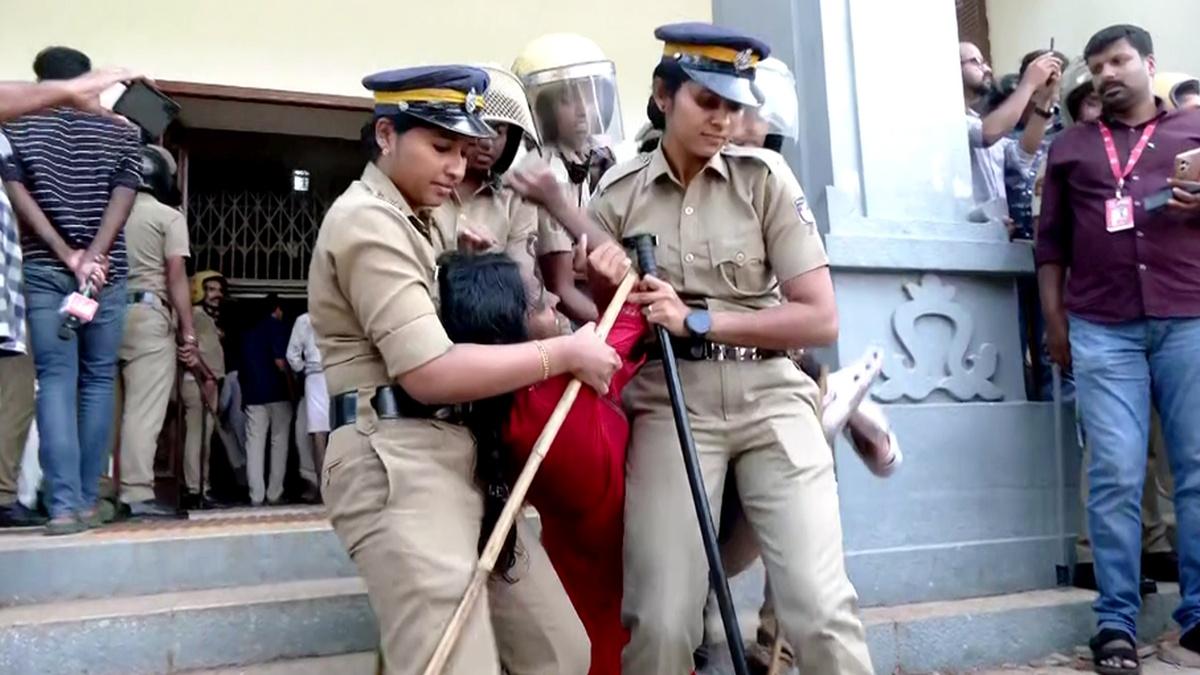
The challenges in taking a view on the Bharat Mata-controversy are fundamentally two.
First, there is the politics surrounding Bharat Mata. The figure is not included among the ideals and institutions that the Indian citizen is expected to revere as Constitutional duty (the national flag and national anthem find mention).
It is a figure with origin and iconography traced to the Indian freedom movement, one that has since come to be held in high regard by sections of the Indian populace.
On the other hand, with the figure of Bharat Mata embraced mostly by the RSS and the Indian political Right, in some quarters (especially those opposed to the political Right), it has become a symbol of majoritarianism.
It then becomes relevant to ask why the office of Kerala's governor insisted on using the picture at Prasad's function at Raj Bhavan and why an image of Bharat Mata was required for the meeting at Senate Hall, a venue associated with a university.
Second, because Bharat Mata is part of the set of beliefs respected by certain sections of our population and because secular politics usually means tolerance of all views, it is relevant to ask -- why should the SFI have a problem with Bharat Mata unless the politics it represents is seeking to be as majoritarian as that of the RSS-BJP lot?
In the Indian context, these are deep dives and typically deep dives end in never-ending dives lasting years, during which time, the most important gain is a hard-earned pragmatic equilibrium authored by the public (not the political parties).
If one knows enough of what happened to higher education in Kerala, then no chancellor would provoke controversy using Bharat Mata.
There are issues, more relevant to the university, those committed to education must attend to.
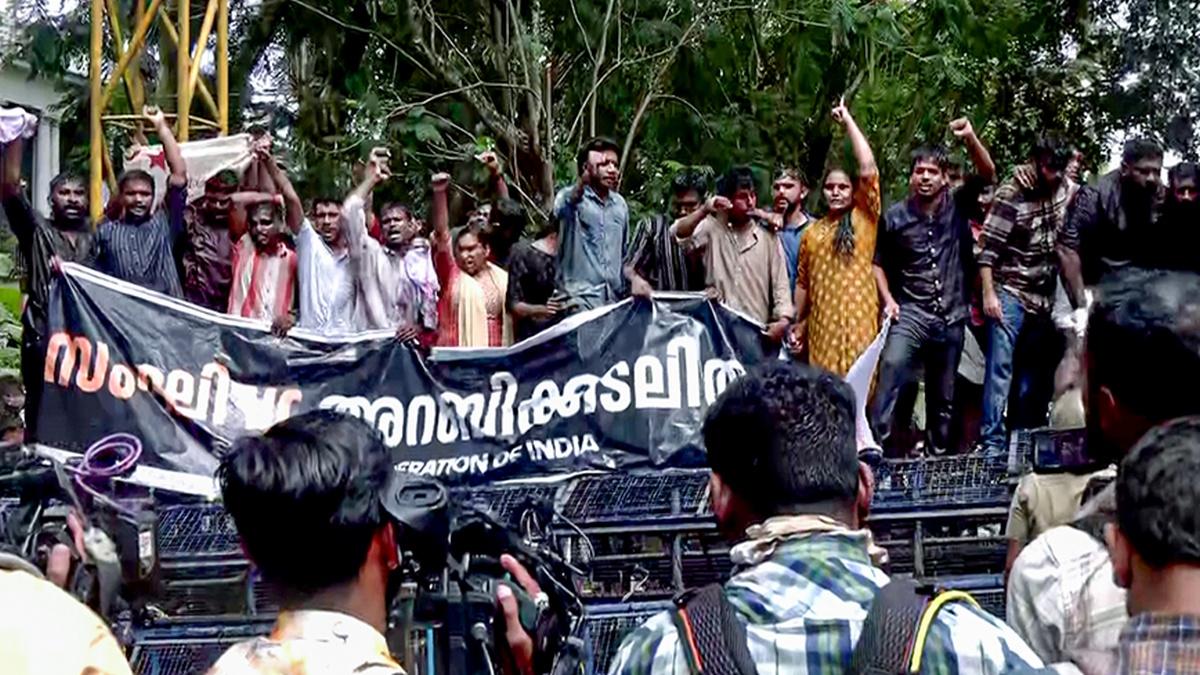
A highly mobile lot with a diaspora employed worldwide, Malayalis value education.
Over the years, the headquarters of University of Kerala, has been the scene of several agitations.
In the years when this columnist was a student at a college in Thiruvananthapuram, strikes spanned students, teachers and university staff.
One agitation in those years was horrible. As a student who had given his final year exams, I remember standing anxiously in front of a Senate Hall protected by layers of security, the day's newspapers reporting of exam papers misplaced and I wondering what the hell I would do.
Sadly, the cumulative aggregate of Kerala's highly politicised education system has been to lower the quality of its higher education to a level that some now feel, is just a notch above the quality of education up to the twelfth standard.
Retired academics told me that quality of teachers and approaches that encourage perpetuating a set environment in learning (because there are people who benefit from it), are also to blame.
There is the perception that whichever party is ruling the state, influences appointments at government institutions.
Appointments at private institutions come with a different set of suspicions. And like in many places in India, in Kerala too, the alternative for affordable, good quality higher education provided by government seems to be expensive private colleges.
Point is -- there is no shortage of topics pivotal to education, confronting Kerala's higher education system. Amidst this, of what relevance is a fight over Bharat Mata?
The question cannot be answered without examining the aptness of state governors as chancellors.
In an article in The Hindu dated January 26, 2025, K Ashok Vardhan Shetty (he is a retired IAS officer and former vice chancellor of the Indian Maritime University) noted two important aspects.
First, the role of governor as university chancellor has not been assigned by the Constitution; it comes courtesy state university laws.
Second, the practice of governors as chancellors was inherited from British colonial rule. It was designed to restrict university autonomy rather than promote it.
'Unfortunately, this model of 'Governor as Chancellor' was adopted wholesale for State universities even after Independence, without reassessing its relevance in a democratic and federal context,' Shetty wrote.
Over the years, governors have changed from being neutral Constitutional functionaries to political instruments wielded by the Centre.
He further noted, 'Reforming State universities in India demands a careful balance of key principles: ensuring accountability to elected State governments, minimising political interference, promoting institutional self-governance, and fostering academic freedom and excellence.
'The vital first step is divesting the Governor of his colonial-era role as Chancellor. While States like Gujarat, Karnataka, Telangana, and Maharashtra have implemented reforms, others such as Tamil Nadu, Kerala, West Bengal, and Punjab face indefinite delays in obtaining Presidential assent for their proposed changes.'
There is another side to the whole Bharat Mata controversy. And it has less to do with education and more to do with politics.
In the CPI's Facebook post featuring Prasad's explanation, the minister has described the image of Bharat Mata shared with him and how it was undoubtedly the version used by the RSS.
He says that it wasn't the image sometimes found used at government functions, wherein the figure holds the tricolour.
In a separate video, CPI state Secretary Binoy Viswam has pointed out that the crux of the matter was the specific image of Bharat Mata, which Raj Bhavan appeared resolved to use.
The Bharat Mata controversy, provoked by Arlekar, has its supporters and critics.
Some from the latter have compared the RSS version of Bharat Mata to Brittania, a much older figure from British history featuring a woman and a lion.
There is also the view that having tasted little political success in Kerala with its regular pieces of Hindu iconography, the Right-Wing may be pushing Bharat Mata as an alternative.
Plus, there is the angle of election season approaching (local body elections in 2025 and assembly polls in 2026) and the need for narratives and controversies to milk.
These observers of Kerala's politics also feel that the SFI through its invasion of the Senate Hall may have robbed the issue of its intellectual and political seriousness and reduced it to a spectacle of unruly student behaviour.
For Kerala's higher education set up, being caught between a propagandist and agenda-driven political Right Wing and a nervous Left yet to completely abandon its appetite for disruptions, is not a pretty place to be in.
One side is baiting constantly; the other side reacts. Who wants either? Watching the television news reports from Senate Hall was a depressing exercise. Any parent would think twice before dispatching a son or a daughter to a university hosting the scenes of chaos, shown.
That's the aggregate achievement of a governor who is also university chancellor, and the politics arrayed against him.
Shyam G Menon, is a freelance journalist based in Mumbai.
Feature Presentation: Rajesh Alva/Rediff






 © 2025