
Housing sales are likely to be hit, especially in affordable and mid-income categories, following the RBI's decision to hike repo rate, according to real estate developers and consultants. However, the impact of RBI's decision to raise the benchmark lending rate by 50 basis points to 5.40 per cent is expected to be for a short term, they added. This is the third consecutive rate hike after a 40 basis points and 50 basis points increase in May and June, respectively.

A 5% increase is expected due to additional interest on approval costs.

India's real estate industry staged a rebound from 2020's downturn, with housing sales seen rising by over 50 per cent. The performance, though short of pre-COVID levels, has property developers hoping for stronger gains in the New Year and the beginning of a long upcycle. A strong foundation has been laid this year for revival in the Indian real estate sector, which is projected to reach $1 trillion mark by 2030 from $200 billion in the pre-pandemic year.

Almost all the big mall developers/investors - such as Raheja-owned Inorbit Malls, Xander-APG joint venture Virtuous Retail South Asia (VRSA), property developer Prestige Estates Projects, and Blackstone-owned Nexus Malls - are looking to double their space in a year or two.

Indian rupee, which earlier this week touched an all-time low, is likely to remain under pressure and may test new levels as a fallout of the US Federal Reserve indicating more interest rate hikes, experts said. The aggressive rate hikes will dampen demand and increase the possibility of a recession in the US. This could accelerate the pace of capital outflows, weaken the rupee and raise the threat of imported inflation.

Shankar Prajapati, a 57-year-old potter in Dharavi, has given up hope of getting a bigger house for his family. He lives cheek by jowl in a hutment measuring 200 square (sq.) feet (ft) in the nondescript shanty town. "We have surrendered to our fate. We cannot wait forever for better accommodation. "Perhaps we are not meant to dream big," despairs Prajapati. Raju Korde, president, Dharavi Redevelopment Committee, and a local resident, agrees with Prajapati.

Despite a 56 per cent fall in residential launches in the first half of the year compared to the second half of 2019, Anarock Property Consultants believes that consolidation in residential real estate is expected to gain ground, and that branded players may garner a market share of 75-80 per cent.

A home loan is a long-term contract, so do shop around before signing on the dotted line, advises Sarbajeet K Sen.
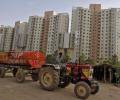
NRI demand would help offset the liquidity problem, which is presently affecting realty sales.

Home First Finance will be answering readers' home loan queries. Mail your queries to getahead@rediff.co.in with the subject line 'Home Loan Query' and we will have your queries answered by Home First Finance.

Mumbai's property markets, where prices earlier crossed Rs 1 lakh per sq. ft in South Mumbai, are seeing a 20-25 per cent markdown from last year's levels.

A recent report by Citi had pegged the total amount stuck in stalled projects across seven major Indian cities (Bengaluru, Mumbai Metropolitan region, National Capital Region, Ahmedabad, Hyderabad, Kolkata and Pune) at Rs 80,000 crore.

In a bad start to the new year, hotels are counting their losses again. Weddings and corporate events for this month have either been called off or postponed. The blow has throttled the nascent recovery which had kicked in around August. It is primarily hurting the banquet-driven hotel chains, some of which are seeing cancellations running into lakhs for a single day.
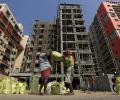
Housing sales across seven major cities in the country fell 35 per cent year-on-year to 50,983 units during the July-September period even as the demand recovered post lockdown, according to data analytics firm PropEquity. Sales stood at 78,472 units in the year-ago period in seven cities -- Delhi-NCR, Mumbai Metropolitan Region (MMR), Chennai, Kolkata, Bengaluru, Hyderabad and Pune.

There's no place like home, but even for the affluent buying one in India is difficult. On top of that, the coronavirus pandemic-now in its eighteenth month-has made life uncertain. A hopeful thing is buying a house looks alluring as loan interest rates fall below 7 per cent, their multi-decadal lows. The slow decline in GDP growth after demonetisation, followed by the economic shock caused by Covid-19 waves, has hurt us unevenly.
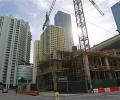
'The fact that housing units worth a whopping Rs 4.5 lakh crore in top seven cities are stuck under various stages of non-completion indicates that there is a dire need to create stress-asset fund which will help bail out lakhs of distressed homebuyers,' says Anuj Puri, Chairman, Anarock Property Consultants, a real estate services company.

'On an average we have been getting four to five such proposals a month, but we aren't pursuing them as they don't tick the boxes.'

Despite the Sensex's 74 per cent run-up over the past year, the Indian equity market could still reward investors if the expected revival in earnings materialises, according to market experts. Returns during the coming year are more likely to be in line with longer-term trends (the Sensex's five-year return is around 14 per cent). Several factors are expected to aid the market's performance this year.
Leading property developers, such as Oberoi Realty, Tata Realty and Infrastructure, and Hiranandani, have turned to redevelopment of existing buildings in the expensive parts of Mumbai as a way of augmenting revenue. Experts estimate that Mumbai's redevelopment projects could be worth Rs 30,000 crore. As such, they are not new. What is new is that the big developers are interested in them. Leading the race is Oberoi Realty, which has set up a separate team for these projects.

'Do some profit booking and bring your equity allocation back to its original level.'

Some of the country's largest listed real estate developers - DLF, Prestige Estates, and Puravankara - are foraying into the Rs 50,000-crore residential property market of Mumbai, where home prices are among the highest in the world. All of them are set to launch residential projects in the financial capital of the country, where the market is dominated by players such as Runwal, Lodha, and Oberoi Realty, among others. Leading the race is Prestige, which has lined up 6 million square feet (msf) of new launches in the city across Mulund and Byculla in the third quarter of this financial year (2021-22).

Growth in credit card outstanding has been the fastest compared to other personal loan segments

Experts say this is a good time to buy a house for self-use, points out Sanjay Kumar Singh.
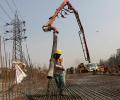
The key demand drivers -- such as low home loan rates and income tax sops, particularly for affordable housing -- that supported the recovery in H2 FY2021, remain in place and will spur recovery again, feel experts.

Consultants who help lease these properties say this is the steepest decline at least in a decade.

Developers are cautious about the timing of launches in the near term, given the relative uncertainty in demand pick-up and logistical challenges during the lockdown. However, affordable housing projects slated for the first quarter (Q1) of 2020-21 (FY21) may get launched this quarter itself.

Prices of all metals - from steel to copper, aluminium, zinc and lead - have shot up by about 5-11 per cent in the past month. Commodity inflation is raising its head, forcing companies to consider price hikes.

After Maharashtra, analysts expect more states like Karnataka and Haryana to slash stamp duty rates. However, analysts, do caution that it's still a long road to recovery for the realty sector.

Builders bet on affordable homes as luxury sales dip, however, signs of revival after note ban and Rera are slowly visible
While sale of residential properties increased only marginally despite plethora of steps taken by the government through the year, office space leasing rose 40 per cent to touch an all-time high of 46.5 million sq ft -- a trend that drew investors to lap up India's first Real Estate Investment Trust at an issue size of nearly Rs 5,000 crore.

Typically, about four to six weeks ahead of the polls, activity in the property market picks up as politicians begin to pull out their money parked in real estate. But this time, it's all quiet till now in real estate so far.

India's GDP estimates for 2020-21 show that the economy is expected to perform much better than earlier projections by different agencies, indicating a sustained V-shape post-lockdown recovery, experts said. The first Advance Estimates (AE) by the National Statistics Office (NSO) has projected a contraction of 7.7 per cent in the real GDP during 2020-21. This was better than the projections by certain international agencies like the IMF and World Bank.

These cities are -- Mumbai Metropolitan Region (including Navi Mumbai & Thane), Pune, Noida (including Greater Noida & Yamuna Expressway), Gurugram (including Bhiwadi, Dharuhera & Sohna), Bengaluru, Chennai, Hyderabad, Kolkata and Ahmedabad.

Hotels are using a combination of platforms to reach out to the guests. These include online travel agents among others. hotels in India are offering guests an option to pay now and stay later.
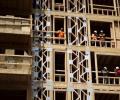
Many developers are facing financial challenges after the IL&FS defaults, after which non-banking finance companies - the major financiers to real estate firms - slowed disbursals.

The sobering news is that retailers - including big firms like Reliance Retail - and exhibitors are contemplating issuing force majeure notices to shopping malls and real estate owners, and are in discussions with them to formulate an action plan for sharing the financial burden of the lockdown.

The plot C-65 in the G Block of Bandra Kurla Complex was leased to Goisu Realty (a unit of Sumitomo) for 80 years by MMRDA.

The move is likely to help 4.59 lakh housing units across the country.
Big conglomerates of Japan, including Mitsubishi Corporation, Sumitomo Corporation, and Mitsui Group, are looking to both build and buy commercial properties in key Indian cities.
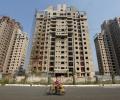
At least 50,000 units of new residential property are set to come up over the next three years
