
Devidas Parbhane said with onion prices touching new lows, farmers like me may be meeting the same fate as other farmers who committed suicide

The national Covid recovery rate was recorded at 98.10 per cent, the data updated at 8 am showed.

'The Modi government is not listening to us. So now we are coming to Delhi to talk with the central government.'
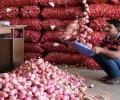
Despite onion prices hitting Rs 130 a kg in the wholesale market, farmers have not gained enough to make a profit this season. Farmers and other stakeholders in the value chain estimate that 30 per cent crop damage this kharif season would result in a decline of about 2 million tonnes in output from Lasalgaon district alone. Similar crop damage across the country could lead to an onion shortage of nearly 7 million tonnes this year.

Modi said many farmers benefitted after fruits, vegetables were brought out of APMC Act in some states a few years ago.

A barrier-free market -- coupled with removal of controls, licensing system, intermediaries and state-imposed levies on farm commodities -- will benefit both sellers and buyers.

Political parties, agriculture experts and progressive farmers demanded such agri reforms for long, he said and attacked the opposition for misleading cultivators on the issue of MSP (minimum support price) and APMCs.

The new laws aim at fetching fair price for farmers' produce and give them liberty to sell it wherever they wish, the Union minister further said.
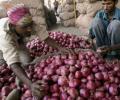
At Lasalgaon mandi, Asia's largest onion selling market, the onion price jumped Rs 1.50 a kg to Rs 32 a kg, the highest since January last year.

Singh noted that opposition members tore rule book, threw papers at the desk of the Rajya Sabha Deputy Chairman Harivansh, who was in the Chair, and climbed the officials' table -- something, he added, he had never witnessed before.
Onion has become costlier by over 33 per cent in the last one week and over 70 per cent in September so far, reports Dilip Kumar Jha.

Nilesh Veera, director of APMC said, complained that availability of workers is a big problem. They have asked the government to provide enough sanitizers, masks, etc, for worker safety, to call them back. There has been no reply.

The government and the farmers must come back to the negotiating table with only the interest of the country in mind, suggests Vivek Gumaste.

Mamata Banerjee accused Modi of trying to mislead the people with half-truth and distorted facts.

While reforms may translate into new opportunities for firms like ITC, Adani Wilmar and Reliance Retail, farmers are unlikely to use it for fear of upsetting commission agents.
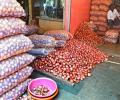
With auctions unable to proceed, the median onion price declined 17 per cent or Rs 6 a kg to trade at Rs 30 a kg on Monday, with arrivals of around 500 tonnes.

The move came a day after Parliament approved two agriculture sector-reform bills which have been bitterly opposed by the opposition parties like Congress and TMC.

Days after their passage in the Lok Sabha, Tomar introduced the Farmer's Produce Trade and Commerce (Promotion and Facilitation) Bill, 2020, and the Farmers (Empowerment and Protection) Agreement of Price Assurance and Farm Services Bill, 2020 in the Rajya Sabha.

The entire Mumbai Metropolitan Region has reported 21,925 cases and 718 deaths.
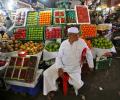
Vegetables and fruits have weights of 1.74 per cent and 2.11 per cent, respectively, in the wholesale price index.

The price of export quality lady's finger, for example, shot up 150 per cent in two weeks to close on Thursday at Rs 40 a kg against Rs 16 a kg on September 16 in the Agricultural Produce Marketing Committee, Vashi, near Mumbai.

The Maharashtra government on Thursday extended the lockdown-like restrictions in the state till June 1 to break the chain of COVID-19.
India's COVID-19 tally rose to 1,11,92,088 with over 18,000 fresh cases being reported in a span of 24 hours in the country after 36 days, while active cases registered an increase for the fourth consecutive day on Saturday and were recorded at 1,80,304, according to the Union health ministry.

'Government is saying that I will not be responsible for ensuring you get MSP but traders and large corporate will be responsible. 'India now is the only country that is saying such things'

To tide over the difficulties due to incessant shutdowns, several farmers in Maharashtra have turned into aggregators and started selling their produce without the help of mandis or agents. They have started contracting with bulk consumers like hypermarkets and co-operative housing societies to sell their produce directly.

Normally, kharif sowing of vegetable seeds starts during the first week of May across the country. Farmers start preparing their fields to make them suitable for kharif sowing during the second fortnight of April. Now, however, faced with the lockdown, farmers are in a hurry to clear their fields of rabi crop and prepare for kharif planting. With a normal monsoon forecast this year, they are doing all they can to take advantage of pre-monsoon showers.

'Political parties are following the Divide and Rule policy to break the unity of farmers.'

No breakthrough has been possible in the five rounds of talks so far as the protesting farmers have stuck to their demand for the repeal of the laws despite the government's assurance to look into specific issues without abolishing the legislations.

According to sources, the government has worked out possible solutions to the provisions on which farm leaders have raised objections.

However, the farmers are still protesting, demanding a law on MSP. Besides MSP, the farmers are also demanding a resolution for the livelihood of the families of the 700 farmers who died while protesting against the three farm laws.
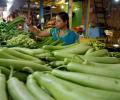
Not only primary vegetables, but also additives like garlic, ginger and chilly have recorded a sharp increase in prices

With a record 1,45,384 fresh cases, India's COVID-19 tally has climbed to 1,32,05,926, the health ministry said.

Data shows that the current system of decentralised marketing and centralised procurement helps Punjab and Haryana farmers the most, while its efficacy in other states has been poor. Experts and farm leaders say success of the laws rests heavily on implementation.

Five labourers allegedly involved in the rape of a college student near Mysuru have been arrested, Karnataka DG and IGP Praveen Sood said on Saturday.

The concept of gold as an asset capable of getting anytime money is evaporating.

Worried about the adverse impact that price rise could cause to Congress' prospects in Lok Sabha polls, Rahul Gandhi unveiled quick fix policy prescriptions for 12 party-ruled states including reform in PDS and giving farmers a wider choice to sell vegetables and fruits.
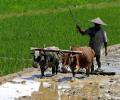
States need to create alternative marketing structures for farm produce since middlemen also provide vital services that are otherwise unavailable to the farmer.

In a meeting with the President on behalf of these 18 non-National Democratic Alliance parties, Leader of Opposition in Rajya Sabha Ghulam Nabi Azad said he has requested the President to return the bills, and only give his assent after they have been passed after following proper rules and procedures.

'The farm bills will not bring in corporate zamindari'

As the issue remained deadlocked with both sides sticking to their respective positions, Prime Minister Narendra Modi, while laying the foundation stone for a new Parliament building, invoked Guru Nanak to underscore the importance of dialogue and noted that the Sikh Guru had said that interaction should continue till eternity.
