
'Of all the areas that define the future for a strong US-India partnership, none is more important than our defence and security ties.'
Will the unpredictable North Korean leader provoke conflict on the Korean peninsula?

Carter has said India's designation as a 'major defence partner' would allow the US to cooperate with it --

'If you look at the relationship with Pakistan, or the relationship with China, both are today, more uncertain than they were when this government came into power.'

'Openness is a great weapon in the armoury of more open societies. That's why the fight with Pakistan isn't just about India be six times bigger, but equally bitter and insecure Pakistan,' argues Shekhar Gupta.
There was no breakthrough in US Secretary of State John F Kerry's India visit, but no breakdown either, says C Uday Bhaskar.

Ever pragmatic, the Americans are convinced that the future is in the Indo-Pacific.
There is a new Indo-Pacific century, and India has to decide whether it has its eyes on the prize, says Rajeev Srinivasan.
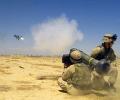
The defence ministry is finalising a decision to allow the FGM-148 Javelin missile, built by US companies Lockheed Martin and Raytheon, into a contest to supply the Indian Army with anti-tank guided missiles. This is bad news for Israelis

India must present its demands of America confidently, instead of fearing that its pocket will somehow be picked, says Ajai Shukla.

Defence Minister Manohar Parrikar expects to see progress in India-US defence relations at the speed of a year per month.

If the aim is to become a player with some strategic space of its own, not just in the Indian Ocean region but also in the adjoining region, then greater interaction with China is desirable, even necessary.
'Secretiveness and the element of surprise in announcing decisions marks the Modi style of diplomacy. From being a voluble politician, he became a reticent statesman... But the diplomatic dance is performed on thin ice and his adroitness is still to be proved,' says Ambassador T P Sreenivasan.

'It is in the interest of both sides that the visit of the US President is seen as being successful. Both sides have invested considerable political capital in it. This rapid exchange of visits and the decisions taken have to be justified, beyond the symbolism, which is no doubt important in itself. This opportunity to impart a fresh momentum to ties should not be missed,' says former foreign secretary Kanwal Sibal.

'Modi's investment in the relationship with Washington is the biggest deliverable of this visit. He means business and that's fantastic!'

'Our approach to India is no different from the approach that we have made in India over the years, recognising its non-aligned status. That's their decision; we're not trying to change that. We have common interests, and we have actually built on those common interests... We think there's more potential to build on those common interests.' 'Security, stability, freedom of sea lanes, economic development, energy, all those are certainly in the interest of India and the region, as they are to the United States.' The transcript of US Secretary of Defence Chuck Hagel's interaction with reporters travelling with him hours before he landed in New Delhi on Friday on a three-day visit to India.
 © 2026 Rediff.com - Advertise with us - Disclaimer - Privacy Policy - Sitemap - Feedback - About us - Terms of use - Grievances