
Retail inflation slipped to 1.54 per cent in September from 2.07 per cent in the preceding month mainly due to subdued prices of food items, including vegetables and pulses, according to government data released on Monday. The consumer price index (CPI) based inflation was 5.49 per cent in September 2024.

"We expect 98 per cent rainfall during the June-September monsoon period," the science and technology minister told reporters in New Delhi.

The slow progress of the south-west monsoon has led to overall deficiency of rains by 22 per cent over the last fortnight, the meteorological department on Wednesday said.

'Even one accident can cause problems for the entire coastal system.'

The country can expect normal rainfall during the southwest monsoon season as a positive Indian Ocean Dipole (IOD) and a lower snow cover over the northern hemisphere are likely to counter the evolving El Nino conditions, the India meteorological department (IMD) said on Tuesday.

'The global climate system doesn't look at where the carbon dioxide is coming from. 'It may be emitted by the US, but it will not remain above the US alone but covers the whole world.'

Retail inflation declined to a five-year low of 3.54 per cent in July mainly on account of subdued prices of food items, and base effect, according to official data released on Monday. The Consumer Price Index (CPI) based retail inflation was 5.08 per cent in June 2024 and 7.44 per cent in July 2023.

Reserve Bank on Thursday retained the growth and inflation projection at 7.2 per cent and 4.5 per cent respectively for the current fiscal amid expectations of a normal monsoon. In its last bi-monthly monetary policy review in June, RBI had projected real GDP growth and retail inflation at the same.

The Reserve Bank of India on Friday revised upwards the GDP growth projection for the current fiscal to 7.2 per cent from 7 per cent on rising private consumption and revival of demand in rural areas. Unveiling the bi-monthly monetary policy, RBI Governor Shaktikanta Das said estimates released by the National Statistical Office (NSO) placed India's real gross domestic product (GDP) growth at 8.2 per cent in 2023-24. "During 2024-25 so far, domestic economic activity has maintained resilience," he said, adding that manufacturing activity continues to gain ground on the back of strengthening domestic demand.
Air, rail and bus services, which were severely affected during the weekend, were plying as usual on Monday as water receded from the roads and tracks. However, the weather office said that warning to fishermen not to venture into the sea continues as the sea is rough.

Weather scientists attribute the early onset of southwest monsoon over Kerala to the influence of the remnants of cyclone Asani that triggered the cross-equatorial flow, a key factor for the seasonal rains.

Who else do we know who meditated so with such impeccable timing (much of the Lok Sabha elections over and with only the last phase to go) and hordes for unsolicited defence of the grand meditation at public expense? asks Shyam G Menon.

The south-west monsoon on Tuesday started withdrawing from parts of south-west Rajasthan and adjoining Kutch in Gujarat, with at least eight states, including rice bowl states of Uttar Pradesh and Bihar reporting deficient rains. It was for the first time since 2016 that the monsoon started withdrawing in the third week of September. "Southwest monsoon has withdrawn from parts of southwest Rajasthan & adjoining Kutch today, against its normal date of withdrawal from southwest Rajasthan of September 17," the India Meteorological Department (IMD) tweeted.

Addressing a press conference virtually, India Meteorological Department Director General Mrutyunjay Mohapatra said September was likely to witness normal rainfall in the range of 91-109 per cent of the long period average of 167.9 mm.

For the Stalin government to win back the confidence of voters ahead of the Lok Sabha polls, post-flooding restoration works, their speed and efficacy would be closely watched, and not just by the political Opposition, notes N Sathiya Moorthy.

The Reserve Bank of India on Thursday decided to keep policy rate unchanged for third time in a row as it maintains heightened vigil on inflation. The rate increase cycle was paused in April after six consecutive rate hikes aggregating to 250 basis points since May 2022.

A red alert indicates heavy to extremely heavy rains of over 20 cm in 24 hours, while an orange alert means very heavy rains of 6 cm to 20 cm of rain.

Today, with the Lok Sabha polls only months away, any inter-state dispute over the Cauvery water dispute has the potential to take more political turns than otherwise, predicts N Sathiya Moorthy.

Reserve Bank of India (RBI) on Wednesday upped inflation projection for the current fiscal to 6.7 per cent from 5.7 per cent forecast in April. RBI Governor Shaktikanta Das said the upside risk to inflation persists and the recent spike in tomato prices would fuel food inflation. Also, high global crude oil prices would add to the upside pressure on inflation. The upward revision in inflation projection comes as domestic retail inflation has remained above RBI's comfort level of 6 per cent for four months in a row, mainly due to the Russia-Ukraine war which has impacted the prices of commodities across the globe.

'The last time we had such a late withdrawal of monsoon was in 1960 or so.'

Heavy rains lashed Mumbai and its suburbs on Wednesday, causing flooding on roads and rail tracks and disrupting suburban train services as the south-west monsoon arrived in the city.

Retail inflation dropped marginally to 7.01 per cent in June mainly due to slight easing in prices of vegetables and pulses, though it still remained above the Reserve Bank's comfort level for the sixth month in a row. The consumer price index (CPI) based inflation stood at 7.04 per cent in the preceding month of May and 6.26 per cent in June 2021. Inflation in the food basket in June 2022 was 7.75 per cent, compared to 7.97 per cent in the previous month, as per the National Statistical Office (NSO) data released on Tuesday.
After a week's delay due to Cyclone Phet, the south-west monsoon finally restarted on its course on Monday, according to the India Meteorological Department.

The south-west monsoon, crucial for the country's agriculture-based economy, is likely to hit the Kerala coast by June 2, the Indian Meteorological Department said on Thursday.

The southwest monsoon which reached the country on May 30 well within its normal onset date

'Storms push a lot of water into land, then there is heavy rainfall due to the cyclone.' 'Along with this, we see the gradual rising of the sea level.' 'We see this during and after the latest Cyclone Tauktae.' 'This kind of overlapping events are increasing and we do not know much about how to tackle them.'

The much-awaited south-west monsoon on Monday brought first showers to the Andaman and Nicobar islands, setting the stage for its early progression towards Kerala.The onset of monsoon has now set the stage for the four-month rainfall season that has been eagerly awaited by the agricultural community who had to bear the brunt of a severe drought last year.The weather office said conditions were favourable for further advancement of the monsoon over more parts of Bay of Bengal

The chief secretary said that as the state is witnessing heavy rains over the last three days, the collectors should be on high alert and take all steps to prevent loss of life, cattle or damage to any property.
South-west monsoon is likely to be below normal this season, government announced on Wednesday raising concerns about its impact on agriculture and economy.

Kerala Revenue Minister E Chandrasekharan made the announcement in the assembly while replying to a notice seeking adjournment motion moved by Congress-led UDF opposition on the serious situation prevailing in the state due to the sharp decrease in rainfall.

A 6-7 million tonnes shortfall in rice production due to a fall in paddy sowing area is likely to keep rice prices at elevated levels, adding to the inflationary pressure that the slowing economy is already grappling with. Elevated food prices, including that of cereals, had led to retail inflation reversing a three-month declining trend, to touch 7 per cent in August. Similarly, the wholesale price inflation, which declined to 11-month low, also showed price pressures from cereals resulting from wheat output being impacted by severe heat waves in some parts of the country.
Caught in a vicious grip of inflation, the government on Wednesday announced that the south-west monsoon, crucial for the nation's agricultural well being, would be near normal this season. "India Meteorological Department's long range-forecast for the 2008 south-west monsoon season is that the rainfall for the country as a whole is likely to be near normal," Earth Sciences Minister Kapil Sibal told reporters in New Delhi.
The south-west monsoon, the lifeline of many farmers of the country, has set in the south Andaman Sea and the south-east Bay of Bengal a good five days in advance. Weather forecasters have predicted widespread rains over Andaman and Nicobar islands during the next three to four days and further strengthening of westerly winds in the region. India's 235 million farmers rely on the timing of the June-September monsoon season to decide which crops to grow.

The funds will be released to West Bengal, Odisha, Karnataka, Madhya Pradesh, Maharashtra and Sikkim as assistance for the damage caused by cyclone, floods and landslides during the year.

'People should realise that what we are fighting for today is actually for tomorrow, for future generations.'

Retail inflation slowed to 4.29 per cent in April from 5.52 per cent in March, mainly due to easing food prices, government data showed on Wednesday. The Reserve Bank mainly factors in the retail inflation based on Consumer Price Index (CPI) while arriving at its monetary policy. As per the data released by Ministry of Statistics and Programme Implementation, inflation in the food basket was 2.02 per cent in April, down from 4.87 per cent in the preceding month.
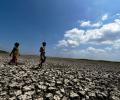
'The first two months of monsoon are not looking good.' 'In case both the halves fail, it is going to be misery.'
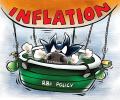
The Reserve Bank of India on Friday raised the retail inflation forecast for 2021-22 to 5.7 per cent due to supply side constraints, high crude oil and raw materials cost. The RBI in June had pegged the retail inflation estimate at 5.1 per cent for the current financial year. The RBI has the mandate to keep inflation in a band of 2-4 per cent, with a tolerance level of 2 per cent on either side.

An IMD bulletin said the low pressure area could intensify into a cyclonic storm, triggering heavy to very heavy rainfall in several parts of Kerala.

Heavy rains lashed Mumbai and its suburbs on Wednesday, causing flooding on roads and rail tracks and disrupting suburban train services as the south-west monsoon arrived in the city with a bang, while the India Meteorological Department (IMD) issued an alert for more downpour.
 © 2026 Rediff.com - Investor Information - Advertise with us - Disclaimer - Privacy Policy - Sitemap - Feedback - About us - Terms of use - Grievances