
Omar Abdullah has so far laboured hard to make best of a bad bargain. Even so, the ground reality is anything but reassuring. The Opposition parties, including notably the PDP, appear to be gaining ground, though more by default. Public patience with Omar's government has nearly run out, notes Mohammad Sayeed Malik, the distinguished commentator on Kashmir affairs.
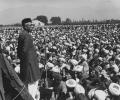
'Sheikh Abdullah ruled the state with secular values. Post 1953, when he was sacked, corruption took over governance.'
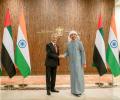
Frankly, was it really necessary in the middle of a fratricidal war for External Affairs Minister S Jaishankar to travel to Abu Dhabi for a one-on-one with the sheikh on April 12?Or, for National Security Advisor Ajit Doval to follow up on April 26? Or, for PM Narendra Modi to follow through today? There are no easy answers, notes Ambassador M K Bhadrakumar.

For India, much is at stake: Crucial energy supplies traversing the Strait of Hormuz, the fate of its 10 million citizens living and working in West Asia -- who send generous remittances home -- and its major trade links with the region.

Pakistani Prime Minister Shehbaz Sharif has briefed Saudi Crown Prince Mohammad bin Salman on Pakistan's diplomatic efforts to de-escalate the situation in West Asia. This follows Pakistan's offer to host talks between the US and Iran to resolve the ongoing conflict.
Pakistani Prime Minister Shehbaz Sharif is actively engaged in diplomatic efforts to de-escalate tensions in West Asia, offering to host talks between the US and Iran and engaging with regional leaders to promote peace and stability.

Pakistan's Prime Minister Shehbaz Sharif has offered to mediate between the US and Iran to de-escalate the ongoing conflict in West Asia, following a joint US-Israel attack on Iran. Sharif has been in contact with Saudi Arabia, the UAE, and other nations to promote dialogue and diplomacy.
Pakistan's Prime Minister Shehbaz Sharif has engaged in extensive diplomatic efforts to de-escalate the conflict in West Asia, offering to host talks between the US and Iran and engaging with leaders from Saudi Arabia, Qatar, Malaysia, the UK, China, and the European Union.

Kharge alleged that it was the leaders of the Hindu Mahasabha and RSS and later, the Jan Sangh, who made statements that Kashmir should be declared an independent country.

New Delhi looks to be testing Omar's endurance with unconcealed glee, never feeling shy to bite whenever a moment comes its way. After all, ruling the country's only Muslim-majority UT/state has been the BJP's burning desire, points out Mohammad Sayeed Malik, the distinguished commentator on Kashmir affairs.
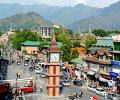
'Often people outside paint a wrong picture of us of Kashmiris. We are not like that. We are cool and bindaas,' said the lady, a teacher, caressing my cheeks in the pressing crowds.
'We called him Sher-e-Kashmir but we realised he was no lion but a pussycat who surrendered.'
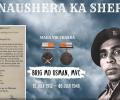
The Pakistanis were so fearful of Brigadier Mohammad Usman, the 'Lion of Naushera', that they announced a Rs 50,000 bounty on his head.

Several Muslim families in Jaunpur, Uttar Pradesh, have adopted Hindu surnames such as Dubey, Pandey, and Tiwari, claiming their ancestors were Brahmins. This follows a campaign by the Vishal Bharat Sansthan, which aims to "reconnect people with their roots" and reduce religious conflict. The campaign has sparked controversy, with some accusing families of converting their religion. The local police are investigating the situation and have deployed extra personnel in the area as a preventive measure.

'Is it right and proper for the US authorities to allow people like Subrahmanya Swamy [sic] go round the country preaching murder, violence, overthrow of the duly elected Government of India?' A fascinating excerpt from Sugata Srinivasaraju's The Conscience Network: A Chronicle of Resistance to a Dictatorship.
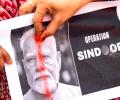
World leaders, including the UN Secretary-General and US President Donald Trump, have urged India and Pakistan to exercise restraint and seek peaceful solutions to the ongoing tensions. The calls for calm come after India conducted airstrikes in Pakistan-occupied Kashmir in response to a recent terrorist attack. Leaders from the US, Russia, UK, China, UAE, Qatar, and Japan have expressed concern over the escalating situation and emphasized the need for dialogue and de-escalation.
'Muslims need to work according to strategy and not fall into the trap of Opposition parties.'
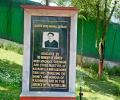
Shaheed Maqbool Sherwani changed the course of Indian history forever, but himself lies forgotten in the town he saved.

Pressure is mounting for a resolution to be moved in the assembly when it meets next week for its maiden sitting to demand 'restoration of Article 370 and Article 35A' as committed in the National Conference's election manifesto, reveals Mohammad Sayeed Malik, the distinguished commentator on Kashmir affairs.
Every trick in the trade is being tried unabashedly.
In simple arithmetical terms every possible 'arrangement' is being made to deny a majority to its rivals. A split verdict would hand a vital advantage to the BJP which is adept at extracting the best out of such a situation, notes Mohammad Sayeed Malik, the distinguished commentator on Kashmir affairs.

The PDP looks a distant third in the race, observes Mohammed Sayeed Malik, the distinguished commentator on Kashmir politics.

Lashing out at Abdullah and Mehbooba Mufti, Rashid on Wednesday alleged that they have "destroyed" Kashmir.

For the last four years since abrogation of Article 370, Kashmir-based political parties have been struggling to forge an alternate narrative to the one forcibly snatched from them. The BJP is bound to go hammer and tongs at them now that their armoury is reinforced with the Supreme Court judgment, notes Mohammad Sayeed Malik, the veteran commentator on Kashmir affairs.

National Conference leader Omar Abdullah was sworn in as the chief minister of Jammu and Kashmir on Wednesday, the first elected government in the Union Territory since 2019 when Article 370 was abrogated.

Last month, Dr Farooq Abdullah announced that he would step down as president of the National Conference in December, saying it is time to hand over the mantle to the new generation.

'INDIA will easily cross 50 seats out of 90 in Jammu and Kashmir.'

'We put the seed of BJP's ideology in Jammu, watered it, nurtured it for four decades and when it was time to reap the fruits of those efforts, the fruits are being sold out to the very same people who worked hard to uproot this tree.' 'Shockingly, our own people are letting this happen and nobody from Delhi bothers to even listen to us.'
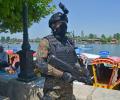
'Article 370 laid down the edifice of the relationship between J-K and the Union of India.' 'If you look at the Article, what is there now is a provision which states that all provisions of the Constitution of India applies to J-K.' 'The veto that the state could exercise previously on most Union laws has ended.'

The festering dispute over the accession of Jammu and Kashmir stands out as one of the world's most volatile fault lines that divides regions, countries, societies, communities and ethnic groups, notes Mohammad Sayeed Malik, the distinguished commentator on Kashmir affairs, on Sheikh Abdullah's 39th death anniversary.
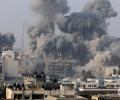
The announcement comes as the military conflict between Hamas militants and Israel continued for the fifth day.
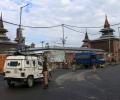
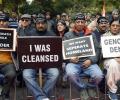
'These statements which you are telling me were never uttered from mosques on that day.' 'And if this had happened, I would have got the report as the chief secretary of J&K.'

At the moment, there appears to be no alternative political narrative to the one lying buried under the debris of havoc caused on this front by the fallout of 'August 5, 2019', asserts Mohammad Sayeed Malik, the distinguished commentator on Kashmir affairs.

'Instead of shouting at cricket matches, why don't we raise our voices for the release of the Indian Navy veterans in Qatar?'

'With the abrogation of Article 370, the Constitutional integration of Kashmir is complete, but whether there has been emotional integration of the Kashmir Valley is a question mark.'
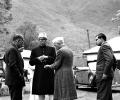
'Aggravated fears about the fate of Article 370 and Article 35A of the Constitution have reopened old wounds and laid bare the widening emotional distance between Srinagar and New Delhi,' says Mohammad Sayeed Malik, the distinguished commentator on Kashmir affairs.
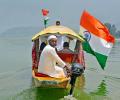
'Article 370 offered very important protections that were related to people's day to day lives.'

In a dig at Rahul Gandhi, Dubey said that the former Congress president was expected to initiate the debate but did not do so last minute as "probably he got up late".
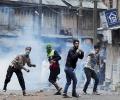
On that day, Sheikh Abdullah, political anchor of J&K's accession with the Indian Union, was unceremoniously removed from power and put behind bars; causing a tectonic emotional breach and setting off disastrous fault lines between Srinagar and New Delhi and its effects continue to this day, says Mohammad Sayeed Malik.

'US officials must grapple with the possibility that one of its closest partners attempted an extrajudicial killing on its soil.' 'This is not something that friends typically do to friends.'
