
Prime Minister Manmohan Singh on Monday concluded his visit to America where he held talks with United States President Barack Obama and met his Pakistani counterpart Nawaz Sharif for the first time, besides addressing the United Nations General Assembly.

Prime Minister Narendra Modi leaves for Brazil on Sunday for attending the five-nation summit of BRICS nations on July 14 and 15 which is expected to finalise the setting up of a development bank and seek reforms of the United Nations and international financial organisations.

India on Thursday said that the United Nations Security Council reform is the "most urgent and pressing need" and called for inclusion of more developing nations in the decision making structures of the powerful world body.

During his two-day stay in Silicon Valley, he would begin and conclude his engagements with the Indian-American community, the last one being an address to a crowd of over 18,500 Indian-Americans at the SAP Centre in San Jose.
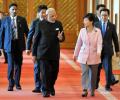
The PM also welcomed South Korea's efforts to maintain peace and stability of the Korean Peninsula.

The tour is aimed at boosting India's economic engagement with these nations and inviting more investment.

She lamented that Africa despite being the largest continent in terms of number of the countries and India, which has has one-sixth of the world's population, still don't have permanent membership of the UNSC.

The agenda is to give a concrete shape to a Development Bank and pitch for reforms of the UN Security Council.

The minister said the terrorist groups created by Pakistan is not only harming India, but also hurting its neighbours.
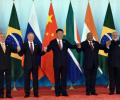
The BRICS also called upon all nations to adopt a comprehensive approach in combating terrorism including countering radicalisation and blocking terror financing sources.
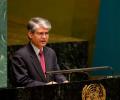
'We have been one of the most frequent countries to be on the Council. We have contributed so much to the maintenance of international peace and security,' India's Permanent Representative to the UN Asoke Mukerji tells Rediff.com's Suman Guha Mozumder.

Prime Minister Narendra Modi and Chinese President Xi Jinping on Thursday began summit-level talks.
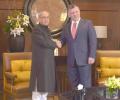
Mukherjee conferred with the Jordanian monarch on a wide variety of subjects, including terrorism, UN Security Council reforms, enhancement of bilateral trade.

Haley also said there was a plan for her to travel to India by the end of this year.

China continues to hold out on fingering Pakistan as the 'mothership of terror,' declaring Masood Azhar a terrorist at the UN, and India's membership of the NSG, says China expert Srikanth Kondapalli.

Prime Minister Narendra Modi made a strong pitch for deeper ties in key areas of counter-terrorism, climate change and UN reforms.

The strategic pacts were inked after the summit between Prime Minister Narendra Modi and his Japanese counterpart Shinzo Abe during which they also discussed international and regional issues of mutual importance including UN security reforms.
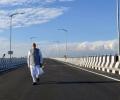
'I say Modi was India's last chance.' 'Because the kind of work this government has done -- I'm talking about physical delivery -- is fantastic, like no time in our history.'

Raising the issue of cross border terrorism during his first visit to Turkey, a traditional ally of Pakistan, President Pranab Mukherjee on Tuesday said the menace must be dealt both "individually and collectively" as it was a threat to global peace.
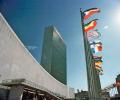
On October 24, the United Nations turns 70. 'The credibility of the UN has been eroded by the fact that the Security Council does not represent the political realities of the world today,' says Ambassador T P Sreenivasan, listing the 10 things the UN needs to do to become more relevant and effective.
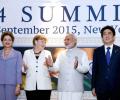
Hosting a summit of leaders of Germany, Japan and Brazil under the G-4 format, the PM said the UNSC "must include the world's largest democracies, major locomotives of the global economy, and voices from all the major continents" to carry "greater credibility and legitimacy".
 © 2026 Rediff.com - Investor Information - Advertise with us - Disclaimer - Privacy Policy - Sitemap - Feedback - About us - Terms of use - Grievances