
Shifting the focus to its next space odyssey after successfully placing a lander on the moon's uncharted South Pole region, the Indian Space Research Organisation (ISRO) chief S Somanath on Saturday said that the country's maiden solar mission Aditya-L1 is ready and will be launched in the first week of September.

Foreign Office spokesperson Mumtaz Zahra Baloch during her briefing on Friday was asked to comment on the successful soft-landing of the Chandrayaan-3 mission on the Moon.

A visibly emotional Modi addressed scientists at the Indian Space Research organisation's command centre in Bengaluru, who were involved in the Chandrayaan-3 mission and lauded them for their efforts.
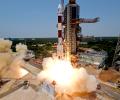
The successful launch of Aditya-L1 - the country's maiden mission to study the Sun - is expected to garner increased investor interest in the Indian space sector and trigger more funding for private players. Several private sector players, including Larsen & Toubro (L&T), MTAR Technologies, and Ananth Technologies, have played a pivotal role in the Indian Space Research Organisation's (Isro's) solar observatory mission. Aditya-L1 on Saturday set off on a 125-day journey on a PSLV-C57 rocket, in its attempt to study various elements relating to the nearest star from the halo orbit around Lagrange point 1 (L1) of the Sun-Earth system, which is about 1.5 million km from Earth.

Once deployed and operational, it will be used to support the satellite imagery requirements of various agencies within the government of Singapore.
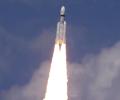
For the Gaganyaan programme, LVM3 rocket is re-configured to meet the human rating requirements and has been christened as 'Human Rated LVM3', ISRO said and it would be capable of launching the Orbital Module to an Low Earth Orbit of 400kms.
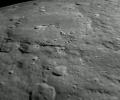
The team led by researchers from the University of Hawai'i (UH) at Manoa in the US discovered that these electrons in Earth's plasma sheet are contributing to weathering processes -- breaking down or dissolving of rocks and minerals -- on the Moon's surface.
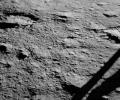
The lessons learned from the failure of Chandrayaan-2 contributed to the success of India's third lunar mission, former space scientist with the Indian Space Research Organisation (ISRO) Nambi Narayanan said, after the successful touchdown of the 'Vikram' lander on the lunar South Pole.

The US Air Force on Wednesday handed over NISAR, an earth observation satellite jointly developed by NASA and ISRO, to the Indian space agency.
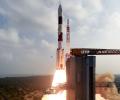
The launch is scheduled at 11.46 am on November 26, said the national space agency headquartered in Bengaluru.

According to the space agency, Chandra's Surface Thermophysical Experiment measured the temperature profile of the lunar topsoil around the south pole, to understand the thermal behaviour of the Moon's surface.

The NCP chief admitted that some MLAs had written to him on joining the Shinde-led government when the one led by the Maha Vikas Aghadi (MVA) collapsed following a split in the Shiv Sena. "But no decision was taken," he said.

Here is a glimpse of the journey of India's third lunar exploration venture has taken so far.

ISRO's Thiruvananthapuram-based Vikram Sarabhai Space Centre successfully conducted a series of drogue parachute deployment tests at the rail track rocket sled facility of the Terminal Ballistics Research Laboratory in Chandigarh during August 8-10.

Amphibious drones for maritime inspection... devices that extract pure oxygen from water for patients in need... self-balancing electric bikes...

The rover will carry out in-situ chemical analysis of the lunar surface during the course of its mobility.

XPoSat or X-ray Polarimeter Satellite is India's first dedicated polarimetry mission to study various dynamics of bright astronomical X-ray sources in extreme conditions.

While the actor did not specify the man in the cartoon, many social media users slammed the actor for making fun of former Indian Space Research Organisation chief K Sivan.

Aditya-L1 is the first Indian space-based observatory that will study the Sun from a halo orbit around the first Sun-Earth Lagrangian point (L1), which is located roughly 1.5 million km from the Earth.
Users jocularly wondered if the name of institutions such as the Indian Space Research Organisation, the Reserve Bank of India and the Board of Control for Cricket in India will be changed.

Interspersing their tweets and posts with an occasional 'Welcome buddy!' and 'Thanks for the ride, Mate!', ISRO's social media handles occasionally departed from using just technical terms to give updates about India's ambitious Moon mission Chandrayaan-3.

NavIC consists of a constellation of seven satellites and a network of ground stations and is touted to be more accurate than GPS.

ISRO made efforts to re-establish communication with rover Pragyan and lander Vikram after they were put into sleep mode in September following the onset of night on the moon.

The soft landing of the spacecraft is planned for late August. The mission is expected to be supportive to future interplanetary missions.

After the successful deployment of Chandrayaan-3's lander and rover on the moon, Indian Space Research Organisation (ISRO) is hoping that their mission life will not be limited to one lunar day or 14 earth days, and that they will come back to life when the sun again rises on the Moon, to carry on with the experiments and studies there.

ISRO aims to send humans into space on a Low Earth Orbit of 400 km for a three-day mission and bring them safely back to earth.

In a giant leap for its space programme, India's Moon mission Chandrayaan-3 touched down on the lunar south pole at 6.04 pm on Wednesday, propelling the country to an exclusive club of four and making it the first country to land on the uncharted surface.
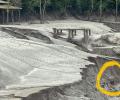
A GLOF occurred in parts of Lhonak Lake, leading to a rapid rise in water levels with very high velocities downstream along the Teesta River Basin in the early hours of October 4. This resulted in severe damage in Mangan, Gangtok, Pakyong and Namchi districts.
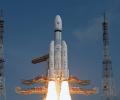
The mission is targeted for launch in the fourth quarter of 2024.
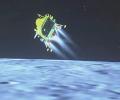
After Chandrayaan-3 touched down on the Moon, the Congress on Wednesday said it is a collective success of every Indian and ISRO's achievement reflects a saga of continuity and is truly fantastic.

The Trans-Lagrangian Point 1 Insertion manoeuvre marks the beginning of the spacecraft's about 110-day trajectory to the destination around the L1 Lagrange point, a balanced gravitational location between the Earth and the Sun.

Russia's state space corporation, Roskosmos, according to the Reuters report, said it had lost contact with the spacecraft shortly after a problem occurred as it was shunted into pre-landing orbit on Saturday.

'ISRO's style is a terrific example of being able to survive, acknowledge failures, and then most importantly of all, learn from them to ensure that subsequent missions are successful.'

The Indian Space Research Organisation (ISRO) on Thursday announced that its lunar mission Chandrayaan-3 will be launched on July 14 from the space port at Sriharikota in Andhra Pradesh.

'Today onwards, the onboard thrusters will be fired and Chandryaan-3 will be taken away from Earth for an eventful landing on Moon's surface on August 23'

So, if ISRO is able to revive them as the Sun rises on the Moon again, information that is derived from experiments that could once again be conducted by the Chandrayaan-3 payloads would be a "bonus".
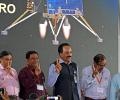
While the historic success of Chandrayaan-3 is celebrated by Indians across the world, two untrumpeted engineering colleges in Kerala are basking in the glory of the key role played by some of their alumni in the crucial Moon mission.

Meet Indian Space Research Organisation scientist Ningthoujam Raghu Singh, who was one of the bright sparks responsible for sending Chandrayaan-3 to the moon.

The ISRO on Sunday scripted yet another history after its LVM3 rocket successfully placed 36 satellites of United Kingdom-based OneWeb group company into intended orbits.

Somanath thanked all those who prayed for the mission's success, and ISRO veterans like A S Kiran Kumar , the space agency's former chief.
 © 2026 Rediff.com - Investor Information - Advertise with us - Disclaimer - Privacy Policy - Sitemap - Feedback - About us - Terms of use - Grievances