
Private hospitals can charge up to Rs 250 per dose of COVID-19 vaccine, official sources said on Saturday as India prepares to vaccinate people aged above 60 years and those over 45 with comorbidities from March 1.

As India gears up to vaccinate people above 60 years of age and those over 45 years with comorbidities against COVID-19 from March 1, the Union health ministry on Friday said the facility of on-site registrations will be available so that eligible beneficiaries can walk into identified vaccination centres, get themselves registered and get inoculated.

On the basis of feedback from the teams, the ministry has written to the states highlighting the areas of concern, including sub-optimal containment operations and contact tracing, skewed testing and shortage of health workers. Authorities need to work in these areas, it said.

'There can be potential hotspots for spread of infection like industrial clusters with closed work environment, people coming from high prevalence areas, other high density areas such as slums, prisons, old age homes etc'
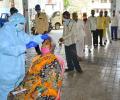
The Centre on Saturday strongly advised 12 states and Union Territories reporting a surge in coronavirus cases to significantly increase testing and ensure people follow COVID-appropriate behaviour, noting that one infected person could spread infection to an average of 406 individuals in a 30-day window without restrictions.

After a long hiatus of more than 20 months, the government had on November 26 announced the resumption of scheduled international commercial flights from December 15.
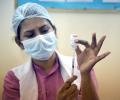
The Centre has asked states and union territories witnessing surge in new COVID-19 cases and high active caseload to continue with the strategy of 'test, track and treat' that had yielded rich dividends at the height of the pandemic and accelerate vaccination for priority population groups in districts reporting higher infections on mission mode.

Union Health Secretary Rajesh Bhushan has written to these states to draw their attention 'to the low and declining testing rates in the states, stating that any laxity at this crucial junction may squander the results of our collective actions in containing the transmission', according to a health ministry statement.
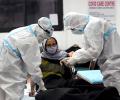
Vardhan, who interacted with chief ministers, state health ministers, principal secretaries and additional chief secretaries of Maharashtra, Uttarakhand, Manipur, Mizoram, Tripura, Meghalaya and Goa through video conferencing and urged them to focus on effective clinical management of COVID-19 cases to reduce deaths in the first 24, 48 or 72 hours.
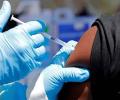
Addressing a press briefing, Union Health Secretary Rajesh Bhushan said healthcare workers and frontline workers need not register themselves as their database has been populated on to the Co-WIN vaccine delivery management system in a bulk manner.

'We have the technical expertise, and international collaborations. We also have robust real-time data. We are a university of pandemic management. If the ministry neglects the role of NCDC, it is the loss of the country'
The Centre, however, noted that the last national serosurvey findings have shown that over 70 per cent of the population is still susceptible to the disease.

A number of countries like Canada, Turkey, Belgium, Italy and Israel have banned flights from the UK as the British government warned that the potent new strain of the virus was "out of control" and imposed a stringent new stay-at-home lockdown from Sunday.

Alert to the looming threat from the 'Omicron' variant, states began to re-tighten curbs and urgently trace people who arrived from abroad in the last one month while a demand to not allow flights from the affected countries was made by Delhi Chief Minister Arvind Kejriwal and Karnataka Chief Minister Basavaraj Bommai.

India has flattened its Covid-19 graph and 146 districts have reported no new case of the viral disease in the last seven days, 18 in 14 days, six in 21 days and 21 districts in the last 28 days, Union Health Minister Harsh Vardhan said on Thursday.
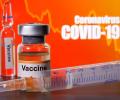
Over the last four days, the Indian arm of US pharmaceutical giant Pfizer, Pune-based Serum Institute of India and Hyderabad-based pharmaceutical firm Bharat Biotech have applied to the Drugs Controller General of India seeking emergency use authorisation for their COVID-19 vaccines.

All travellers and contacts have been tested and quarantined.

The ministry, however, said it could not be sufficiently established yet if these variants were behind the recent spike in COVID-19 cases in some states.

Maharashtra is in the beginning of a second COVID-19 wave, a central team report has said, highlighting that there is very limited active effort to track, test, isolate cases and quarantine contacts, and there is no adherence to COVID appropriate behaviour among people in rural and urban areas in the state.

Easing restrictions, all private hospitals were on Tuesday allowed to give the vaccines if they adhere to the laid down norms, while the 9 am to 5 pm timing was also done away with.
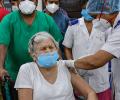
Addressing a press conference, NITI Aayog member (Health) V K Paul said concerns about adverse effects and serious problems post immunisation, as of now, seem to be unfounded, negligible and insignificant, and stressed that both the vaccines -- Covishield and Covaxin -- are safe.
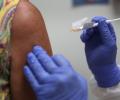
Indian Council of Medical Research Director General Balram Bhargava said the purpose of the COVID vaccine drive would be to break the chain of viral transmission.

Officer on Special Duty in the Health Ministry Rajesh Bhushan said 21 states and Union Territories have case positivity rate less than 10 per cent, while in four it is less than five per cent.
The appointment of new expenditure secretary comes a month-and-a-half ahead of the Budget for 2020-21 to be presented on February 1.

While the United States' share in global COVID-19 cases is 22.4 per cent, those who have recuperated there comprise 18.6 per cent of total worldwide recoveries, according to data presented by Bhushan.

"Also, 35 per cent deaths were recorded in the age group of 45-60 years, 10 per cent in the age group of 26-44 years and one per cent each in the age group of 18-25 years and below 17 years," the health secy said.

India's COVID-19 fatality rate has dropped significantly to 2.43 per cent from 3.36 per cent on June 17 due to effective clinical management of coronavirus cases, the health ministry and asserted that the country has handled the pandemic 'relatively well'.

India's COVID-19 cases and deaths per million population are amongst the lowest in the world, the govt says.

A massive pan-India inoculation drive against COVID-19 was set in process on Tuesday with more than 56 lakh doses of the Covishield vaccine flown to 13 cities across India from Pune and taken to designated national and state-level stores amid tight security.

The health ministry said that 86 per cent of the total active cases were recorded in 10 states of the country.
 © 2026 Rediff.com - Investor Information - Advertise with us - Disclaimer - Privacy Policy - Sitemap - Feedback - About us - Terms of use - Grievances