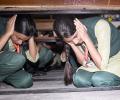
India conducted nationwide civil defence mock drills simulating multiple hostile scenarios like air raids, fire emergencies, and rescue operations across several states and union territories. The drills, dubbed 'Operation Abhyaas,' aimed to enhance emergency preparedness in light of recent terror attacks. The exercises involved coordinated efforts by various agencies, including civil defence personnel, police, fire and emergency services, and the military. Mock drills were conducted at various locations, including railway stations, malls, and high-rise buildings, showcasing the response capabilities of authorities in different emergency scenarios. The drills highlighted the importance of public awareness and cooperation in dealing with real-time emergencies.

The accused had obtained mobile phone SIM cards in fake names and used to take betting amounts from people through QR codes, the official said.

The Met office has issued a "red" warning for Delhi, Haryana, Punjab and west Rajasthan, stressing the need for "extreme care for vulnerable people".

The United States took 101 days to administer 13 crore doses of COVID-19 vaccine, while China took 109 days to cross the same number.

States like Punjab, Delhi, Rajasthan, Uttar Pradesh, Gujarat and Maharashtra reported 7.08 per cent, 3.95 per cent, 3.91 per cent, 3.78 and 3.63 per cent and 3.59 per cent respectively.

The ministry also said that the cumulative number of COVID-19 vaccine doses administered in the country has crossed 15.22 crore.
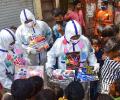
The country's total vaccination coverage has surpassed 6 crore on Sunday.

A study shows that the country has experienced 706 heatwave incidents from 1971-2019.

India has recorded more than 4 lakh daily COVID-19 recoveries in a single day for the first time, while new coronavirus infections settled below 3 lakh for the second day, the Union health ministry said.
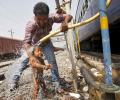
Several states are likely to witness heat wave conditions, the India Meteorological Department said in its summer forecast for the season (March to May).

IMD has said the temperature in April-June across most parts in India is expected to be 0.5-1 degrees Celsius warmer than normal. However, doctors and scientists say they haven't found any direct correlation between the speed of COVID-19 spread and warm weather.
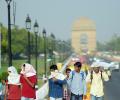
"The season averaged maximum temperatures in Himachal Pradesh, West Rajasthan, Konkan, Goa, Coastal Karnataka, Kerala and Arunachal Pradesh are likely to be higher than normal by 0.5-1.0 degree Celsius," the Met department has said in its forecast.

The seasonal temperature would be above normal by more than one degree Celsius over Northwest India.
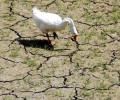
In the first of a two-part series, Business Standard examines the impact of the upcoming summer on agriculture and drinking water supply.
 © 2026 Rediff.com - Investor Information - Advertise with us - Disclaimer - Privacy Policy - Sitemap - Feedback - About us - Terms of use - Grievances