
Corporation Bank is the biggest beneficiary of this round of capital infusion with Rs 9,086 crore of funding, followed by Allahabad Bank with Rs 6,896 crore.

Stock market investors are expecting a balanced Budget with a focus on job creation, increased spending on infrastructure, reigning in the deficit, and bringing the economy back on track, experts said on Wednesday. Stock markets have been subdued in the run-up to the Union Budget with BSE's benchmark Sensex is almost flat so far this month. Even the corporate earning season failed to excite the markets, while some indices like IT and bankex have seen some positive movements.
However, the likely impact of strike may not be much excluding few areas, said SBI.

State-run auto insurance providers are fast losing ground to private players and their market share could be under pressure unless PSUs change their strategy, says a JD Power study.

When a former police constable was appointed Gujarat unit chief, everyone was surprised. Now workers are laying bets on when he will be elevated to the Union Cabinet, notes Aditi Phadnis.

Omkeshwar Singh, Head, Rank MF, a mutual fund investment platform, answers your queries.
The capital infusion would help improve the financial health of banks. While some banks would get necessary regulatory capital while others would get it for fueling growth.

The DCGI's nod came after the subject expert committee on COVID-19 of the CSDCO last week recommended granting emergency use authorisation to Covovax for the age group of 7 to 11 years.

BMS, BKS and SJM are trying to forge common cause with outfits on the other side of the ideological divide over the government's policies they are not in agreement with.

After outperforming the broader market and their public sector peers for the better part of the post-Lehman period, private sector banks - such as HDFC Bank, ICICI Bank, Axis Bank, and Kotak Mahindra Bank - are now underperforming. Last week, the Nifty Private Bank index was up just 6 per cent year-to-date in the calendar year 2021, against nearly 13 per cent rally in the Bank Nifty and a 15 per cent rise in the benchmark Nifty50. Public sector (PSU) banks, such as State bank of India, Bank of Baroda, and Punjab National Bank, are now rally leaders and outperforming the broader market. The Nifty PSU Bank index was up 42 per cent since the beginning of this calendar year. But on a longer term, the Nifty Private Bank index is up 101 per cent since March 2016, against a 118 per cent rally in the Bank Nifty and just 2 per cent rise in the Nifty PSU Bank index in the period.
One crucial revenue source that can help the government achieve its fiscal-deficit target is the proceeds from the sale of its stakes in public sector companies.
Employees of public sector banks have called off the strike planned on February 25 and 26

This comes even after the Indian ambassador there had said this would affect the interests of other Indian companies.

The government has tweaked the income tax laws to make it easier for the new owners of loss-making public sector undertakings (PSUs) to carry forward the accumulated losses and set them off against future profits. This will result in significant tax savings for the new owners if they are able to turnaround operations of the ailing PSU within a few years. This will, in turn, boost the post-tax earnings and returns for the new owners.
He alleged that the public enterprises department headed by Heavy Industries and Public Enterprises Minister Sontosh Mohan Dev has been "pursuing a much narrower agenda, in which governance reform of PSUs does not figure

In eight cases, the banks would violate the minimum public shareholding norms if their promoter, the Government of India, infused capital as announced.

TMFs invest in a public index, so investors know beforehand which instruments the fund will invest in.

IndusInd Bank was the top gainer in the Sensex pack, jumping nearly 5 per cent, followed by Bharti Airtel, HCL Tech, Reliance Industries, Titan and Asian Paints.

Over 25,600 cases of banking fraud reported up to December 21, 2017, says Minister RS Prasad.

Domestic institutional shareholders, who together hold around 39 per cent stake in the National Stock Exchange, are unhappy with the exchange's strategy of not charging transaction fees in the currency derivative segment.

'The government will take proactive steps to see that their participation in the equity market, especially in PSU stocks, is rewarding.'

A section of analysts feel now may not be a bad time to buy select PSBs.

The Tamil Nadu government on Thursday enhanced the retirement age of its employees, including teachers and PSU staff, to 60 years.
Bank of Baroda has relatively better position on impaired assets.
Jaitley said the government had earmarked Rs 25,000 crore (Rs 250 billion) for recapitalisation.

Equity benchmark Sensex climbed 154 points to end at a fresh all-time high on Monday, tracking gains in ICICI Bank, L&T and Kotak Bank amid persistent foreign fund inflows and a largely positive trend in global markets.

The BSE Sensex slumped 456 points on Wednesday, tracking losses in index majors Reliance Industries, Infosys and ICICI Bank as market participants continued to book profits at high levels.

Investors not comfortable investing directly may take the mutual fund route, where they get exposure to a diversified portfolio of bonds.

SBI remains a favourite of most brokerages in the PSB segment.
There is the larger issue of whether PSUs should be going through such elaborate tendering procedures when no private company follows the same procedures. In today's ultra-competitive world, it does seem an invitation to disaster.
Employees of public sector banks on Wednesday withdrew their proposed strike on Friday, called to protest the cases filed by the management of Central Bank of India against its employees for going on strike last month.

'Returns can be very variable in equity markets.' 'That is why I tell small investors don't put 100 per cent of your money in equities, even if you are young.'

Despite unprecedented levels of uncertainty in Samvat 2077, investors have little to complain about on the returns front. The BSE Sensex delivered returns of 38 per cent in this period, while the Nifty registered a return of over 40 per cent. As is the case in bull markets, companies in the small- and mid-capitalisation basket outperformed the benchmarks, with returns almost twice those of frontliners.
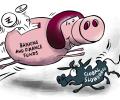
Invest only if you wish to go overweight on the sector.

Improved credit profile may make you eligible to transfer your existing home loan to another lender at a much lower rate.

Industry body CII has pitched for a reduction in personal income tax rates, decriminalisation of the goods and services tax and a relook at the capital gains tax rates as part of its agenda presented to the government for the forthcoming Budget. Arguing that the GST law already contains adequate penal provisions for deterrence against evasion of taxes, CII has suggested decriminalisation of GST law. Also, the applicability of prosecution provisions should not be based on the absolute amount of tax evasion but should be based on real intent to evade the taxes and a certain percentage of the tax payable, it stated.

PowerGrid was the top gainer in the Sensex pack, rising around 4 per cent, followed by NTPC, Tata Steel, Bharti Airtel, Sun Pharma and Bajaj Finserv. On the other hand, IndusInd Bank, Asian Paints, Infosys, Bajaj Auto and Maruti fell up to 2.59 per cent.

ITC was the top loser in the Sensex pack, tumbling over 5 per cent, followed by ICICI Bank, Kotak Bank, Axis Bank, SBI and HDFC Bank. NSE Nifty sinks 354 points to 17,857.25.

The windfall tax on oil produced within India and fuel exported overseas will make up for more than three-fourths of the revenue that the government lost when it cut excise duty on petrol and diesel to cool soaring inflation, industry sources said. India on July 1 joined a select league of nations globally that have taxed windfall gains accruing to oil companies from soaring energy prices. The government slapped a Rs 6 per litre tax on the export of petrol and jet fuel (ATF) and Rs 13 a litre on the export of diesel effective July 1. Additionally, a Rs 23,250 per tonne tax was levied on crude oil produced domestically.
Sensex catapults 1,241 points and Nifty vaults 382 points in two sessions in a row.
