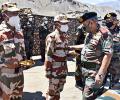
China has protested to India over Chief of Defence Staff General Bipin Rawat's reported remarks about Beijing constituting the "biggest security threat", the Ministry of Defence here said on Thursday.
If the visit takes place, it will be the first trip by a senior Chinese leader to India after the eastern Ladakh standoff between the two countries began in May 2020.
"I still have not heard a credible explanation as to why they chose to bring that size of forces to that sector of our border. Now, if peace and tranquility is disturbed and attempts are being made to change the LAC status quo unilaterally and large forces are brought to the border in contravention of written agreements, then obviously the relationship will be impacted," he said.
The MEA said there has not been any change in India's position on the LAC and the mutual redeployment as a result of the disengagement process should not be misrepresented.
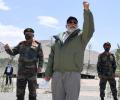
In a fresh incident in eastern Ladakh, the Chinese PLA carried out "provocative military movements" to "unilaterally" change the status quo on the southern bank of Pangong Tso lake but the attempt was thwarted by the Indian troops, the Army said here.

Rezang La is the site of an epic battle where Indian troops bravely fought the Chinese soldiers in 1962.
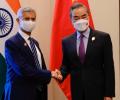
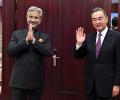
External Affairs Minister S Jaishankar on Thursday conveyed to his Chinese counterpart Wang Yi the need for an early resolution of all outstanding issues along the Line of Actual Control in eastern Ladakh, and asserted that bilateral ties should be based on mutual respect, mutual sensitivity and mutual interest.

The incident had taken place at a time when the Indian Foreign Minister, S Jaishankar, was in Moscow for the Shanghai Cooperation Organisation meeting, where he met his Chinese counterpart to address the border issues.

Sources said the Indian delegation was warmly greeted by senior officials of the Chinese Army before the talks began.
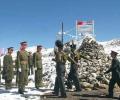
The two sides have already held at least 12 rounds of talks between local commanders and three rounds of talks between major general-rank officials but no positive outcome came out from the discussions, they said.

Satellite images dated August 17, 2021, have revealed upgraded infrastructure near the Depsang plains along with the Western sector of the LAC between India and China.

At a media briefing in Beijing, Chinese Foreign Ministry spokesman Wang Wenbin said the two sides have maintained smooth communication on border-related issues through diplomatic and military channels.

India recently outflanked China by taking control of strategic height near Pangong lake's southern bank.

The talks between India and China on the border row in eastern Ladakh have helped 'build trust' and the situation in the region has been normal since the disengagement in the Pangong Tso areas in February, Chief of Army Staff General M M Naravane said on Thursday, exuding confidence of resolution of the 'remaining issues'.

China said on Tuesday that the current situation on the border areas with India was "stable" as it confirmed that the 14th round of Corps Commander-level talks to discuss the disengagement process in the remaining friction points in eastern Ladakh will be held on Wednesday.

External Affairs Minister S Jaishankar on Thursday asserted that India's relationship with China cannot be normal unless there is peace in the border areas and there is no ambiguity in New Delhi's signalling to that country.
The Indian side is expected to present specific proposals at the talks to deescalate tension in Pangong Tso, Galwan Valley and Demchok -- the three areas in eastern Ladakh where the two sides have been on a bitter standoff for last one month, the sources said.

Out of 18, four personnel were critically injured but they are responding to treatment and are stable now, people familiar with the matter said.
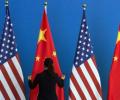
Throughout its standoff with India along the Line of Actual Control (LAC), Chinese officials sought to downplay the severity of the crisis, emphasising Beijing's intent to preserve border stability and prevent the standoff from harming other areas of its bilateral relationship with India, the Pentagon said in a report on Tuesday.
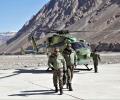
'This reluctance to respond forcefully to Chinese PLA provocations and outright aggression has as much to do with Prime Minister Modi personally, as with the institutional mindset of the MEA or even the Indian Army.' 'They are scarred by the 1962 War and are still cowed by China.'

The talks between the two sides near Galwan Valley ended in a stalemate on Tuesday as well as Wednesday, the sources said.
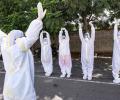
Yoga remains a ray of hope when world fights Covid pandemic, underscored Prime Minister Narendra Modi today on International Yoga Day. Here's how the world marked the special day.

'The use of military power to settle disputes is not always preferred and is the last preferred option, but it certainly remains an option.'
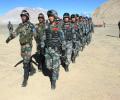
The last time the Chinese military had taken Indian soldiers captive was in July 1962 after a clash in Galwan Valley.
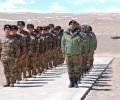
There was no comment from the Indian side on the statement made by the Chinese defence ministry spokesperson Colonel Wu Qian, and carried by China's official media.
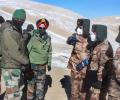
Sources said the Indian troops resolutely confronted the Chinese PLA soldiers.
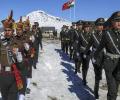
The disengagement plan was discussed between the two sides during the 8th Corps Commander-level talks which were held on November 6 in Chushul.
According to sources, the post at which the Chinese army has put up loudspeakers is under 24x7 constant watch by Indian soldiers and it is possible that the Chinese might be indulging in such drama to distract our troops or perhaps just relieve the pressure.

It is learnt that the Indian delegation insisted on a time-bound implementation of the agreement finalised during the extensive talks between External Affairs Minister S Jaishankar and his Chinese counterpart Wang Yi in Moscow on September 10 on the sidelines of a Shanghai Cooperation Organisation(SCO) meet.
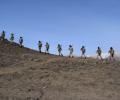
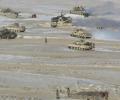
The enhancement of combat capability by the two armies in the region came even as both the countries continued their efforts to resolve the dispute through talks at military and diplomatic levels.

"The two former defence ministers had some clarifications and doubts on the situation which were clarified by the CDS and the Army chief," sources said.
Chinese Foreign Ministry spokesman Wang Wenbin said this at his media briefing as he parried questions on India's assertion that consensus reached by the leaders on maintaining peace along the border cannot be swept under the carpet.
'The two sides should support rather than undermine each other, strengthen cooperation rather than guard against each other, and enhance mutual trust rather than be suspicious of each other'

The two sides have also agreed for a joint mechanism to verify the progress in the disengagement process through delegation meetings as well as using unmanned aerial vehicles.
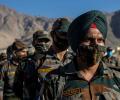
A day after the nearly 13-hour meeting, the two sides in a joint statement on Saturday reaffirmed that such a resolution would help restore peace and tranquillity along the Line of Actual Control (LAC) in eastern Ladakh and facilitate progress in bilateral relations.
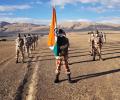
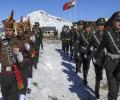
The troops carried the Indian flag at various strategic locations along the border.
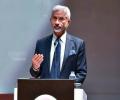
We very much hope that wisdom dawns on the Chinese side, Jaishankar said in Bangkok.

The talks came a day after the two armies began a limited disengagement in a few areas in Galwan Valley and Hot Spring in a demonstration of their intent to end the row peacefully.
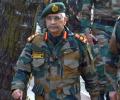
Chief of Army Staff Gen MM Naravane on Friday visited several forward areas in eastern Ladakh and carried out a comprehensive review of India's operational preparedness in the backdrop of its prolonged military standoff with China in the mountainous region.

The shelters were installed in locations near Tashigong, Manza, Hot Springs and Churup among others, in reflection of simmering tensions between the two sides in the region.
 © 2026 Rediff.com - Investor Information - Advertise with us - Disclaimer - Privacy Policy - Sitemap - Feedback - About us - Terms of use - Grievances