
'After the Galwan clash, the rules of engagement changed with the army commanders allowed to use any means at their disposal as they deem fit for tactical operations.'
'China's basic purpose of taking the Shaksgam Valley was access to the Indian Ocean.'

On November 18, 1962, 114 soldiers of the 13th Kumaon fought till the last man, and last bullet, in sub-zero temperatures, to beat back the huge Chinese army. We salute the Heroes of Rezang La.
Stakeholders said the industry was first hit by widespread cancellations after the April 22 Pahalgam terror attack in Jammu and Kashmir, and the fresh disturbances have further dented travellers' confidence.

The Congress party has accused the Modi government of a 'deny, distract, lie, and justify' (DDLJ) policy regarding China, alleging territorial setbacks and misplaced economic priorities.

'If Washington has to balance Chinese power, she will have to turn to the third biggest power in the world which is India.' 'The United States and India will have to work together in order to keep Chinese ambitions in check.'

The former Congress president is currently on a tour of Ladakh -- his first since the region was made a Union territory after being carved out of Jammu and Kashmir in August 2019 -- and is likely to visit Kargil next week.

The breakthrough reveals the dazzling world of miniature plasma loops, or tiny loops, which stretch almost as long as the distance between Kashmir and Kanyakumari.The breakthrough reveals the dazzling world of miniature plasma loops, or tiny loops, which stretch almost as long as the distance between Kashmir and Kanyakumari.

The Indian Army maintains a strict vigil in the Pangong Tso theatre, ever attentive for sneaky Chinese intrusions.
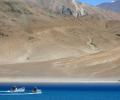
The people familiar with the development said the new bridge is being built in an area that is over 20 km from the Line of Actual Control (LAC).
"As regards reports about a bridge being made by the Chinese side on Pangong Lake, the government has been monitoring this activity closely," External Affairs Ministry Spokesperson Arindam Bagchi said.
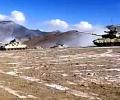
The sources said withdrawal of armoured elements from the south bank of Pangong Tso is almost complete and temporary structures erected by both sides will be demolished in the next few days.

Military experts said the aim of constructing the bridge in the Khurnak area could be to ensure that the Chinese People's Liberation Army is able to quickly mobilise its troops in the region.
Foreign policy expert C Raja Mohan has said that the recent disengagement of troops with China in eastern Ladakh has given a small opening to India, but the "big issues" remain. He also stressed the importance of strengthening India's ties with the US for technological and economic growth.

The government needs to answer the critical question of whether it has accepted any restrictions on its infrastructure creation activities, asserts Ajai Shukla.

At a media briefing, External Affairs Ministry Spokesperson Arindam Bagchi said India monitors such developments.

They said the Indian Army has further bolstered its presence around the Southern Bank area of Pangong lake by deploying additional troops and bringing in more weaponry including tanks and anti tank guided missiles.

The Army has also further bolstered overall surveillance mechanisms in all areas along the Line of Actual Control (LAC) in eastern Ladakh after foiling China's fresh attempt to occupy an area on the southern bank of Pangong lake, they said.

The 30-member committee, chaired by senior Bharatiya Janata Party leader and former Union minister Jual Oram and of which Rahul Gandhi is also a member,wishes to visit the eastern Ladakh region in the last week of May or in June.

The Chinese military has already completed moving back its troops from the face-off sites in Galwan Valley, Gogra and Hot Springs in line with the first phase of the disengagement process from the friction points on the LAC in eastern Ladakh, sources said. The main focus now shifts to Pangong Tso. India has been insisting that China must withdraw its forces from areas between Finger Four and Eight.

He said that the government of India has never accepted this illegal occupation.
Senior Congress leader and former defence minister A K Antony on Sunday alleged that disengagement in both the Galwan Valley and Pangong Tso Lake areas and the creation of a buffer zone was a 'surrender' of India's rights.

Official sources said withdrawal of tanks and other armoured elements from certain friction points is nearing completion while pulling back of troops from the North bank areas is being undertaken.

The Chinese and Indian armies continued with the disengagement process in the North and South banks of Pangong lake in eastern Ladakh as per plan and the entire pullback exercise is expected to take another six-seven days, sources in the defence and security establishment said on Monday.

Sources indicated that during Saturday's talks, India will insist on a faster disengagement process in remaining areas to bring down tension in the region, which has witnessed a tense standoff between the two militaries for over nine months.

China on Wednesday said the Chinese and Indian militaries are implementing the resolutions concerning the disengagement in eastern Ladakh along the Line of Actual Control (LAC) in an 'orderly' manner.

As per the agreement reached by the two sides, India and China will withdraw the forward deployment in a phased and coordinated manner, the defence minister said.

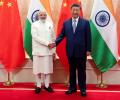
India and China have implemented a pact on patrolling in Depsang and Demchok along the Line of Actual Control (LAC) in eastern Ladakh, as per agreed modalities and timelines. The agreement was reached on October 21 and includes provisions for disengagement and patrolling in the last two friction points in the region. The pact has been effected and implemented as agreed, with both sides resuming patrolling activities and grazing, where applicable, as per longstanding practice before the friction began. The terms of the disengagement agreements reached prior to the latest pact continue to hold in relevant areas in eastern Ladakh. The agreement applies mutually to both sides and is without prejudice to India's positions on the LAC or boundary lines. India and China are each carrying out one round of patrolling in Depsang and Demchok, but they have maintained their deployment of troops along the LAC. The focus now is on de-escalation of the overall situation. The agreement was endorsed by Prime Minister Narendra Modi and Chinese President Xi Jinping in a meeting in Kazan, Russia, signaling attempts to normalize ties.
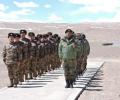
The sources said the ongoing engagement and dialogue at military and diplomatic levels have resulted in complete disengagement of troops at patrolling point 14, 15 and 17 A in eastern Ladakh.

The sources also said another round of military talks between the two sides on Wednesday to defuse tensions in the area remained inconclusive. The talks lasted nearly seven hours.

India and China have agreed to work towards a "roadmap" for rebuilding mutual trust following the border standoff in eastern Ladakh, according to a statement from the Indian Defence Ministry. Defence Minister Rajnath Singh met with his Chinese counterpart Dong Jun in Vientiane, Laos, on the sidelines of a regional security conclave. Singh called for drawing lessons from the "unfortunate border clashes" of 2020 and emphasized the need for cooperation rather than conflict. Both sides agreed to work towards a roadmap for rebuilding mutual trust and understanding, and a meeting of the Special Representatives and Secretary-Vice Minister mechanism will also take place soon.

"The Modi government's approach to the entire crisis could be described as DDLJ: Deny, Distract, Lie and Justify," Ramesh said.

Army Spokesperson Colonel Aman Anand said troops from China's People's Liberation Army (PLA) 'violated' the consensus arrived at during military and diplomatic engagements on the ongoing standoff in eastern Ladakh, and carried out provocative military movements to change the status quo.
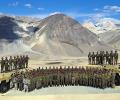
If China is accommodating regarding Depsang and Demchok, a resolution of the Sino-India territorial dispute in Eastern Ladakh could be possible.

China on Tuesday confirmed that it has reached an agreement with India to end the standoff between the two armies in eastern Ladakh.

Xu, 60, is expected to travel to New Delhi soon to take over his new posting.

Chinese Foreign Minister Wang Yi has expressed readiness to join hands with India's National Security Advisor Ajit Doval to "properly handle" issues related to the situation on the ground in the border areas, amid the protracted border row in eastern Ladakh.

Jaishankar said that both sides also exchanged views on the next steps in the India-China bilateral ties.
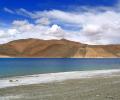
Ladakh's picturesque Pangong Tso lake is under threat from tourists who care less for the fragile environment and the Ladakhi culture

On Sunday, August 20, his father Rajiv Gandhi's 79th birth anniversary, Rahul will perform a pooja at Pangong Lake.
 © 2026 Rediff.com - Investor Information - Advertise with us - Disclaimer - Privacy Policy - Sitemap - Feedback - About us - Terms of use - Grievances