
One of the most important cases which have political implications is the Ayodhya land dispute case.
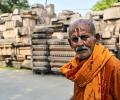
'Gods of different religions haven't warred, so we shouldn't either.'

Mir Baki was not the commander who had led the invasion on Ayodhya, Mishra said leading the bench to ask him as to what he was trying to prove by referring to these historical books.
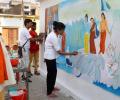
The submissions were made during the eighth day hearing in the case before a bench headed by Chief Justice Ranjan Gogoi.
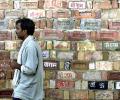
These images of deities on pillars of the structure are not found in mosques and found in temples, the counsel for the deity told SC.
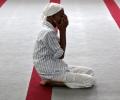
The issue had cropped up when a three-judge bench headed by Chief Justice Dipak Misra was hearing the batch of appeals filed against the Allahabad high court's 2010 verdict by which the disputed land on the Ram Janmabhoomi-Babri Masjid area was divided in three parts.
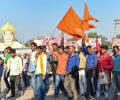
It will be heard by a five-judge Constitution Bench headed by Chief Justice Ranjan Gogoi.
By pegging the exact area of the Babri Masjid site at 0.313 acres, and not the original 2.77 acres, the government hopes to be in line with the court ruling in the 1994 Ismail Faruqui case which mentions return of land to original claimants once the exact area needed for acquisition is determined, observes Saisuresh Sivaswamy.

The submission was vehemently opposed by senior advocate C S Vaidyanathan, representing deity 'Ram Lalla', who said: "This is totally unwarranted".
The counsel stated that from the pillar bases, artefacts, circular shrine, intersecting brickbat walls found in excavation, an inference can be drawn that the massive structure was a temple and not any Islamic structure.

The Muslim parties also attacked 2003 ASI report which had found certain remains, idols and artefacts suggesting existence of a structure before Babri Masjid.

Indian politics, held captive in one way or the other by Ayodhya, may now well seek its emancipation from this issue, and the pursuit of welfare, asserts Congress leader Salman Khurshid in this excerpt from his latest book, Sunrise over Ayodhya.

'The appearance of idols of deities inside Babri was not a miracle. It was a planned and surreptitious attack to put them on the intervening night of December 22-23, 1949'
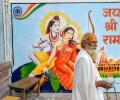
SC was requested to judicially scrutinise whether Babur dedicated the disputed structure in Ayodhya to 'Allah'
'Akahara' apprised a 5-judge Constitution bench, headed by Chief Justice Ranjan Gogoi, of its stand following a direction whether it opposes the plea of the deity in view of the fact that its right as 'shebait' (devotee) over the property can only stand if the lawsuit of 'Ram Lalla Virajman' is allowed.
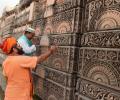
'Ayodhya will once again become Ram's city.'
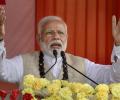
The prime minister made these remarks at a meeting of the council of ministers, while asserting the need to maintain an atmosphere of amity and harmony in the country.
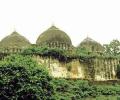
The petitioners seeking reconsideration by a larger bench, the observations made by it in a 1994 verdict that a mosque was not integral to Islam.
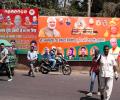
'Today, the situation in the country is bad.' 'The distance between Hindus and Muslims is increasing.' 'If an out-of-court settlement is reached, then a cordial atmosphere will prevail in the country.'

'It is entirely possible that there are many treasures of our history and our faith buried deep underground,' points out Rajeev Srinivasan.
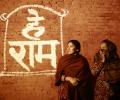
'People should see it as a victory for India.'

Narendra Modi's agenda is to build a Ram mandir, Hashim Ansari, the oldest litigant in the Ram Janambhoomi-Babri Masjid title suit, tells Syed Firdaus Ashraf/Rediff.com
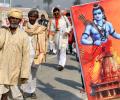
In a fresh plea on Tuesday, the Centre said it had acquired 67 acres of land including the 2.77 acre disputed Ram Janambhoomi-Babri Masjid site and sought permission of the top court to return the excess land to its original owners.

Bharti said she would 'embark on a pilgrimage to devote time for Ganga river and Lord Ram by leaving power'.
Tired of living under the restive shadow of communalism, Ayodhya residents, be it Vijay Singh or Mohammad Azim, do not want any fresh political trigger for communal disharmony.
The appropriate bench will fix the schedule with regard to the hearing of appeals in the case. "We will fix the date of hearing of Ayodhya dispute case before the appropriate bench in January," the CJI said.
Senior advocate Rajeev Dhavan told the bench that Justice Lalit appeared for former UP CM Kalyan Singh in 1994.
The litigant, in review plea filed through lawyer Ejaz Maqbool, has also sought an interim stay on operation of the verdict in which it had directed the Centre that a trust be formed within three months for construction of the temple at the site.
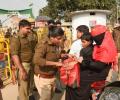
Authorities said social media posts will be monitored to ensure that no attempt is made to vitiate the atmosphere.
The judgment in the matter is to be pronounced by November 17, the day the CJI will retire.
The bench, which was hearing the politically sensitive case on 34th day, asked Parasaran as to whether 'it has been held that any Hindu temple, including the land has been accorded the juristic personality'.
The bench took serious note of the submission of senior advocate Kapil Sibal, appearing for one of the parties, that the appeals be heard in July 2019 after completion of the next Lok Sabha polls as the atmosphere at present was not conducive.
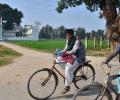
Iqbal Ansari, one of the main plaintiffs who fought for the right of the community over the disputed land, says Muslims in Ayodhya won't be satisfied if the Sunni Waqf Board accepts the five acres in Dhannipur.

Mohan Bhagwat said the temple would be constructed in the same grandeur as it existed before, using the "same stones" under the guidance of those who were the flag-bearers of the Ram Janmabhoomi movement for the last 25 years.

Though Mohammed Hashim Ansari was the oldest litigant in the case and was against the Ram temple coming up at the site, he never spoke ill of his neighbours who were Hindus.

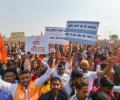
Once Ram temple is built it will become a 'ghoshit (declared) Hindu Rashtra', a VHP leader told the gathering.
'Babur has been facing gross historical injustice for the last two centuries, when he had no role either in the demolition of any temple or in the construction of the so-called Babri mosque at Ayodhya.'
 © 2026 Rediff.com - Investor Information - Advertise with us - Disclaimer - Privacy Policy - Sitemap - Feedback - About us - Terms of use - Grievances