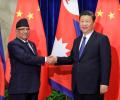
Nepal plunged into a political crisis last Sunday after Oli, known for his pro-Beijing leanings, in a surprise move, recommended dissolving the 275-member House, amidst a tussle for power with former prime minister Pushpa Kamal Dahal 'Prachanda'.

'This allows opportunities for (Chinese) entry into the domestic politics of Nepal, something that is also encouraged by Nepali politicians's willingness to play the China card (vis-a-vis India).'
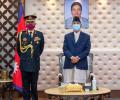
Did Oli turn to India when he realised that China was backing unity of the Nepal Communist Party rather than the government led by his faction?
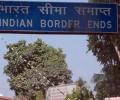
Both India and Nepal claim Kalapani as an integral part of their territory -- India as part of Uttarakhand's Pithoragarh district and Nepal as part of Dharchula district.

'Keeping its financial interests in mind, China wants no enmity with the Nepalese government.'
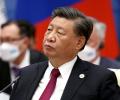
Xi Jinping's recent actions in South Asia have amply demonstrated the disastrous impact of China's embrace, observes Jayadeva Ranade, the retired senior RA&W officer and China expert.
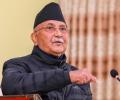
The decision to remove Oli from the party's general membership was taken at the Standing Committee meeting of the faction led by former prime ministers Prachanda and Madhav Kumar Nepal after Oli failed to produce explanation to his recent moves as sought by party leadership, sources said.

A five-member Constitutional Bench of the Supreme Court led by Chief Justice Cholendra Shumsher Rana issued the verdict stating that President Bhandari's decision to dissolve the lower house upon a recommendation of Prime Minister K P Sharma Oli was an unconstitutional act, delivering a major blow to the veteran Communist leader who was preparing for snap polls.

Oli said the territories belong to Nepal 'but India has made it a disputed area by keeping its Army there'. "Nepalis were blocked from going there after India stationed its Army," he said.
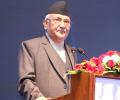
Nepal plunged into a political crisis after President Bidya Devi Bhandari dissolved the House of Representatives and announced dates for mid-term elections at the recommendation of Prime Minister Oli on Sunday, sparking protests from a section of the ruling party and various opposition parties.
Prime Minister Oli secured 93 votes in the lower house of parliament during a special session convened on the directives of President Bidya Devi Bhandari.

The turning point in his career was undoubtedly Nepal where he was sent as ambassador and acted with a cool head.
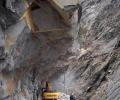
The India-Nepal bilateral ties came under strain after Defence Minister Rajnath Singh inaugurated a 80-km-long strategically crucial road connecting the Lipulekh pass with Dharchula in Uttarakhand on May 8.

60-year-old Khanal, leader of the Communist Party of Nepal (United Marxist-Leninist), secured 368 of the 557 votes cast in the 601-member Parliament, the speaker announced.


Two student leaders were arrested and the offices of the Communist Party-UML ransacked by the police ahead of a May 1 anti-King rally.

China has not limited the 'battle' to the diplomatic field alone; the People's Liberation Army has become aggressive on the ground too. The recent 'fights' in Northern Sikkim and Ladakh are part of the pattern, asserts Claude Arpi.
According to The Kathmandu Post, a leading English daily, Tulsi Giri vice-chairman of King's Council of Ministers took the loan from a government bank two decades ago but never paid back.

The decision was taken just a day before the Army squad was set to travel to Pune, where the drill will commence on Monday, the Kathmandu Post reported.

'Although the real Ayodhya lies at Thori in the west of Birgunj, India has claimed the Indian site as the birthplace of Lord Ram'

Now, the bill will undergo a similar process in the National Assembly, wherein the ruling Nepal Communist Party commands two-thirds majority.
Nepal's political crisis deepened on Friday as both embattled Prime Minister K P Sharma Oli and the Opposition parties staked a claim for the formation of a new government by submitting letters comprising signatures of lawmakers to President Bidya Devi Bhandari.

President Bidya Devi Bhandari administered the oath of office and secrecy to Oli, 69, at a ceremony at Shital Niwas, after he was reappointed to the post on Thursday night as the Opposition parties failed to secure majority seats in Parliament to form a new government.
Nepal last month released the revised political and administrative map of the country laying claim over the strategically key areas, more than six months after India published a new map in November 2019.
The government had registered the amendment proposal in Parliament on May 22 after releasing the new political map of Nepal depicting Kalapani, Lipulekh and Limipiyadhura as its territories on May 18.
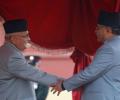
Prime Minister Oli did not attend the meeting of the 45-member Standing Committee, he said, adding that the next meeting of the top body of the NCP will be held a week later. The meeting took place after it was postponed seven times to allow Oli and Prachanda more time to sort out their differences.
The move comes as the intra-party feud reached climax in the ruling NCP which has been witnessing months long tussle between two factions, one led by 68-year-old Oli and Party's chairman and another led by 66-year-old 'Prachanda', also the executive chair of the party and former premier.
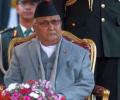
'The Prime Minister's remarks that India was conspiring to remove him was neither politically correct, nor diplomatically appropriate,'

India last month reacted angrily to Nepal showing the three areas as Nepalese territory in the new map and cautioned the country that saying such "artificial enlargement" of territorial claims will not be acceptable to it. India has been maintaining that these three areas belong to it.
'The redrawing of the map with the inclusion of Kalapani area by Nepal and endorsement from the House of Representatives shows the KP Oli government's move to gain cheap popularity in the name of nationalism'

'By treating Nepali politicians as shabby buffoons to be pampered one day and collared another day, India badly exposed itself.' 'A belief got entrenched in the Nepalese mind that we are a dangerous neighbour,' observes Ambassador M K Bhadrakumar.

Though General Naravane's visit will not deal with 'impermanent' issues like the changing stands of politicians, it will certainly reinforce the deeper 'permanent' links between the people of Nepal and India. Time will hopefully tackle the present impermanence of the Sino-Nepalese romance, notes Claude Arpi.
 © 2026 Rediff.com - Investor Information - Advertise with us - Disclaimer - Privacy Policy - Sitemap - Feedback - About us - Terms of use - Grievances