
Developers are entering one of the busiest construction cycles, with the top four firms planning launches worth Rs 1.13 trillion over the near to medium term, even as execution faces pressure from approval delays, labour shortages, rising costs, and contractor capacity limits across the industry.

India's housing market has remained resilient this festival season (Dussehra-Diwali period), despite global macroeconomic challenges, tech-sector layoffs, and affordability pressures, with developers reporting 10-25 per cent year-on-year (Y-o-Y) rise in home sales across major cities.

'The directives to enhance last-mile funding, consider revival funds, and systemic reforms across the sector are expected to revive stalled projects, improve accountability, and accelerate the delivery of affordable and mid-income housing.'

The government should provide home loan up to 25 lakh at a lower interest rate of 5 per cent to the people of the middle class, a prominent realtors' body appealed to the government against the backdrop of soaring home prices. G Hari Babu, president of the National Real Estate Development Council (Naredco), in an online interaction with Business Standard, said that the middle class in India accounts for roughly 30 per cent of the total population and is dependent on rental accommodation.
While demand for sub Rs 50-lakh affordable housing prevails, market players cite increased land rates, escalated construction costs and low margins as key prohibiting factors.

Housing demand should improve nationwide after the Reserve Bank of India (RBI) cut the repo rate by a larger-than-expected 50 basis points (bps) on Friday, said real estate industry executives. The rate cut comes after housing sales in top Indian cities in the first quarter of 2025 dipped 28 per cent due to skyrocketing residential property prices and geopolitical headwinds, according to Anarock.

Credit outstanding to the housing sector rose by nearly Rs 10 lakh crore in the last two fiscals to reach a record Rs 27.23 lakh crore in March this year, according to RBI's data on 'Sectoral Deployment of Bank Credit'. Experts from banking and real estate sectors attributed this growth in housing credit outstanding to a strong revival in the residential property market post-COVID pandemic on pent-up demand. According to the data of the Reserve Bank of India (RBI) on sectoral deployment of bank credit for March 2024, the credit outstanding to the housing (including priority sector housing') stood at Rs 27,22,720 crore in March 2024, up from Rs 19,88,532 crore in March 2023, and Rs 17,26,697 crore in March 2022.
Commerce and Industry Minister Piyush Goyal that the players in the sector should start lowering prices and, if the worst comes to the worst, write off investment as bad business decisions.

The sentiment in the real estate industry turned optimistic during October-December 2020 and the outlook for the next six months is positive on the back of revival in demand for both residential and office properties, according to a survey by Knight Frank India-FICCI-Naredco. The 27th edition of 'Real Estate Sentiment Index Q4 2020 survey' of developers, banks, financial institutions and private equity players operating in the sector was released on Monday in a video-conference. As per the report, the 'Current Sentiments Score', for the first time in 2020, entered the optimistic zone at 54 points in Q4 (October-December) 2020, a significant jump of 14 points over the previous quarter.

As per a Knight Frank FICCI Naredco report, a majority 69% of the stakeholders say that the residential sales will remain tepid or may even go down further in the coming six months.
India's residential market is expected to sustain demand momentum despite rise in mortgage and property rates as sales this year across the top 7 cities are likely to breach pre-pandemic level of 2.62 lakh units, industry players said. After braving four back-to-back disruptions in form of demonetisation, RERA, GST and COVID-19 in the last 6 years, industry experts feel the housing market is going through a lot of structural changes and is now at the start of a long-term upcycle. Homebuyers body FPCE gives credit to the Real Estate Regulatory Authority (RERA) under the Real Estate (Regulation & Development) Act, 2016 for this improved buying sentiment.

Budget expectations housing sector.

Hit by slackening demand amid economic slowdown and high interest rates, the real estate sector has asked for infrastructure status for the housing sector in the Budget for 2013-14, which would help it avail of tax benefits and easier flow of credit.

Housing sales across seven major cities are estimated to fall 47 per cent year-on-year to 1.38 lakh units this year on lower demand because of the COVID-19 pandemic, according to property consultant Anarock. New housing supply, too, is likely to fall 46 per cent to 1.28 lakh units in 2020 in seven cities -- Delhi-NCR, Mumbai Metropolitan Region (MMR), Pune, Bengaluru, Hyderabad, Chennai and Kolkata.

India's real estate industry staged a rebound from 2020's downturn, with housing sales seen rising by over 50 per cent. The performance, though short of pre-COVID levels, has property developers hoping for stronger gains in the New Year and the beginning of a long upcycle. A strong foundation has been laid this year for revival in the Indian real estate sector, which is projected to reach $1 trillion mark by 2030 from $200 billion in the pre-pandemic year.
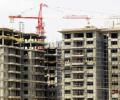
Real estate developers and home buyers will feel the pinch of higher interest rates, which could slow down home sales. Higher interest will push up monthly installments for home loans for existing as well as new home buyers.

Increase in service tax would make properties costlier to buyers.

All real estate developers may not be able to avail the benefit of Reserve Bank of India's one-time restructuring scheme as they might not meet the required financial ratios and have the necessary credit rating, HDFC vice chairman and CEO Keki Mistry said. He was speaking at a real estate and infrastructure investor summit organised by Naredco. "Restructuring may not necessarily help every developer because not too many will be able to meet the criteria laid down in terms of meeting the various ratios and getting credit ratings," Mistry said.
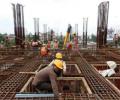
Around 576,000 housing units, worth Rs 4.64 trillion, are delayed in seven major cities of the country

There was no relief for existing home buyers who are stuck in stalled projects and are paying both rent and EMI on their home loans.

Experts said the builders will now factor in their losses arising from the removal of input tax credit when they pass on the benefits to end users while the latter may want the entire GST cut to be given to them.
With the insistence on data centres to be onshore, entities in real estate believe there is going to be a rise in demand for specialised Grade-A commercial spaces to set these up.

Realty players want single window clearance for all affordable projects, reports Karan Choudhury.
'The government has just scratched the tip of the surface with the recent announcement. They are not realising the gravity of the situation.'

Massive crowds thronged liquor stores, more vehicles plied on roads and cab-hailing platforms resumed services as India entered the third phase of the lockdown on Monday with further easing of curbs except in containment zones in the shadow of the highest rate of recovery yet from coronavirus.

Karan Choudhury reports on the implications of the strict Real Estate (Regulation and Development) Act and the prosecution of Unitech MDs, Sanjay Chandra and Ajay Chandra, in an alleged fraud case.
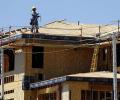
For those in the EWS and LIG category who wish to take a loan up to Rs 600,000, there is an interest subsidy of 6.5 per cent for a tenure of 15 years.

Construction costs would be reduced to some extent and this benefit can be passed on to the customers, thereby spurring home buying

N Sundaresha Subramanian, Karan Choudhury and Shreya Jai report on the sorry condition of homebuyers who invested in Jaypee Infratech and the Amrapali group's Noida-based projects.

Some developers point out that what comes in the way of low-cost housing is the sky-high price of land
 © 2026 Rediff.com - Investor Information - Advertise with us - Disclaimer - Privacy Policy - Sitemap - Feedback - About us - Terms of use - Grievances