
The Supreme Court has announced that a nine-judge bench will begin final hearings on petitions related to discrimination against women in religions, including the Sabarimala Temple case, starting April 7.

The Left government in Kerala on Thursday withdrew a handbook for police personnel on duty at the Lord Ayyappa temple in Sabarimala after the Bharatiya Janata Party raised a hue and cry over a mention in the book that all pilgrims can enter the temple.

The SC issued a notice informing listing of petition filed by Indian Young Lawyers Association seeking review of its 2018 judgment. The bench will also look at other contentious issues of alleged discrimination against Muslim and Parsi women.

The judges on the bench are CJI S A Bobde, Justices R Banumathi, Ashok Bhushan, L Nageswara Rao, M M Shantanagoudar, S A Nazeer, R Subhash Reddy, B R Gavai and Surya Kant.

The apex court's observation came when senior advocate Indira Jaising, appearing for a woman devotee, Bindu Ammini, alleged violation of the 2018 verdict and said her client was attacked for her bid to enter the shrine.
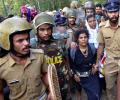
The apex court said it would endeavour to constitute the larger bench at the earliest to hear the matter.
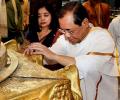
Justice Gogoi's tenure as judge and as CJI was marked by some controversies and personal allegations but that never came in his way of his judicial work that was reflected in the last few days when benches headed by him delivered some path-breaking judgments.
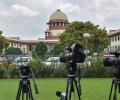
Verdicts paving the way for construction of a Ram Temple at Ayodhya and India's multi-billion dollar Rafale fighter jet deal with France were 2019's landmark imprints of the Supreme Court, which also found itself at the centre of a controversy with then Chief Justice of India Ranjan Gogoi being accused of sexual harassment before getting the clean chit.

A majority verdict by Chief Justice Ranjan Gogoi and Justices A M Khanwilkar and Indu Malhotra decided to keep pending the pleas seeking a review of its decision regarding the entry of women into the shrine, and said restrictions on women in religious places was not restricted to Sabarimala alone and was prevalent in other religions as well.

'The BJP had ruled earlier too, but nothing of this sort happened then... I don't say the government is behind the attacks, but they don't do anything to stop the attacks.' 'The prime minister has to tell the perpetrators that it is not in the interest of the government that such incidents happen.' 'When somebody says all Indians are Hindus, responsible people should ask him to stop and assure the country that this is not the opinion of the government. But it is not happening and it is quite unfortunate,' Cardinal Baselios Cleemis tells Shobha Warrier/Rediff.com in an exclusive interview.
 © 2026 Rediff.com - Advertise with us - Disclaimer - Privacy Policy - Sitemap - Feedback - About us - Terms of use - Grievances