
The data, to be compiled by the ministry of statistics and programme implementation, will bring out the proportion of population actively contributing to production of goods and services, also known as the labour force participation ratio, every quarter.

Wholesale price-based inflation, which dipped to sub-zero levels following the impact of the global crisis, has started firming up and rose to 7.3 per cent in December, 2009.

New chief statistician T C A Anant said on Monday hiking fuel prices was a better option than keeping them artificially low and widening the fiscal deficit, even as the Opposition organised a nationwide strike against the government's decision on Monday.

The services sector contributes the highest of around 54 per cent to the country's gross domestic product. At present, the WPI, which is released every week, contains prices of primary articles, fuel and manufactured products. Data from banking and transport services would be the first sectors to be covered on an experimental basis. The plan is to initially build a separate services index, which would be integrated into the WPI later.
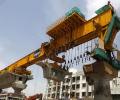
As many as 449 infrastructure projects, each worth Rs 150 crore or more, have been hit by cost overruns totalling more than Rs 4.29 lakh crore, according to a report. The ministry of statistics and programme implementation monitors infrastructure projects worth Rs 150 crore and above. Of the 1,736 such projects, 449 reported cost overruns and 547 were delayed.
Strangely, no consolidated figures on infrastructure investments made on ground are ever disseminated by any official arm of the Government of India.
Your friendly postman, besides delivering letters, could soon be collecting crucial data on consumer prices, if a proposal from the Union ministry of statistics and programme implementation is accepted by the Department of Posts.
The finance ministry and Reserve Bank of India have reservations on the computation of inflation data on a monthly basis, a senior government official said on Thursday. Finance Minister P Chidambaram will have to meet the Reserve Bank to reach a consensus on the committee's suggestions to have a new series of WPI on a monthly basis, he said on the sidelines of a function to release the results of the Fifth Economic Census.

The government on Monday admitted in Rajya Sabha that almost half of 951 central sector projects are delayed resulting in cost overrun to the tune of over Rs 40,000 crore (Rs 400 billion).

Manufacturing sector production registered a decline of 17.1 per cent, while the output of mining and power fell 19.8 per cent and 10 per cent, respectively.
The Ministry of Statistics and Programme Implementation (MOSPI) is in talks with the Department of Posts to take the help of its staff in collecting sample data for the proposed Consumer Price Index for Rural India (CPI-R). The data for the index would be collected from 1,000 villages, Chief Statistician of India Pronab Sen said on the sidelines of a national seminar on the results of the 61st round of the National Sample Survey.

In May 2019, the food inflation was 1.83 per cent as per the full CPI data released for that period.

'Revision of the base year for both CPI and GDP are long overdue.' 'The basic data that went into the 2011-2012 series were mainly from surveys done in 2011 or earlier.' 'We have since seen the emergence of new sectors like platform-based work and online marketing.' 'The employment surveys and the consumption surveys need to reflect these adequately.'

As many as 403 infrastructure projects, each worth Rs 150 crore or more, have been hit by cost overruns of over Rs 4.05 lakh crore owing to delays and other reasons, according to a report.

Retail inflation slowed to 4.29 per cent in April from 5.52 per cent in March, mainly due to easing food prices, government data showed on Wednesday. The Reserve Bank mainly factors in the retail inflation based on Consumer Price Index (CPI) while arriving at its monetary policy. As per the data released by Ministry of Statistics and Programme Implementation, inflation in the food basket was 2.02 per cent in April, down from 4.87 per cent in the preceding month.
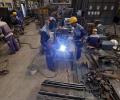
Industrial production growth entered positive territory after a gap of two months with a record 22.4 per cent rise in March this year, mainly due to the low-base effect and good show by manufacturing, mining and power sectors. The manufacturing sector -- which constitutes 77.63 per cent of the index of industrial production (IIP) -- grew by 25.8 per cent in March 2021, as per the data released by the National Statistical Office (NSO) on Wednesday. The mining sector output too grew 6.1 per cent in March, while power generation increased by 22.5 per cent.
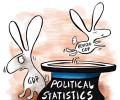
There has been criticism of the official statistics ever since MoSPI came out with new methodology to estimate the GDP on the base year of 2011-12 compared to earlier 2004-05.
Powered by the high growth of the manufacturing sector, industrial growth touched 7.6 per cent during the first quarter of the current financial year as against 5.7 per cent during April-June, 2003.

Industrial production contracted by 1.9 per cent in November, entering the negative territory after a two-month gap, mainly due to poor showing by manufacturing and mining sectors, official data showed on Tuesday. The manufacturing sector -- which constitutes 77.63 per cent of the index of industrial production (IIP) -- recorded a contraction of 1.7 per cent in November 2020, as per data released by the National Statistical Office (NSO). Mining sector output too witnessed a decline, shrinking 7.3 per cent.
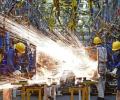
Industrial production declined by 10.4 per cent in July, mainly due to lower output of manufacturing, mining and power generation, as per the government data released on Friday.
The per capita income of Indians continued its climb up the ladder, increasing 11.1 per cent in 2004-05 to Rs 23,308 (at current prices) compared to Rs 20,989 in 2003-04.

The findings of the report showed consumer spending falling for the first time in over four decades in 2017-18.

'How low GDP would have been, we don't know.' 'It raises serious questions because so many indicators are pointing to such a sharp decline and GDP estimates are still showing 4 per cent growth.'

Industrial production surged by 13.6 per cent in June mainly due to a low-base effect and good performance by manufacturing, mining and power sectors but the output remained below the pre-pandemic level. The manufacturing sector, which constitutes 77.63 per cent of the Index of Industrial Production (IIP), grew by 13 per cent in June this year, according to the data released by the National Statistical Office (NSO) on Thursday. The mining sector output rose by 23.1 per cent in June while power generation increased by 8.3 per cent.
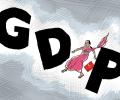
Though the ministry is considering 2017-18 as the new base year, no decision has been taken as the committees of experts are awaiting some more data before finalising their opinion.

The ministry of statistics and programme implementation on Friday released quick estimates of the Index of Industrial Production (IIP) which showed the index value at 88.4 in May against 53.6 in April, indicating a graded pickup in industrial activity. The index stood at 135.4 in May 2019.
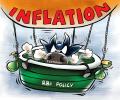
The RBI, which mainly factors in CPI for arriving at its bi-monthly monetary policy, has been mandated by the government to ensure that inflation remains at 4 per cent, with deviation of 2 per cent on either side.

Per capita income is a crude indicator of the prosperity of a country.

Leading indicators suggest economic activity has been disrupted after demonetisation.

The Gross National Income (GNI) at 2011-12 prices is now estimated at Rs 112.13 trillion as against Rs 112.14 trillion estimated earlier for 2015-16.

Rediff Labs shows the number of both domestic and foreign tourists visiting each state in 2015 and its growth rate.

The IIP data showed a significant slowdown in the manufacturing sector, which grew at 4.2 per cent in July 2019 as compared to 7 per cent a year ago.

The employment rate in the country declined marginally from 39.2 per cent to 38.6 per cent between 2009-10 and 2011-12, the Rajya Sabha was informed on Wednesday.

There was a slowdown in the manufacturing sector, which grew at 1.2 per cent in June 2019 as compared to 6.9 per cent a year ago.

Department of Economic Affairs secretary Atanu Chakraborty said that equity capital flows have been positive this year.

The inflation in the food basket spiked to 7.89 per cent in October 2019 as against 5.11 per cent the preceding month.

The pace of retail price rise in January 2016 is the highest since 6.46 per cent in September 2014.

According to a statement available on the Ministry of Statistics and Programme Implementation website, gross domestic product, consumer price index and index of industrial production will now be released at 5.30 in the evening.
 © 2026 Rediff.com - Advertise with us - Disclaimer - Privacy Policy - Sitemap - Feedback - About us - Terms of use - Grievances