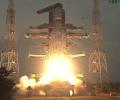
The heaviest communication satellite to be launched from the Indian soil onboard a new generation, homegrown 'Bahubali' rocket was successfully placed into the intended orbit on Sunday, the Indian Space Research Organisation said.

With the development of GSLV Mark-III, India will be able to launch heavy satellites into the geosynchronous transfer orbit. This vehicle is billed as the technological successor to GSLV Mark-II.
Indian Space agency Indian Space Research Organisation would launch the Geo-synchronous Satellite Launch Vehicle-Mark III (LVM3 X mission) on December 18 which would carry active solid boosters, liquid core stage and a passive cryo-stage.
Enthused over its successful launch of GSLV D5 with GSAT-14 communication satellite from Satish Dhawan Space Centre in Sriharikota on Sunday, the Indian Space Research Organisation is planning a series of GSLV launches and an experimental launch of the advanced version GSLV Mark III soon from the spaceport.
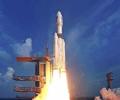
Taking its baby steps towards realising India's ambition to send humans into space, Indian Space Research Organisation on Thursday successfully tested the atmospheric re-entry of a crew module after its heaviest launch vehicle GSLV MK III blasted off from Sriharkota.

The fire on a merchant vessel off the Karwar coast has been brought under control after more than 24 hours but one of the ship's 21 crew members was missing, the Indian Coast Guard (ICG) said on Saturday.

The 21-gun salute is conducted by a specifically-designed cartridge or a blank round which is used to create the sound of firing as opposed to actual shells being fired.
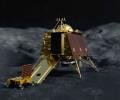
A number of private companies have contributed to the development of ISRO's Chandrayaan-3 spacecraft which successfully landed near the south pole of the Moon on Wednesday evening.

Only three countries (United States, Russia and China) have successfully landed spacecraft on the airless lunar surface.

Officials hint the visit could finally see a formal defence industrial road map being adopted by both nations.

The new year will witness two unmanned missions under the "Gaganyaan" project, deep ocean exploration project, "Samudrayaan" and many more.

In a giant leap for its space programme, India's Moon mission Chandrayaan-3 touched down on the lunar south pole at 6.04 pm on Wednesday, propelling the country to an exclusive club of four and making it the first country to land on the uncharted surface.

The Indian Space Research Organisation (ISRO) on Thursday announced that its lunar mission Chandrayaan-3 will be launched on July 14 from the space port at Sriharikota in Andhra Pradesh.

People gathered in educational institutions, offices, city squares and religious places to watch the Indian Space Research Organisation's live telecast of Chandrayaan-3's final descent to the uncharted surface of the lunar south pole.

The entire mission operations of Chandrayaan-3, right from the launch till landing, "happened flawlessly" as per the timeline, the team that led India's third mission to the Moon said on Wednesday.

An entire nation waited, praying and hoping fervently, as the countdown to touch down on the moon wound to a slow close on Wednesday with many thousands gathering in schools, places of worship and elsewhere and scientists doing last minute checks to ensure Chandrayaan-3 makes a soft landing on the lunar south pole.

The cost of acquiring the advanced light helicopters from the state-run Hindustan Aeronautics Ltd (HAL) has been estimated at Rs 3,850 crore while a batch of rocket ammunition will cost Rs 4,962 crore, the defence ministry said.

Friday's mission is the fourth operational flight of LVM3 which aims to launch the Chandrayaan-3 spacecraft into a Geo Transfer Orbit.

Modi will unfurl the national flag and deliver the customary address to the nation from the ramparts of the historic monument.

India will become the fourth country to master the technology of soft-landing on the lunar surface after the US, China and the erstwhile Soviet Union.

The entire process being autonomous when the lander has to fire its engines at the right times and altitudes, use the right amount of fuel, and scan of the lunar surface for any obstacles or hills or craters before finally touching down.
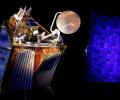
On Sunday, at 12.07 am in Sriharikota, off the coast of the Bay of Bengal, it was almost like an early Diwali, with the sky lit up by the launch of 36 OneWeb satellites. The Indian Space Research Organisation (Isro) did the launch on a 43.5-metre-tall Geosynchronous Satellite Launch Vehicle Mark III (GSLV Mk III) rocket. After the countdown, which started 24 hours in advance, once the mega screen marked the launch, a select group of invitees at the gallery cheered by applauding the feat.
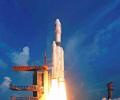
The rocket can put satellites weighing upto four tonnes in space, double the weight that the current GSLV-Mark-II can lift.
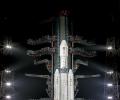
The Indian Space Research Organisation on Thursday launched its first experimental suborbital flight. Here are five things you need to know about the GSLV Mark III mission.

The space agency lines up GSLV-III and Chandrayan-II in 2017-18.

"ISRO has been launching at least one satellite every month, so our calender is perennially packed and at this point of time it looks difficult to launch the South Asian satellite in December. It could get delayed by a month," a senior official said.

GSLV Mark-III will be India's most powerful launch vehicle built to lift the heaviest Indian communications satellites to space.

A large Dhruv order could significantly boost Indian defence exports. These have grown from Rs 1,940 crore in 2014-2015 to Rs 10,745 crore in 2018-2019.

Dr Bhabha and Dr Sarabhai didn't feel guilty for their ambitions; it was for those 'mad scientists' that India is a powerhouse -- both at the atomic level and in the vastness of space, observes Kumar Abishek.

India's heaviest rocket ever is expected to take to the sky next January on an experimental flight whose later versions could be used to send humans on space missions.
The successor to the popular 5D Mark II is out. Swapnil Mathur of ThinkDigit tells you if it's worth the money.
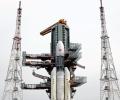
The Indian Space Research Organisation said that the countdown started at 6.51 am on Sunday.

The results for the People's Choice Award for the Wildlife Photographer Of The Year are in.

"I am extremely happy to announce that GSLV Mark III successfully injected Chandrayaan 2 in the defined orbit, infact the orbit is 6,000 km more than what was intended," Sivan said.

The four-day event, which will conclude on March 11, saw many foreign aircraft companies display their flying machines. Rediff.com's Venkata Sathish gives a preview.

Since Pakistan has 'opted out' of the project, it is now being called South Asian satellite.
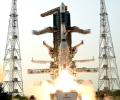
Over 32 missions -- satellites and rockets -- have been planned for the year.

It has already tasted success with the moon mission and Mangalyaan. Is man in space the next frontier for ISRO?
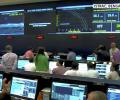
NASA said it is looking forward to explore the solar system with its Indian counterpart.

The Indian space agency has already begun work on the third generation of the earth observation satellite -- the first of which will be ready by 2018 and boost the capability to generate digital maps.
 © 2026 Rediff.com - Investor Information - Advertise with us - Disclaimer - Privacy Policy - Sitemap - Feedback - About us - Terms of use - Grievances