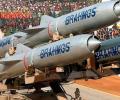
The Philippines, confronted with Chinese bullying in the South China Sea, have become the first foreign military to order the shore-based, anti-ship cruise missile.
China dismissed the reports as groundless.

The participants would include senior ministers dealing with the situation along with the senior military leadership. The leadership is likely to discuss the Chinese military activities in Doklam and other areas on Bhutanese soil along with the Indian preparations to deal with the situation.
The statement of Commander of US Indo-Pacific Command Admiral John Aquilino on Wednesday came ahead of the 15th round of high-level military talks between India and China on March 11.
The Indian side also told the Chinese delegation that the talks on disengagement should include Depsang as well as all face-off sites, insisting that it should be a simultaneous process and not a selective one.
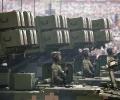
A new military rank system had been introduced for the PLA, but all soldiers must always obey the Communist party, reveals Jayadeva Ranade, the distinguished China expert and retired RA&W officer.
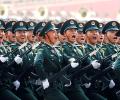
Currently, the reserve forces are under the dual leadership of military organs and local Communist Party committees and they would be brought under the control of the ruling party and the CMC from July 1, the state-run Xinhua news agency reported.
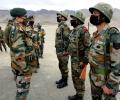
India, China have agreed to hold another round of talks soon.
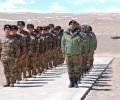
The sources said both sides held extensive deliberations on modalities for disengagement of troops from all the friction points in eastern Ladakh at the talks.

'It is because of the bravery of Colonel Santosh Babu and his men that we have not seen a violent escalation anywhere else along the LAC.'
In an address at a seminar, the army chief said senior military commanders of India and China are holding talks to iron out modalities for de-escalation of tension in eastern Ladakh.

Chinese President Xi Jinping has underlined the need for building a combat-ready army and accelerate the building of the theatre joint combat command system, amidst the People's Liberation Army flexing its muscles in the disputed South China Sea.

Initial information from a reliable police source said that the two women killed in the blast were Chinese nationals and may have been the target of the blast.

It is learnt that the face-off took place after a Chinese patrol tried to enter Indian territory and the troops of China's People's Liberation Army were forced back.

'The military advantage the Indian Army had gained by the Special Frontier Force occupying the heights of the Rezang La-Rechin La ridge on the Kailash Range is lost without the PLA withdrawing to east of the Khurnak Fort line.'
'China's opaque defence allocation processes are shrouded in mystery and have triggered security dilemmas among its neighbours and others,' notes China expert Srikanth Kondapalli.

United States officials have identified Pakistan as a base of operations or target for numerous armed and non state militant groups, some of which have existed since the 1980s, the independent Congressional Research Service said in the report.

'The Chinese are retaining geostrategic pressure on India by keeping troops there and building infrastructure continually.'

The paper also includes musing that SARS -- which hit China in 2003 -- could have been a man-made bioweapon deliberately unleashed by "terrorists".

The video was reportedly shot at Fuyang Railway Station while the troops were preparing to head to a military camp in Hebei province, according to Taiwan News.

After the occupation of heights by the Indian Army, the Chinese army has deployed around 3,000 additional troops of its combined arms brigade including its infantry and armoured troops near the Rezang la and Rechen La heights.

According to sources, the post at which the Chinese army has put up loudspeakers is under 24x7 constant watch by Indian soldiers and it is possible that the Chinese might be indulging in such drama to distract our troops or perhaps just relieve the pressure.

The humanitarian gesture by the army came when it is dealing with an aggressive behaviour by the Chinese troops in eastern Ladakh.

External Affairs Ministry Spokesperson Anurag Srivastava said China's claim over Galwan Valley was not in accordance with its own position in the past, noting that attempts of transgression by Chinese side were invariably met with appropriate response from the Indian troops.
He said that the Communist Party of China has used the COVID-19 pandemic as a smokescreen for ratcheting up their oppression of Hong Kong and advancing their control and influence throughout the region.

China has not yet talked about the number of casualties suffered by the People's Liberation Army during the clash.

Sources said the Indian side has prepared very well for responding to the Chinese reaction in view of the action by own troops including a Special Operations unit and Sikh Light Infantry troops there.
'This reluctance to respond forcefully to Chinese PLA provocations and outright aggression has as much to do with Prime Minister Modi personally, as with the institutional mindset of the MEA or even the Indian Army.' 'They are scarred by the 1962 War and are still cowed by China.'

With his eye on next year's Party Congress, Xi Jinping is using the CCP's centenary celebrations to publicise the benefits for China from its leadership, and boost his image and contribution to China's rise, observes Jayadeva Ranade, the distinguished China expert and retired RA&W officer.

'It's a very tough situation. We're talking to India. We're talking to China. They've got a big problem there'
The Chinese authorities have been rapidly building defence infrastructure along the Line of Actual Control, indicating that they are preparing for a long period of tension with India, points out Jayadeva Ranade, the former senior RA&W officer and China expert.
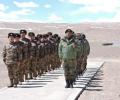
The US hopes that the differences will be resolved peacefully, officials said in Washington.

Senior officers recounted extreme Chinese brutality to the Indian prisoners, with some of them being pushed over cliffs and soldiers' bodies being recovered from the Galwan River.

"As regards reports about a bridge being made by the Chinese side on Pangong Lake, the government has been monitoring this activity closely," External Affairs Ministry Spokesperson Arindam Bagchi said.

Four Chinese soldiers were killed in the fierce clash with the Indian Army in the Galwan Valley in eastern Ladakh in June last year, the People's Liberation Army (PLA) acknowledged for the first time on Friday.

China is engaged in hotly contested territorial disputes in the South and East China Seas. Beijing has also made substantial progress in militarising its man-made islands in the past few years, which it says it has the right to defend.

In the fourth such incursion since March, two helicopters of the People's Liberation Army of China hovered for about five minutes in Uttarakhand's Chamoli district and "could have carried out aerial photography of Indian ground troops," according to official sources in the government.

Col Babu was awarded the gallantry medal for resisting the Chinese Army attack while establishing an observation post in the face of the enemy in the Galwan valley in the Ladakh sector during Operation Snow Leopard.
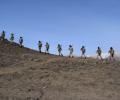
Twenty personnel of the India-China LAC guarding Indo-Tibetan Border Police (ITBP) force have been awarded gallantry medals for displaying bravery during standoff and clashes between militaries of the two countries in the eastern Ladakh region last year.

Key to China's decision regarding Taiwan will be its leadership's assessment whether the US will come to Taiwan's defence, explains Jayadeva Ranade, the former senior RA&W officer and China expert.
 © 2026 Rediff.com - Advertise with us - Disclaimer - Privacy Policy - Sitemap - Feedback - About us - Terms of use - Grievances