
Let's work flat out and create a policy framework that fosters the growth of Indian non-family business VC and private equity firms. This will allow our Indian startups' dreams to flourish, explains Ajit Balakrishnan.
'The Election Commission's involvement in the avoidable SIR controversy has carried a message down to the last voter -- who just does not like it,' observes N Sathiya Moorthy.


In 1930, John Maynard Keynes predicted that by 2030 technology would be so advanced that three hours of work per day would suffice. Has AI brought about the transformation that Keynes predicted, asks Atanu Biswas.

For all its claims to economic glory, the majority of India's population lives vulnerable lives, a situation that has only worsened over the past 15 years, to the extent that the government now fears to release economic data or even conduct a proper Census, notes Rathin Roy.

Markets are assuming that by the second half of 2021, the world will be approaching some type of normalcy, points out Akash Prakash.
'Well, what can be done now, when the economy is tanking? 'Austerity', the officials cry. That would be fine, but austerity by whom? Normally, the answer is: Belt-tightening by the common man (Indians already pay some of the highest prices in the world for petroleum products, and a lot of that is punitive taxes), but ostentatious spending and extravagance by the political classes and their cronies,' says Rajeev Srinivasan.
The global financial crisis has empowered fiscal conservatives in India.

As the global economic scenario is improving, Ajay Chhibber, regional director (Asia and the Pacific) for the United Nations Development Programme, believes employment will be the major indicator to gauge the firmness of the economic recovery.

'Event management can distract from, but not permanently mask, execution failures,' points out Rathin Roy, director, National Institute of Public Finance and Policy.

Major subsidies must be knifed before unwinding excise cuts
The developments at Bear Stearns have left many people certain that more collapses are to follow.
Evidently, the economy has come out of the low growth phase in the past two years and it does appear the economy will continue to remain in the plus-five per cent range.

Thomas Isaac has been in and out of the national news in his role as Kerala's finance minister since 2018 for various path-breaking tax initiatives. But it is 2020 that he has become more prominent, principally in the GST council.
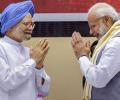
'The Modi government, like the Singh one, has run into what is called a perfect storm, where everything that can go wrong does so at the same time,' points out T C A Srinivasa-Raghavan.
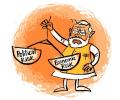
'Should the most important part of economic reform not comprise the way we look at the fiscal deficit?', asks T C A Srinivasa Raghavan.

'The government has failed to understand the seriousness of the situation, and that's why they are underestimating the problem.' 'They think some tinkering here and there will fix the economy automatically.'

'Has the time come to devise Version 2 of ad hoc T-bills?' 'In return, the government must agree to privatise all but five or six banks.' 'If something like this is not done, we will have governments going on the rampage, with increasing frequency,' says T C A Srinivasa Raghavan.

Now, the world over, policymakers are dusting off their copies of Keynes' classic, The General Theory of Employment, Interest and Money, and figuring out whether there are any answers there to our own challenges of growing our economies.
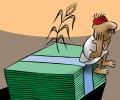
'The revival of household savings and investment is the litmus test of whether we are on the road to recovery,' says Nitin Desai.
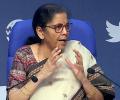
'The Modi government is about privatising profits and nationalising losses.'
.jpg)
The Keynesian advice comes after Finance Minister P Chidambaram has said he considers the fiscal deficit at 4.8 per cent of gross domestic product in 2013-14 as a 'red line'.

India's freedom, its rambling but working Constitution, its parliamentary democracy, its lumbering administrative machinery all have many a father, but its greatest claim to fame, especially today, that of being a modern state, is due to but one person: Its first and longest-serving prime minister, Nehru, says Shreekant Sambrani.

No new ideas, please, we are Indian. Seventeen years into the 21st century, we are still fixated by the ideas of the 20th century.

A V Rajwade wonders if the Modi sarkar is pursuing price stability at the cost of potential social instability in both rural and urban India.

Inclusive growth is about enabling wider participation in the growth story, but the current if fiscal debate is about how to compensate losers using annual Budgets, says Rathin Roy.

GST will make it easier for governments to spend more, says T C A Srinivasa Raghavan.
Don't waste the money on politically motivated social programmes.

The world seems to have caught severe pneumonia, or worse, as China had flu.

India must weave a quick-fix formula to ensure growth.

Global brokerage firm CLSA is positive on India's growth stroy.
Equity markets are currently difficult to gauge as the market has probably priced in a lot of things ahead of actual events.
Richard Clarida's recent paper could be key for policymakers in deciding whether India should move to an 'inflation targeting policy regime', says Vivek Dehejia.
 © 2026 Rediff.com - Investor Information - Advertise with us - Disclaimer - Privacy Policy - Sitemap - Feedback - About us - Terms of use - Grievances