The two countries that will be most affected by the internal developments in Pakistan are India and the United States, says Bob Blackwill. Aziz Haniffa reports

'Prime Minister Manmohan Singh may be anxious for a farewell visit to Washington in October,' says retired Ambassador K C Singh, 'but bending backwards on America's PRISM policy is going to earn him scorn at home and contempt abroad.'
The United States has ruled out acceding to either of the two Indian demands --withdrawal of charges against its diplomat Devyani Khobragade, and an apology for alleged mistreatment, after her arrest in New York last week.

Those killed include 41 police officers, 47 civilians, 2 soldiers, 104 coup plotters.
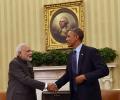
Furthering Indo-US cooperation on terrorism, Prime Minister Narendra Modi and President Barack Obama on Tuesday agreed to make "joint and concerted efforts" to dismantle safe havens for terror and criminal networks like Lashkar-e-Tayib, Jaish-e-Mohammad, Dawood-company, Al Qaeda and the Haqqani network.

Calling the US "the anchor of global security," Obama in a televised address offered moral, political and strategic arguments for being ready to launch limited military strikes while trying to negotiate a diplomatic solution.

The climate conference on Saturday came out with an ambitious final draft that will commit USD 100 billion a year from 2020 to help developing countries.
'The threat that India faces and the threat the United States faces is not just to the homeland, but to our people and to our institutions wherever they may be.' In an exclusive conversation with Aziz Haniffa/Rediff.com, US Assistant Secretary of State Nisha Desai Biswal outlines the importance of Prime Minister Modi's visit for America.

A double-quick analysis of the Lankan election results would show that the relatively narrow victory margin of challenger Maithripala Sirisena was made up by the three minority communities of Tamils, Muslims and Christians, says N Sathiya Moorthy.

'If the Americans believed that India is as strong as China or Russia, would they have shown this scant respect for us,' asks Tarun Vijay, MP. 'An economically strong and militarily powerful India would never have had this experience. Not just the Americans, everyone in this world respects might. China receives respect, India gets the law book.'

'If at all,' says Suhasini Haidar, Foreign Affairs Editor, CNN-IBN, 'Devyani Khobragade is to avoid facing a full trial, the process of that negotiation must start immediately, for which the current acrimonious atmosphere must be improved. It is no more than the US was willing to do for Raymond Davis; the Italian government for its sailors; and India for Captain Sunil James and Vijayan in Togo. Devyani Khobragade is not accused of charges anywhere as serious they were, and whether Preet Bharara's office recognises it or not, she is a diplomat who represents a proud country that has taken the insult to her as a personal insult to the country.'

Today, the biggest challenge for any state is to evolve indigenous hardware options. It is important for the states like Germany, India etc to increase their stakes in the global IT setup and this could allow them to control the US domination, says Ajey Lele.

It was clear in Brunei at the 8th East Asia Summit that China doesn't want the South China Sea issue to even dominate the discussion, reports Sheela Bhatt, who is part of the prime minister's media contingent to the summit

'The ISI has given a stunning display of its capacity to do with impunity what it likes within Kabul. Incensed over the triumphalism of the hardliners in Kabul, the ISI has hit out; it is a typical ISI reflex action that Indians are familiar with,' says Ambassador M K Bhadrakumar.

'Devyani -- she is a public servant and her personal life has already received far too much attention -- and her ambitious father now need to retreat to the background so that wiser diplomatic heads restore sanity to India-US relations as India prepares for parliamentary elections,' says Ambassador K C Singh.

'It is in the interest of both sides that the visit of the US President is seen as being successful. Both sides have invested considerable political capital in it. This rapid exchange of visits and the decisions taken have to be justified, beyond the symbolism, which is no doubt important in itself. This opportunity to impart a fresh momentum to ties should not be missed,' says former foreign secretary Kanwal Sibal.

Despite criticism of a lack of transparency and communication from the Modi-led government, BJP leaders point to "good beginnings" on several fronts to defend its performance. Sheela Bhatt/Rediff.com reports.
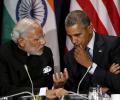
'Big countries do not agree on every set of issues.' 'Look, one of the differences in the relationship is that when we do not agree, we are sitting down and talking to each other.'
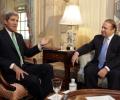
Pakistan Prime Minister Nawaz Sharif continues his exhortation for US mediation in Kashmir, and harks back to his meeting with former Prime Minister Atal Bihari Vajpayee when the latter had agreed to a resolution of Kashmir imbroglio; senior us officials assert there is 'absolutely no change in us policy' that Kashmir has to be resolved bilaterally. Aziz Haniffa reports.
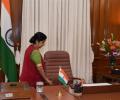
Sushma Swaraj, like Clinton, has a strong political base in her own party and is likely to have her imprint on foreign policy, says Ambassador T P Sreenivasan.

The city readies itself for the biggest economic, political and social event of the year

'We are encouraged by what the prime minister said recently on these issues... We will keep a close eye on these issues. They are very important and as are other elements of our human rights and religious freedom.' 'So, absolutely, we'll keep a focus on them.'

'To consider BRICS anything more than a temporary club with some common interests would be folly. The goal should be to induce others (Japan, ASEAN, South Africa) to align with us -- a non-threatening, democratic nation, rather than with malevolent China or waning America. For us to consider aligning with either China or the US would be absurd. India is just too big to be a sidekick,' says Rajeev Srinivasan.
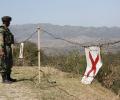
'The response to terror is not always reciprocal terror, nor is launching a conventional response the best response.' 'The best response is to make the sponsor pay a price he cannot afford,' says former RA&W chief Vikram Sood.

'Evacuating' Devyani's maid's family from India on T visas -- associated with severe sex or labour trafficking... The maximum number of persons thus evacuated by the US from foreign countries last year was from India... A thorough investigation of this is required at India's end,' says former foreign secretary Kanwal Sibal, 'with the US warned that such interference in India's judicial system will not be tolerated.'
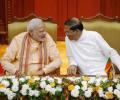
'What we have heard from the Sri Lankans is their desire to have a foreign policy that allows Sri Lanka to best advance its own interests rather than a foreign policy that relied solely on one relationship.' 'We think this is an attitude that makes a lot of sense. India and Sri Lanka have many areas of shared interests, and it's certainly welcomed by us to see that deepening of those ties.'
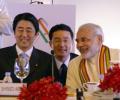
'Both nations have a common problem: A rampaging, jingoistic and hostile China which is making substantial territorial claims. In the long run, Japan and India are going to be the victims of Chinese aggression -- so they might as well hang together to contain China,' argues Rajeev Srinivasan.

Narendra Modi speaks to CNN's Fareed Zakaria in his first interview after becoming prime minister. The excerpts

'Clearly, from the Indian viewpoint, the US retrenchment from Asia cannot be happening as good news.' 'The abandonment of the US' pivot to Asia exposes the US-Indian partnership to be a mere transactional relationship,' says Ambassador M K Bhadrakumar

Developed and developing countries are very different and they are different from variety of reasons on climate change.

The India that needs strategic alliances, defence cooperation and engaging meaningfully with neighbouring countries is quietly moving ahead with confidence, says Tarun Vijay

'When it comes to India-Pakistan relations, seminal moments of progress invariably bring out saboteurs of peace -- whether we're talking about fresh provocations along the LoC, or even a terror attack in India.'

'The Modi-Xi and Modi-Obama meetings, with an interval of just 12 days, are juxtaposed superbly at a crucial point in the prime minister's life. Can Modi carve out a win-win situation with the superpower and the emerging superpower at the same time?'

'The US wants Modi to succeed because we want India to succeed. For our part, when India thinks of its partners in the world, we want it to think of the US first. That means positioning our country as the preferred provider of the key inputs that can help to propel India's rise.' 'The meeting between Modi and Obama is, and must be, an opportunity for true strategic dialogue -- not a scripted exchange of talking points, but an open discussion of the big questions. What kind of world do we want to live in? What are our true priorities? And most importantly, why does this partnership still matter?'
With Beijing having had a profound rethink on India's admission as a full member of the Shanghai Cooperation Organisation, the tectonic plates of the geopolitics of a massive swathe of the planet stretching from the Asia-Pacific to West Asia are dramatically shifting. That grating noise in the Central Asian steppes will be heard far and wide -- as far as North America, says Ambassador M K Bhadrakumar.
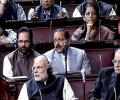
It is not in the Lok Sabha, where the BJP has a clear majority, but the Rajya Sabha that the Opposition has ganged up to checkmate Prime Minister Narendra Modi's ambitious plans.
 © 2026 Rediff.com - Advertise with us - Disclaimer - Privacy Policy - Sitemap - Feedback - About us - Terms of use - Grievances