
According to the proceedings of the case, the complainant has alleged that the "Indian Railways serves only halal-processed meat in non-vegetarian meals, which creates unfair discrimination and causes human-rights violations".
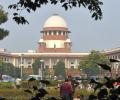
The Supreme Court of India has sought the Indian government's response to a petition filed by a Muslim woman seeking to be governed by the Indian succession law instead of Shariat. The woman, Safiya P.M., argues that she does not believe in Shariat and wants to be governed by secular law, including the Indian Succession Act of 1925. The court has asked the government to file a counter affidavit within four weeks.

The SC issued a notice informing listing of petition filed by Indian Young Lawyers Association seeking review of its 2018 judgment. The bench will also look at other contentious issues of alleged discrimination against Muslim and Parsi women.

The Supreme Court on Wednesday will hear a plea against restricting women's entry in Kerala's Sabarimala temple.

The judges on the bench are CJI S A Bobde, Justices R Banumathi, Ashok Bhushan, L Nageswara Rao, M M Shantanagoudar, S A Nazeer, R Subhash Reddy, B R Gavai and Surya Kant.

The five-judge Constitution bench said that it is the devotion which makes a woman to visit a temple.

"The right to enter a temple is not dependent on a legislation. It is the constitutional right," the bench said.

The apex court had on Tuesday agreed to hear on January 22 in open court the pleas seeking review of its verdict but refused to stay its judgment.
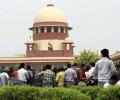
On the last date of hearing, the Maharashtra police had produced additional letters to establish Moist links of the arrested accused even as the petitioners described it as cooked-up evidence.

The temple board, in earlier round of litigation, had opposed the public interest litigation by Indian Young Lawyers Association seeking to throw open the shrine for all women.

Denying women the right to enter and pray in the historic Sabarimala temple in Kerala cannot be justified on the basis of traditions which violated constitutional principle, says the SC.

A three-judge bench headed by Chief Justice Dipak Misra framed several questions to be dealt with by the Constitution Bench, including whether the temple can restrict women's entry.
The Supreme Court asked the Sabarimala temple management, "How mensturation is linked to purety?"
The Board, which also comprise the state government nominees, told a five-judge Constitution Bench headed by Chief Justice Ranjan Gogoi that it is high time that a particular class not be discriminated on the ground of 'biological attributes'.

Asserting that it would decide on the right of women to enter the historic Sabarimala shrine on the basis of constitutional principles.
The state govt said that celibate status of deity cannot be a ground for barring entry of women.

This was also part of the right to privacy of the deity, the lawyer said.
A five judge Constitution bench headed by Chief Justice Dipak Misra was apparently not in agreement with the argument of the Travancore Devaswom Board running the over 800-year-old Lord Ayyappa temple that the "practice and belief" that have continued uninterrupted cannot be tested on the ground of "modern ethos".

Kerala Union of Working Journalists decided to boycott the press meets called by the BJP after saffron party workers attacked mediapersons.
The Supreme Court asked on Friday as it said it would examine the issue of entry ban on women of menstrual age in the historic Sabarimala temple on the basis of constitutional parameters.

'The Supreme Court should not have come out with this kind of order and in my opinion, the court should correct it.'

Justice Ranjan Gogoi, who will demit office as the Chief Justice of India in a week's time, has etched his name in the annals of history by giving finality to one of the most politically and religiously sensitive cases, the Ayodhya land dispute, which dates back to even before the Supreme Court came into existence in 1950.
 © 2026 Rediff.com - Investor Information - Advertise with us - Disclaimer - Privacy Policy - Sitemap - Feedback - About us - Terms of use - Grievances