
In the manufacturing sector, output is expected to decline by about 70 per cent as only food-processing, and drugs and pharma industries are allowed to operate while other segments, such as engineering and metals, have shut operations.

The volume in the anonymous trading platform, NDS-OM, was Rs 7,210 crore - less than half the normal volume, but not as bad as the start of the day indicated.

Recent data from market analytics firm Nielsen shows that the rural market in the country's 630,000-odd villages is pulling down the overall FMCG business.

The retrenchments at the company promoted by Mumbai BJP chief Mangal Prabhat Lodha come at a time when the economic growth has dipped to a six-year low of 5 per cent, which has led many to fear if the spectre of job losses across sectors awaits next.
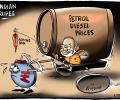
Oil sank to the lowest level in a month after shedding all of its gains from the US-Iran clash as traders waited to see whether any further hostilities will disrupt exports from the East Asia.

Fitch Ratings director Thomas Rookmaaker said India's debt-to-GDP ratio is likely to rise to 76 per cent from 70 per cent currently due to wider fiscal deficit and low economic growth.

Stretched valuations and slowdown in DII flows are some of the reasons why Goldman Sachs cut its India rating to 'market-weight'

'It will be only in fiscal year 2023 when the size of the Indian economy will be bigger than what it was in 2020, you will see demand and employment rising.'

In fact, India's investment activity growth is also estimated to touch a 17-year low in FY20. With overall demand not showing signs of revival, investment activity may take longer to recover, economists said.

High loan-to-value and high-yield buckets have reported higher delinquencies

Scams happen with high regularity because the price of getting caught is insignificant. Aggrieved investors run from the police to already clogged courts to find redress for issues for which financial regulators have been specifically set up. For over 3,750 years we have known what to do, but we don't do it, observes Debashis Basu.

If imputed inflation for April and May is used, then you have inflation of over 6 per cent for two consecutive quarters, which is a worrying signal for the RBI.

'We expect a pick-up in the second half of the current fiscal. But before that, data is likely to show a further slowdown. The second quarter print is likely to be worse than the first quarter,' said a senior official.

Out of the total potential loss, the share of state-run banks will be Rs 24,800 crore in FY18, while that of the private sector banks will be Rs 5,700 crore

While the government has infused huge capital into PSBs, the same has largely been used to mitigate losses and has failed to contribute meaningfully to credit growth.

As per the 2011 census, 31 per cent population in the country lives in urban areas.

The world's biggest lockdown that shut a majority of the factories and businesses, suspended flights, stopped trains and restricted movement of vehicles and people, may have cost the Indian economy Rs 7-8 lakh crore during the 21-day period, analysts and industry bodies said.

This move was triggered by a whistleblower complaint sent to Sebi against senior management interference in ensuring good ratings specifically in IL&FS and its subsidiaries.

Stating that an economic recession gripped global economy following the lockdowns due to COVID-19 pandemic, Fitch Ratings on Friday said the initial disruptions to regional manufacturing supply chains in China have now broadened to include local discretionary spending and exports.
According to data compiled by the World Bank, the UK's economy grew to $2.82 trillion and the French economy expanded to $2.78 trillion in 2018, against India's $2.73 trillion, showed the data.
Without disclosing reasons, ICRA informed the stock exchanges on Thursday, 'The board, after due consideration and taking into account the best interests of the company and its various stakeholders, has decided to terminate the employment of Takkar with immediate effect.'

Such cold-shoulder by banks also indicates a credit freeze that is hard to overcome, unless the government comes out with credit guarantee schemes for loans given by banks. Since that is not happening, and there is no indication of that too, banks are not willing to listen to RBI prodding.

'It may sound like sacrilege, but does it really matter if the global raters downgrade India for fiscal slippage?' asks Tamal Bandyopadhyay.

'If the government spends Rs 10 lakh crore this year then you would be looking at a GDP growth of minus 5 per cent.' 'If you do not do this, you will be looking at GDP growth between minus nine and minus 10 per cent.'

Despite the 3 per cent gain in September 2019, the FPI sell-off during the quarter has seen the benchmark indices - the S&P BSE Sensex and the Nifty 50 register negative returns in Q3CY19.

'Our government's claim that there are no undetected cases of infection that happened within our bustling cities because of exposure to infected international travellers are not credible,' notes Rahul Jacob.

It was 55.3 per cent for the same period last year, and data shows the fiscal deficit for April-May was kept in reasonable check in spite of heavy frontloading of expenditure.
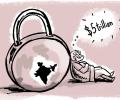
'There is a fiscal crisis building up, which might become apparent when the Finance Commission presents its report,' warns T N Ninan.

For the week, the Sensex climbed 28.24 points, or 0.08 per cent, while the Nifty shed 38.15 points, or 0.36 per cent.

While the COVID-19 pandemic has completely halted production and new orders, exporters say that payments have also been delayed for the shipments sent before the lockdown. Exporters say some customers are not taking delivery of the shipments because they have shut shop. Ready-made garment players had been hoping for a revival in demand in China but with the virus spreading to Europe, the US and other major markets, there are no orders coming from the major retailers.
While the UN report said that FDI inflows rose 6 per cent in 2018 to $ 42 billion, the government's own data for the entire FY19 period has shown that inbound equity investments declined for the first time in six years in FY19.

It had upped India's rating to Baa2 from Baa3 and changed its rating outlook to 'stable' from 'positive', saying the reforms would help stabilise rising levels of debt.

It came on the back of tepid dispatches in the March quarter as consumer sentiment took a knocking, owing to uncertainty ahead of the general election.

India Ratings on Friday downgraded the outlook of domestic construction sector to 'Negative' due to challenges faced in the execution of projects on account of delays in environment clearances and other issues.

The rating agency also expects merchandise exports to grow by 8-10 per cent in the next fiscal year.
Retaining India's sovereign rating at the lowest investment grade, global agency S&P on Tuesday warned that a downgrade is likely for the country if its political climate worsens and pace of fiscal reforms slows down.

The amount of loans that carry a high risk of slippage into the NPA category over the next few quarters is about Rs 2.8 trillion.
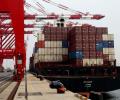
The WTO's quarterly outlook indicator, comprising seven trade parameters, stood at 96.3, the lowest since March 2010 and down from 98.6 in November. Exports from India would be hit if there is a slowdown in world trade.

$10 billion TAPI pipeline unlikely before 2020

'One must remember that a dragon has a forked tongue,' warns Vivek Gumaste.
