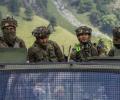
India and China on Saturday held another round of military talks with a focus on taking forward the disengagement process in Hot Springs, Gogra and Depsang in eastern Ladakh and bring down the tensions in the region, official sources said.
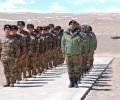
The two countries have been engaged in a military standoff for almost a year but disengaged from the most contentious Pangong lake area last month after extensive talks at both military and political levels.

Spokesperson in the MEA Anurag Srivastava said both sides have agreed to work for an early resolution to the issue in keeping with broader guidance provided by leaders of the two countries for ensuring peace and tranquillity along the border areas. He, however, did not respond to questions relating to reports of pulling back of troops by both India and China from certain friction points in the Galwan Valley and Hot Spring areas in eastern Ladakh in the last few days.

Chief of Army Staff Gen Manoj Pande has carried out a comprehensive review of India's military preparedness along the Line of Actual Control (LAC) in Arunachal Pradesh in his first visit to the border state after last month's clash between Indian and Chinese forces in the Tawang sector.
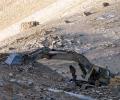
The 11th round of the Corps Commander-level talks began at around 10.30 am at the Chushul border point on the Indian side of the Line of Actual Control (LAC) in eastern Ladakh, they said.

The talks are being held with an aim of resolving the ongoing standoff in eastern Ladakh and reaching an agreement on the last remaining friction point in the Hot Springs area which had emerged post April-May 2020 aggression shown by Chinese troops along the Line of Actual Control (LAC) in Ladakh.
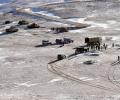
The MEA said the two sides agreed to continue discussions through diplomatic and military channels to resolve the remaining issues "at the earliest" so as to create conditions for the restoration of normalcy in the bilateral relations.
The international community must be clear that such a behaviour is unacceptable, a top US senator said.
Indian Army Chief General M M Naravane had said on Wednesday that India was hopeful of resolving issues related to disengagement at Patrolling Point 15 (Hot Springs) in eastern Ladakh in the 14th round of talks.
'We hope this round of meeting, on the basis of previous meetings, can move forward, further enlarge consensus, narrow differences and work for a solution that is acceptable to both parties,' the spokesperson said in updated comments posted on the ministry's website.

At a media briefing in Beijing, Chinese Foreign Ministry spokesman Wang Wenbin said the two sides have maintained smooth communication on border-related issues through diplomatic and military channels.
Two days after the India-China military talks, the joint statement, issued in New Delhi by the Indian Army said both sides had a 'candid and in-depth exchange' relating to disengagement along the Line of Actual Control (LAC) in the Western Sector of India-China border areas.

Assistance from PLA has been sought to locate the individual on their side and return him as per established protocol, sources noted.

The move comes amid reports in a section of media that claimed that Chinese soldiers had displayed their flag in the region a few days ago.

It seems that the People's Liberation Army (PLA) is not in a mood to de-escalate the situation on the Line of Actual Control (LAC) as it has continued deployment of around 40,000 troops in its front and depth areas for the Eastern Ladakh sector.

The structure and the level at which the hotline would be set up is likely to come up for discussion in future meetings between the two countries at the military level, they said.
Since the June 15 clash, the PLA has inducted large numbers of troops, armoured vehicles and artillery along the LAC, from Depsang and Galwan in northern Ladakh to Hot Springs, Pangong Tso, and Chushul in central Ladakh, to Demchok and Chumar in southern Ladakh.

It has been argued that India should have held back on disengagement from the Kailash Range, using that as a trump card to force Chinese concessions in areas such as Depsang, where they hold the advantage.
There was no official word on the outcome of the talks.
Citing media reports that China has built shelters in the Depsang area in Ladakh, the Congress on Saturday questioned the government's 'silence' over the issue and asked what steps were being taken by it to ensure status quo ante of April 2020.

India recently outflanked China by taking control of strategic height near Pangong lake's southern bank.
The sources said the mutual disengagement of troops at the two friction points is likely to be completed within two days, and that there has been 'substantial' withdrawal of forces by Chinese military from the areas.
'We hope the Indian side will work with China to follow through the important consensus of our two state leaders, abide by relevant agreements and treaties to de-escalate the tension at the border'
Indian and Chinese militaries on Monday moved back their frontline troops to the rear locations from the face-off site of Patrolling Point 15 in the Gogra-Hotsprings area in eastern Ladakh and dismantled temporary infrastructure there as part of a five-day disengagement process.

These eight images prove it's an odd, odd world!
The actions on the ground would be confirmed and are expected to be followed up soon.
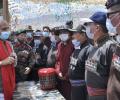
The dedication of Indian soldiers and veterans towards the country is an 'exemplary example', Defence Minister Rajnath Singh said on Sunday soon after arriving in Ladakh on a three-day visit aimed at taking stock of India's military preparedness in the region in the face of a prolonged border row with China.


Both sides have completed creation of a buffer zone of three kilometres in the three friction points of Galwan Valley, Gogra and Hot Springs as part of a temporary measure aimed at reducing the possibility of any confrontation.
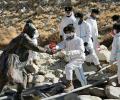
India and Chinese troops on Saturday exchanged sweets and greetings at 10 border posts along the Line of Actual Control (LAC) including in eastern Ladakh to mark the New Year, officials said.
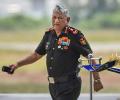
The talks between the two sides have been going on for the last three months including five Lieutenant General-level talks but have failed to yield any results, so far.

China plans to build a new highway along the Line of Actual Control (LAC) with India as part of Beijing's efforts to strengthen its strategic position and project its power, a media report said on Wednesday.
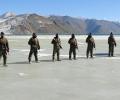
A day after the nearly 12-and-half-hour talks, the two sides, in a joint statement on Monday, reaffirmed that the resolution of the pending issues would help in the restoration of peace and tranquility along the Line of Actual Control (LAC) in the region and enable progress in bilateral relations.

'Why wouldn't so strategically-minded an adversary, such as China, not militarily exploit to the maximum Indian timidity, stupidity, and cupidity all along the LAC and legitimate, as it has done so often in the past, the fait accompli of incremental territorial grabs which, by the way, is its strategy and policy as implemented on the ground?'
Gen Wang is the fourth commander to head the Western Theatre Command after the eastern Ladakh standoff began in May last year.
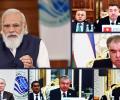
The Shanghai Cooperation Organisation (SCO) will hold its first in-person summit in Samarkand in Uzbekistan on Thursday after two years, shaking off Covid fears and providing a rare opportunity for all its eight heads of state to meet on the sidelines of the event to have face-to-face talks on pressing global and regional issues of common concern.

After a gap of over three months, India and China on Wednesday are holding another round of high-level military talks to resolve the 20-month-long military standoff in the remaining friction points in eastern Ladakh, sources in the security establishment said.
"Against such background, the words and deeds of relevant important military and government officials and military deployments should be conducive to deescalating and cooling down the situation, and to enhancing mutual trust, rather than the opposite", the spokesman said.

India and China are likely to hold another round of diplomatic talks this week on eastern Ladakh with a focus on moving forward in disengagement of troops in the remaining friction points, people familiar with the development said on Tuesday.
'The Indian government wakes up after the fact when it can do nothing, or rather lacks the will to prosecute military actions to reverse these adverse PLA-driven developments.'
 © 2026 Rediff.com - Investor Information - Advertise with us - Disclaimer - Privacy Policy - Sitemap - Feedback - About us - Terms of use - Grievances