
Pakistan's hawkish Army chief Gen Ashfaq Parvez Kayani, who did little to change the force's India-centric stance, will leave the world's sixth-largest army grappling with a host of security challenges when he steps down on Friday.

Friday's incident at Herat has dampened somewhat the spirit behind the invitation. It reminds Modi much before he officially becomes prime minister, of the challenge that awaits his government, says Sheela Bhatt/Rediff.com

Immediately after India launched its surgical strikes, sources said, it had informed the US of its action.

What India has failed to acknowledge is that sub-conventional war is the name of the game and irregular forces have emerged with greater strategic value over conventional and even nuclear forces, and reliance purely on conventional force and diplomacy is grossly inadequate, says Lt Gen Prakash Katoch (retired).

'This is the first time the US has formally recognised the threat India faces from terrorist organisations based in Pakistan.'
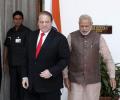
India'Prime Minister Narendra Modi has been congratulated for his speedy diplomacy and his talks with Pakistani counterpart Nawaz Sharif. However, academic Christine Fair and former Pakistan ambassador to US Husain Haqqani dismiss the meeting, calling it merely a photo-op and an exercise in futility. Aziz Haniffa reports.
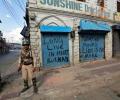
Separatists and their wide network must be neutralized for peace in the Valley
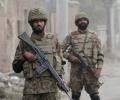
India must watch for signs after Peshawar that Pakistan is waking up to the dangers of Islamism, muses Ajai Shukla
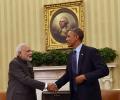
Furthering Indo-US cooperation on terrorism, Prime Minister Narendra Modi and President Barack Obama on Tuesday agreed to make "joint and concerted efforts" to dismantle safe havens for terror and criminal networks like Lashkar-e-Tayib, Jaish-e-Mohammad, Dawood-company, Al Qaeda and the Haqqani network.

'The creation of Pakistan was integral to Britain's grand strategy.' 'If they were to ever leave India, Britain's military planners had made it clear that they needed to retain a foothold in the NWFP and Baluchistan because that would provide the means to retain control of Iran, Iraq, Kuwait, the UAE, Bahrain and Qatar.'

'We're going to see a defence relationship that really takes off -- now that India is a major defence partner of the US, the sky is the limit for arms sales.' 'The economic partnership will lag behind the security relationship, but the meeting and joint statement give cause to believe that it will progress more robustly than many of us would have expected.'

'We are completely engaged in fighting poverty; alas, our neighbour Pakistan seems only engaged in fighting us.'

'What is the ISI doing and why can't they understand for their own interest that bringing stability to the region will help all the countries become prosperous, whereas a continuation of incitement will only lead to misery for all.'

'Omar Khorsani has called repeatedly for the most barbaric of attacks. He is very adept on social media. He is, in other words, eerily similar to the ISIS leader Baghdadi.' 'The crux of the army's 'strategic asset' policy -- its policy of regarding militants as those that can help Pakistan pursue its regional interests -- is that Pakistan needs help in weakening India or in keeping its presence minimal in the region.' Michael Kugelman reveals what the world can expect next from the Tehreek-e-Taliban Pakistan, the terrorists responsible for the Peshawar school massacre.

'The Senators were playing safe, not angering either the pro-India lobby or the pro-Pakistan lobby, but perhaps more importantly, the military-industrial complex -- the most powerful lobby of all -- which the majority of Senators are beholden to in terms of largesse to their campaign coffers.'

Countries in the region like Afghanistan, Pakistan and Maldives face serious existential threats from a mix of terrorist groups active in the region and elsewhere

'Diplomatic engagement will continue even as India keeps all its options open with respect to discretely targeting the Pakistani military and its terrorist proxies.'

'It is in the interest of both sides that the visit of the US President is seen as being successful. Both sides have invested considerable political capital in it. This rapid exchange of visits and the decisions taken have to be justified, beyond the symbolism, which is no doubt important in itself. This opportunity to impart a fresh momentum to ties should not be missed,' says former foreign secretary Kanwal Sibal.

This is the joint statement issued by the ministry of external affairs on the visit of US President Barack Obama to India.
 © 2026 Rediff.com - Advertise with us - Disclaimer - Privacy Policy - Sitemap - Feedback - About us - Terms of use - Grievances