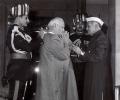
Vice President V V Giri's resignation in 1969 triggered political upheavals that saw the ruling party defy its own presidential nominee, the expulsion of a sitting prime minister by her party president, and a historic split in the Indian National Congress, recounts Utkarsh Mishra.
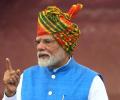
The record lies with first prime minister Jawaharlal Nehru who did the honours 17 times from 1947 to 1964.

Till now, the maximum Bharat Ratnas were awarded in 1999 when four recipients were given the coveted award.

The story of India's prime ministers from 1947, told in photographs.
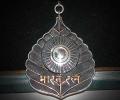
Educationist Madan Mohan Malviya and former Prime Minister Atal Bihari Vajpayee are the 44th and 45th distinguished personalities who have been conferred with the country's highest civilian award Bharat Ratna.

It is for the first time in the history of Independent India that not a single Muslim is part of the Union Cabinet.

Dr Mitra called the Pandara Road crowd a 'cheerful collective of young dreamers,' united in its 'love and pride for the newly Independent India,' despite 'sharp disparities in background, temperament and attitude.' Dr Shreekant Sambrani recalls his encounters with the legendary economist who passed into the ages.
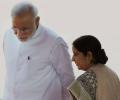
A Union minister and a chief minister stand accused of corrupting their office. If Prime Minister Narendra Modi lets them continue, he will have broken his election promise substantively, says Aakar Patel.
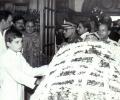
I Ramamohan Rao, former principal information officer of the Government of India, reminisces the day Prime Minister Indira Gandhi was shot dead by her bodyguards.

The 64-year-old Planning Commission, a vestige of the socialist era, will soon become history.

Ambassador Venu Rajamony, who served as press secretary to President Pranab Mukherjee during his tenure, salutes the statesman and political legend, who passed into the ages on Monday.
'Even though he knew full well that the manipulation went against the facts as he knew them, Pillai nonchalantly contented himself with stating that since the file came from the minister himself, he just passed it on as it was,' says B S Raghavan.

Glimpses of the final days of the 1965 War, as seen from the diary then defence minister Y B Chavan maintained during the war.

'In her insecurity, she destroyed the institutions of democracy.' 'She packed Parliament with her supporters with loyalty being more important than ability; she superseded judges; she corrupted the civil service.' 'She knew how to use people against each other and was quite a master of that.' 'She would do this with calculated skill and in the bargain cause enmity between brothers, split up families.'

'In her insecurity, she destroyed the institutions of democracy,' says Khushwant Singh.
