
The increase in stubble burning has kicked off a political slugfest, with Union Environment Minister Bhupender Yadav on Wednesday saying that there had been a 19 per cent rise in farm fires over 2021 in Punjab and that the Aam Aadmi Party had turned the national capital into a gas chamber.

He alleged that the BJP made people burst firecrackers on Diwali.
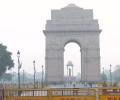
According to forecasting agencies, the city is set to record its best air quality for the day after Diwali since 2015 on Tuesday.

The overall Air Quality Index (AQI) of Delhi stood at 398 at 11 am, worsening from 357 at 4 pm on Friday. It was 354 on Thursday, 271 on Wednesday, 302 on Tuesday and 312 on Monday (Diwali).

Skies over Delhi hung heavy with smoke and its air quality inched towards "severe" category on Diwali night as people burst firecrackers in a blatant disregard to the government's ban against it, imposed amid an increase in the contribution from farm fires.

People living in the national capital and in states such as Maharashtra, Uttar Pradesh, Madhya Pradesh and Tamil Nadu are more likely to contract COVID-19 due to prolonged exposure to high concentration of PM 2.5, according to a new pan-India study.

The dramatic reversal in the situation caught people and weather scientists unaware.
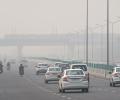
The neighbouring cities of Faridabad (469), Greater Noida (464), Ghaziabad (470), Gurgaon (472) also recorded 'severe' air pollution levels.

According to the Graded Response Action Plan (GRAP), the air quality is considered to be in the emergency category if the PM2.5 and PM10 levels continue to be above 300 micrograms per cubic metre and 500 micrograms per cubic metre respectively for 48 hours or more.

'When you are travelling in Mumbai when the air quality is bad, you feel suffocated.' 'You may feel uncomfortable breathing Delhi air, but the level of discomfort is higher in Mumbai.'

On Sunday, too, a drizzle resulted in an increase in humidity, triggering a massive pollution spike.

The news may come as a relief to the Delhi government, whose odd-even traffic rule is set to be rolled out from January 1.

With increasing temperature, the toxic ozone levels, which cause a number of health problems especially for asthmatics, have breached the permissible limits in the city, the MET department said on Thursday.

Welcoming the reduction in pollution, environmentalists urged the government to treat it as a "wake-up call" and stop its "obsession" with "development" at the cost of the environment.
Delhi recorded 8.6 on the UV index on Tuesday while it was 8.2 at noon on Wednesday.
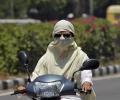
Data show that the ultra-violet radiation index is dangerously high in Delhi, other Indian cities.

Air quality in the national capital deteriorated alarmingly a day after Diwali as pollution levels spiked more than five times higher than normal leaving many at the risk of respiratory problems.

Delhi woke up to the season's worst air quality as smoke from Diwali fireworks, coupled with moisture and nearly stagnant wind movement, shrouded the city in a thick cover of smog with respirable pollutants reaching perilous levels.

Authorities alerted people to avoid staying outdoors and L-G ordered to halt all civil construction activities across the city till Sunday.

'They don't always agree with our governments, their teachers or their parents, but it is the conviction of their ideas, and their determination to share them with the world that, I believe, is one of the greatest sources of hope for our planet.' 'The colonisation of space, understanding the very building blocks of matter and the universe, utilising our understanding of the human genome to conquer disease -- these are the tasks waiting for a fellowship of minds to realise new triumphs in our collective destiny.'
 © 2026 Rediff.com - Advertise with us - Disclaimer - Privacy Policy - Sitemap - Feedback - About us - Terms of use - Grievances