
The Supreme Court declined to hear a plea from the producer of Vijay's 'Jana Nayagan' regarding censor board clearance, directing them to the Madras High Court. The case involves delays in certification and political undertones in the film.

The Supreme Court has clarified that a decree passed only against a real estate developer cannot be enforced against its directors or promoters in their personal capacity unless the original adjudication clearly finds them liable.

The Supreme Court has taken suo motu cognisance of the controversy surrounding the definition of Aravalli hills and is scheduled to hear the matter. The court had previously accepted a uniform definition and banned fresh mining leases in the area.
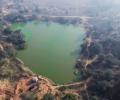
The Supreme Court has kept in abeyance its previous verdict on the definition of the Aravalli hills and ranges and proposed a high-powered committee to examine the issue.
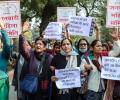
The Supreme Court on Monday stayed the Delhi high court's order suspending the life sentence of expelled Bharatiya Janata Party leader Kuldeep Singh Sengar in the 2017 Unnao rape case.

The Supreme Court refused to interfere with an order dismissing Jacqueline Fernandez's plea to quash an ECIR in a Rs 200 crore money laundering case involving Sukesh Chandrasekhar.

The Supreme Court refused to stay a provision barring the declaration of tribal lands as waqf properties, upholding key provisions of the Amended Waqf Act.

The Supreme Court of India has stayed several key provisions of the Waqf (Amendment) Act, 2025, citing potential violations of the Constitution. The court emphasized that laws should only be stayed in rare cases where provisions are manifestly unconstitutional or violate fundamental rights.

The Supreme Court has upheld the deletion of the 'waqf by user' provision in the amended waqf law, stating it is not arbitrary and addresses potential misuse.

The Supreme Court has put on hold several key provisions of the Waqf (Amendment) Act, 2025, including the clause that only those practicing Islam for the last five years can dedicate a property as Waqf. The court also addressed the powers of collectors and non-Muslim participation in Waqf Boards.

'You are Leader of Opposition. Say things in Parliament, why do you have say it on social media?'
The Supreme Court on Monday agreed to hear a plea of Ashoka University's political science department head Ali Khan Mahmudabad challenging his arrest for social media posts related to Operation Sindoor.
A bench comprising Chief Justice B R Gavai and Justices Augustine George Masih and AS Chandurkar also directed that the offending video be immediately taken down and restrained the YouTube channel from republishing it or similar content.
ISKCON Bangalore had moved the top court on June 2, 2011 challenging the high court's verdict of May 23, 2011.

The Supreme Court dismissed Allahabad High Court judge Yashwant Varma's plea seeking invalidation of a report that found him guilty of misconduct in the cash discovery row.

The Supreme Court of India dismissed a plea seeking the inclusion of Vinayak Damodar Savarkar's name in the Emblems and Names (Prevention of Improper Use) Act, 1950. The petitioner, appearing in person, argued for the inclusion based on his 30 years of research and claimed a need to establish facts about Savarkar in a legally verifiable manner. However, the court found no violation of fundamental rights and suggested the petitioner make a representation to the Union of India for curriculum inclusion. This dismissal follows the court's earlier reprimand of Congress leader Rahul Gandhi for his remarks on Savarkar at a rally in Maharashtra, although criminal proceedings against Gandhi were stayed.
The Supreme Court of India granted bail to an accused in a cheating case being investigated by the Central Bureau of Investigation (CBI), criticizing the Allahabad High Court for adjourning the bail hearing 27 times. The Supreme Court deemed the repeated adjournments in a matter related to personal liberty unacceptable and issued a notice to the CBI.
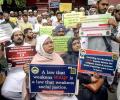
A bench comprising Chief Justice B R Gavai and Justice Augustine George Masih asked senior advocate Kapil Sibal, appearing for those challenging the validity of the law, and Solicitor General Tushar Mehta, representing the Centre, to file their written notes by Monday.

"It is a policy matter. You ask Parliament to enact the law," a bench of Justices B R Gavai and Augustine George Masih told the counsel appearing for the petitioner.

Issuing notice to the ED on the plea filed by the Tamil Nadu government and Tamil Nadu State Marketing Corporation (TASMAC), a bench comprising Chief Justice B R Gavai and Justice Augustine George Masih told Additional Solicitor General S V Raju, appearing for the anti-money laundering probe agency, that "Your ED is crossing all the limits."
The Supreme Court of India has sought responses from the Centre and others on a petition challenging the constitutional validity of certain provisions of the Waqf Act, 1995. The petition argues that the Act gives undue favor to waqf properties and deprives non-Muslims of their property rights. The court has tagged the petition with pending petitions that raise similar issues.

The matter would be heard by Chief Justice B R Gavai and Justice Augustine George Masih.
A bench of Justices Prashant Kumar Mishra and Augustine George Masih, which initially questioned the over two-month window sought by the NBE for holding the examination, said the board's plea appeared to be "bonafide".

As soon as one of the pleas came up for hearing on Friday, Solicitor General Tushar Mehta, appearing for the Centre, objected and said there can't be an "endless" filing of pleas challenging the Act.

The Supreme Court of India has advised a petitioner, who claims to have suffered disability due to the side effects of the first dose of a Covid-19 vaccine, to file a suit for damages instead of pursuing his plea before the court. The court suggested that filing a suit could provide quicker relief than waiting for a potentially lengthy decision on the petition.

Dubey launched a broadside against the Supreme Court on Saturday, saying Parliament and state assemblies should be shut if the apex court has to make laws.
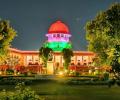
Article 363 bars the interference of courts in any disputes which may arise from certain treaties, agreements, covenants, sanad, engagements, etc., executed between a princely state and the government of India.
The plea claimed the blocking was effected by the intermediary pursuant to an undisclosed direction allegedly issued by the Centre citing vague grounds of "national security" and "public order".

A bench of Justices Surya Kant and N Kotiswar Singh deferred the hearing on Shah's plea after his counsel and senior advocate Maninder Singh made a request.

The Supreme Court on Tuesday agreed to hear next week a plea which flagged Bharatiya Janata Party MP Nishikant Dubey's recent criticism of the apex court and Chief Justice of India Sanjiv Khanna, and sought removal of derogatory videos from social media platforms.

The Centre on Wednesday told the Supreme Court that nobody can claim right over government land and it is legally empowered to reclaim properties which are declared waqf by using the waqf by user principle.
The Supreme Court of India has reserved its interim orders on three key issues related to the Waqf (Amendment) Act, 2025, including the power to denotify waqf properties, the composition of waqf boards, and the provision regarding government land. The court heard arguments from both the petitioners, who challenged the validity of the amended law, and the Centre, which defended the Act as a secular concept. The petitioners sought interim orders to prevent the implementation of certain provisions while the court considers the legal challenges.

Every word uttered by a minister has to be with a sense of responsibility at a time the country is undergoing "such a situation", the Supreme Court said on Thursday as it reprimanded Madhya Pradesh's Vijay Shah who is facing an FIR for his remarks targeting Col Sofiya Qureshi.

The verdict will have far-reaching implications for judicial service aspirants.
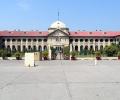
The Supreme Court on Tuesday took exception to the Allahabad high court's recent remarks in a rape case as reportedly saying the complainant "herself invited trouble", and wondered why it made such observations while deciding a bail plea.
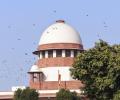
The Indian government defended the Waqf (Amendment) Act, 2025 in the Supreme Court, arguing that waqf, while an Islamic concept, is not an essential part of Islam. Solicitor General Tushar Mehta stated that waqf is essentially charity, which is recognized across religions, and cannot be considered a fundamental tenet of any faith. He also argued that the amended law addresses secular aspects of waqf and activities unrelated to Islam, and that "waqf by user" does not grant ownership of public land. Mehta highlighted the extensive consultations involved in the bill's creation, including feedback from various stakeholders. The hearing will continue on Thursday.
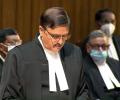
Justice Abhay S Oka, known for his unwavering commitment to liberty and constitutional values, bid farewell to the Supreme Court of India. In his final address, he stressed his dedication to upholding constitutional liberties, emphasizing that it was his "honest endeavor" to fulfill the dream of the Constitution's framers. He also expressed gratitude to the bar and his colleagues for their support and shared heartfelt memories from his time on the bench. Justice Oka's departure marks the end of a distinguished judicial career spanning over two decades, during which he served as a judge of the Bombay High Court, Chief Justice of the Karnataka High Court, and ultimately, as a Supreme Court justice.
The Supreme Court on Monday directed uniform pension benefits for all retired high court judges, irrespective of their mode of appointment or tenure, saying "one rank one pension has to be the norm in respect of a constitutional office".
The Supreme Court of India has decided to issue a showcause notice to senior advocate Rishi Malhotra, asking why the designation conferred upon him by the apex court should not be revoked. The decision comes in the wake of allegations of misconduct against Malhotra, including suppressing material facts in multiple cases and making misleading statements despite warnings from the court. The full court, convened by Chief Justice Sanjiv Khanna, has decided to give Malhotra one more opportunity to explain his conduct before stripping him of the senior designation. The court has expressed concerns about the effectiveness of the senior designation system and whether it ensures that only deserving advocates are being designated.

The Supreme Court of India has directed the governments of Punjab and Haryana to cooperate with the Centre in finding an amicable solution to the long-standing dispute over the Sutlej-Yamuna Link (SYL) canal. The court deemed the de-notification of land acquired for the canal in Punjab an "act of high-handedness" and emphasized the need to consider "wider ramifications" beyond legal considerations. The court has set August 13 for a further hearing if an amicable solution is not reached.
 © 2026 Rediff.com - Investor Information - Advertise with us - Disclaimer - Privacy Policy - Sitemap - Feedback - About us - Terms of use - Grievances