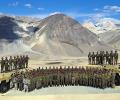
If China is accommodating regarding Depsang and Demchok, a resolution of the Sino-India territorial dispute in Eastern Ladakh could be possible.
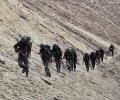
The government needs to answer the critical question of whether it has accepted any restrictions on its infrastructure creation activities, asserts Ajai Shukla.

In underlining the role of border villages as custodians of India's frontiers, New Delhi is following China's example in Tibet.
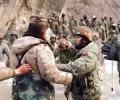
The army refused to disclose the information saying it was third party information which cannot be shared under Section 8(1)(j) of the Act, which exempts from disclosure the information which is personal in nature.
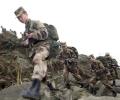
The Indian Army has been slow to react. Indian troops have deployed in the vicinity of PLA incursions, but there are no attempts to outflank Chinese positions.
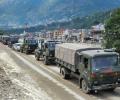
Indian Army planners find themselves contemplating the possibility of more Chinese intrusions along the contested 3,488-km border. That could lead to the army having to man a 'hardened LAC' round the year, like the LoC with Pakistan, reports Ajai Shukla.
Some may see China's decision to antagonise India as strategically unwise. But China believes its prestige demands standing up to India, whatever the cost.

The Indian Army started bringing the T-90 Bhishma and T-72 Ajay tanks along with the BMP series Infantry Combat Vehicles from the deserts and plains in a big way to these high altitude locations from last year with the beginning of the Operation Snow Leopard to counter the Chinese aggression in eastern Ladakh last summer.

'The Chinese staying put in Pangong Tso, and creating a buffer zone on Indian territory in other areas,' a senior serving general tells Ajai Shukla.
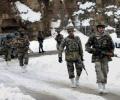
Within the army, there is growing concern that New Delhi will allow the Chinese to retain the territory they have occupied in the last month.

China has chosen to keep New Delhi guessing, while retaining for itself the option of constantly changing facts on the ground and shifting the LAC westwards -- the strategy called 'salami slicing', notes Ajai Shukla.

Sources said that even though India and China have been talking at the diplomatic and the military level for over six weeks now, there has been no thinning down in troop numbers or equipment by the Chinese side on this front.

A total of around 100 troops took part in the operations from the Indian side while the Chinese had over 350 people on the location.

Chinese troops are reinforcing their posts in large numbers, increasing their patrolling, stepping up violations in the Tawang and Walong areas.
With the Indian Army having blocked the PLA several kilometres inside India, hundreds of soldiers from both sides remain in a tense face-off.
Since the June 15 clash, the PLA has inducted large numbers of troops, armoured vehicles and artillery along the LAC, from Depsang and Galwan in northern Ladakh to Hot Springs, Pangong Tso, and Chushul in central Ladakh, to Demchok and Chumar in southern Ladakh.

China remains in firm control of an estimated 600-800 square kilometres of Indian territory.
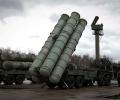
RInstead of disengagement, the Indian and Chinese armies have deployed an estimated 35,000 to 40,000 soldiers each along the LAC. The PLA has deployed S-400 air defence missiles to neutralise the IAF's advantage in air power
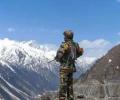
'China has forcibly occupied territory it had never occupied before, blocked Indian patrols' access to areas they had patrolled for decades and, most provocatively, killed 20 Indian soldiers.' 'Most countries would regard these as acts of war.' 'New Delhi has apparently taken off the table the option of evicting the PLA with force,' observes Ajai Shukla.
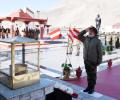
Lieutenant General Harinder Singh, who commands the 'Fire and Fury' 14 Corps, has the experience and talent to face down the Chinese challenge. The general is a rare combination of thinker and tough-minded doer, observes David Devadas.
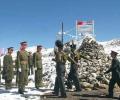
'We will not accept these misadventures by the Chinese.'
 © 2026 Rediff.com - Investor Information - Advertise with us - Disclaimer - Privacy Policy - Sitemap - Feedback - About us - Terms of use - Grievances