
Zomato has lost over 9 per cent thus far in calendar year 2023 (CY23) and has underperformed the S&P BSE Sensex that has slipped nearly 5.3 per cent during this period. Despite this underperformance, analysts at HSBC think that the stock can hit Rs 87 going ahead - up over 64 per cent from the current levels. The food delivery industry, wrote Yogesh Aggarwal and Abhishek Pathak of HSBC in a recent note, has slowed considerably in the last few months.

The stock of the retail chain Avenue Supermarts (Dmart) was the biggest loser in the BSE 100 Index shedding 4.35 per cent on Thursday and added to these losses on Monday by falling an additional 1.3 per cent. The Street was reacting to lower than expected operational performance by the company in the March quarter. The country's largest listed retailer by market capitalisation reported a 20 per cent year-on-year (y-o-y) growth in its top line to Rs 10,337 crore.

India has substantially increased its crude oil imports from the US, with the country's share in India's crude basket hitting a record 14.3 per cent in December, commerce ministry data showed.

The domestic hospitality industry is looking to 'fly' in 2023 cashing in on India's G20 presidency, having received the 'oxygen' to run in 2022 after being crippled in the past two years by the pandemic. Domestic travel, especially the leisure segment, gave wind to the industry this year and is expected to continue into the next. Industry players believe that as international arrivals are also likely to pick up even further, the outlook for 2023 is buoyant.

Parliament has approved a gross borrowing for Rs 7.1 lakh crore for the entire 2019-20 fiscal.

With a new chief executive officer (CEO) at the helm, the country's largest two-wheeler maker Hero MotoCorp is now looking to cut flab and move towards a leaner organisation. It has launched a voluntary retirement scheme (VRS) for its staff as it aims to make the organisation 'agile and future-ready'. Recently, the company's erstwhile chief financial officer (CFO) Niranjan Gupta was elevated as CEO.

Zomato said it has consistently gained market share over the last four years to become the category leader in the food delivery space in India in terms of gross order value from October 1, 2020 to March 31, 2021.
Vedanta group chairman, Anil Agarwal, 69, is well known for his business journey from a scrap dealer from Bihar to a London-based globe-girdling metal and oil and gas conglomerate with revenues of $19 billion. Now his abilities to keep his group from over-leveraging itself will be put to the test. Over the years, Agarwal, now based in London, set up the conglomerate via acquiring iron ore producer Sesa Goa, Cairn's oil producing assets in India, and Electrosteel Steel.

While HDFC Bank has vowed to recoup its lost market share in the credit card segment in three to four quarters by aggressively sourcing new cards, brokerages believe it is a little hard to come by, given how competitive the landscape has become, with other players in the market becoming equally aggressive to gain market share. Kotak Institutional Equities in its report on Monday said, "We would like to believe that the recovery in market share is likely to be gradual, if any. "All the key players, including Axis Bank, are now willing to expand their credit card portfolios as they have tested quite well against Covid-19."

'Companies are being forced to pay higher salaries to retain and hire employees due to a big rise in attrition in the industry.'

Finance Minister Nirmala Sitharaman has brought down the budgetary allocation for the fertiliser subsidy for FY21 to Rs 71,309 crore, from the RE of Rs 79,998 crore for FY20, while increasing food subsidy to FCI through "ways and means advance" to Rs 50,000 crore for FY21, from Rs 36,000 crore in RE for FY20, and under the National Food Security Act (NFSA) to Rs 77,982 crore, from Rs 75,000 crore.

Despite gold prices hitting record highs, analysts aren't gung-ho about the outlook for gold financiers Muthoot Finance and Manappuram Finance. This, they said, was due to intense competition from banks, coupled with stagnating loan books and likely pressure on margins.

The dream-run in railway stocks may soon run out of steam, caution analysts. The rally, which has lasted nearly a year, may meet time-wise correction post the Union Budget announcements as investors begin scalping profits. "There is going to be a build-up in expectations for the sector from the Union Budget, which is still two-odd months away.
With the first quarter gross tax mop-up reaching Rs 5.6 lakh crore, Icra Ratings on Friday said the government is set to exceed the budgeted tax collection target of Rs 22.2 lakh crore for 2021-22, led by indirect taxes. The government has budgeted a modest 9.5 per cent growth in tax collections at Rs 22.2 lakh crore for FY22, over FY21 collections of Rs 20.2 lakh crore. However, despite the second wave of the pandemic, the April-June quarter tax collections rose to Rs 5.6 lakh crore, which is 39 per cent higher than Q1 of FY20.

Gold, the safest haven amid the ongoing uncertainty, also emerged as one of the most lucrative investment options in financial year 2022-23 with an impressive return of 16.1 per cent in rupee terms, and 2.3 per cent returns in dollars. And, had it not been for the very high inflow of smuggled gold and the huge discount prevailing in the market due to high prices, the returns in gold would have been much higher, analysts said. The precious metal has consistently been delivering positive returns in India since 2016.

Experts attribute this trend to a combination of end of capital expenditure cycle, increased automation, RIL's preference for time-bound labour contracts, and telecom and retail's outsourced human resource model.

Road construction witnessed a near 60 per cent year-on-year jump in the first two months of financial year 2021-22 (FY22), despite restrictions being imposed in the wake of the second wave of Covid-19. Around 1,470 km of roads were constructed during the first two months of the current fiscal, as against 847 km in the corresponding period last year, according to official figures. However, these are provisional numbers as the state public works departments of Maharashtra and Goa are yet to provide data.

'In FY23, PV sales are expected to end the year at a record 3.8 million units, up 26 per cent. In FY24, however, the industry is expecting 5-7 per cent volume growth'

Amit Shah's net worth grew 32 per cent to Rs 37.91 crore, mainly due to 80 per cent appreciation in the market value of his securities.

Byju's is planning to raise $500-600 million from Abu Dhabi's sovereign wealth funds and existing investors, according to sources, as the start-up world is facing a funding freeze. The educational technology (edtech) giant targets profitability by March next year. "There is no change in Byju's valuation. The new fundraising process is still going on," said a person familiar with the matter. "Any new valuation would be determined in the futureByju's is planning to raise $500-600 million from Abu Dhabi's sovereign wealth funds and existing investors, according to sources, as the start-up world is facing a funding freeze. The educational technology (edtech) giant targets profitability by March next year. "There is no change in Byju's valuation. The new fundraising process is still going on," said a person familiar with the matter. "Any new valuation would be determined in the future as it is very tough for investors to do that in this environment." as it is very tough for investors to do that in this environment."

'We should look at is full year's growth rather than quarter numbers.'

The Supreme Court has appointed its former judge P V Reddi to mediate the dispute between SpiceJet and its former promoter Kalinithi Maran, the airline said on Wednesday. The dispute dates back to 2015, when Maran sold his stake in SpiceJet of 58.46 per cent, or 50.4 million shares, to Ajay Singh for Rs 2 after the airline suffered financial trouble. A year later, Maran approached the Delhi high court, alleging a breach of agreement by Singh for not issuing him 189 million share warrants and preference shares despite Maran's Rs 679-crore infusion.

The numbers become all the more important because actual tax collections fell short by Rs 1.91 trillion compared to what was projected in 2018-19. Besides, the Budget for FY20 did not give actual figures for 2018-19, but the revised numbers given in the interim Budget.

The Centre is in "mission mode" to fill vacancies in government departments and ministries. The Department of Expenditure is currently following up with other wings of the government to expedite pending appointments. Regular follow-ups are being made to fill the vacant positions, so that the stated target of eliminating 1 million vacancies is met by December 2023, ahead of the next Lok Sabha elections. Even as the nodal ministry for filling vacant positions in the government is the Department of Personnel and Training (DoPT), the Department of Expenditure's Establishment Coordination (Personnel) division is providing support for the recruitment drive.

Its production declined for the third consecutive year in financial year 2020-21 (FY21) to an 11-year low, while sales volume contracted for the second year to the lowest since FY15. The company manufactured around 1.08 million vehicles last fiscal, a decline from 1.17 million the previous year, and a steeper fall from its all-time high tally of 1.62 million reported in FY18.

Starting with the third quarter of financial year 2020-21 (Q3FY21), we have seen "unlock" trades at various times. Whenever lockdowns have been eased, traders have taken long positions in consumer-facing businesses. Let's look at the logic. Since March 2020, sectors like retail, personal vehicles, hospitality, aviation, fast-moving consumer goods (FMCG), multiplexes, etc., have been under severe pressure. As a result, there's been a low base effect. Every company in these spaces has suffered top line contraction. Many suffered losses, especially in the first half of FY21.

At a time when banks are engaged in a fierce battle to gain market share in the credit card segment, Citibank India has been losing its share, both in terms of outstanding cards and spends in the last few years. Still, average spends on Citi cards are higher than any other Indian bank. Last year, the global banking behemoth announced exit from its consumer banking franchises in 13 markets across Europe, Middle East and Asia, including India, citing lack of scale.

Defence outlay alone will jump 22 per cent

Private equity (PE) investments in real estate sector fell 32 per cent to $4.3 billion in the last fiscal year mainly due to the COVID-19 pandemic, according to property consultant Anarock. PE investments in real estate stood at $6.3 billion in the 2020-21 financial year. According to Anarock Capital's FY22 year-end edition of its FLUX report, PE inflows in real estate were $5.1 billion in FY'20, $5.6 billion in FY'19 and $5.4 billion in 2017-18 fiscal. The consultant attributed the fall in PE investments in real estate to the second wave of the COVID-19, leading to multiple lockdowns in various parts of the country.

A slowdown in hiring by India's top IT companies has resulted in a sharp increase in the industry's profit per employee in Q3FY23. The top four IT companies earned a net profit of 1.7 lakh per employee during October-December 2022, up 8.6 per cent from Rs 1.57 lakh in Q2FY23 and 16.3 per cent from a record low of Rs 1.47 lakh in Q1FY23. Earnings per employee in the third quarter were, however, still down 0.9 per cent on a year-on-year (YoY) basis.

Corporate revenues will decline for a third consecutive quarter in March on a YoY basis - one of the worst shows by these companies in many years.

At a closed-door meeting with global investors, the largest asset manager in the country boasted of its nearly Rs 37 trillion assets under management (AUM) - 16.6 times that managed by the second-largest insurer SBI Life. The numbers are as of March 31, 2021. The assets of LIC are 1.2 times the net assets of the entire Indian mutual fund industry, which had AUM of Rs 31.43 trillion as of March 31, 2021 (about Rs 37.3 trillion until November this year). The standalone assets that LIC manages are equal to 18.7 per cent of India's GDP and worth more than gross domestic product (GDP) of the UAE, Bangladesh, Malaysia, Singapore, Hong Kong, South Africa, New Zealand, and Pakistan.

Indian Sellers Collective (ISC), a trade association of micro and small enterprises and family businesses, on Wednesday urged IT veteran NR Narayana Murthy to cooperate in the Competition Commission of India's antitrust probe against Amazon for alleged anti-competitive practices. In 2014, Murthy's Catamaran and Amazon had formed a joint venture, Prione Business Services. On Monday, the partners announced that they have mutually decided not to continue the JV beyond May 2022. ISC thanked Murthy for deciding to end the joint venture with Amazon.

Ola has reported its first operating profit of Rs 89.82 crore for 2020-21, even as the ride-hailing company's revenue declined 65 per cent to Rs 689.61 crore amid COVID-19 induced lockdowns. As per regulatory documents filed by ANI Technologies - the parent company of Ola - it had logged standalone operating profit (profit before finance cost, depreciation, amortisation and tax (EBITDA)) of Rs 89.82 crore in FY21 on a standalone basis, while it had registered a loss of Rs 610.18 crore in the preceding fiscal year.

The stellar rise in corporate earnings in financial year 2021-22 (FY21) and FY22 did not result in a corresponding boom in capital expenditure (capex), with listed companies' investment in fixed assets rising just 2.3 per cent year-on-year (YoY) in FY22, growing at the slowest pace in the last six years. In comparison, the firms' combined net profit jumped 63.5 per cent YoY in FY22, while net sales increased 31.1 per cent - the fastest pace in over a decade. The 955 non-financial companies in Business Standard's sample reported combined net profit of Rs 7.18 trillion in FY22, compared with Rs 4.39 trillion in FY21 and Rs 2.59 trillion in FY20.

What could be the reason for the successive downward revisions across the board? Some key indicators make it evident, reports Abhishek Waghmare.

The stock, which is a play on the growth story of Indian Railways, has corrected 15 per cent from its 52-week high level of Rs 2,072.95 scaled on March 9. Yet, this has not deterred brokerages from holding a bullish view on the stock.
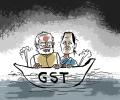
CAG recommended fixing a definite time frame for rolling out simplified GST return forms.

First-time buyers of cars and sport utility vehicles (SUVs) have made a comeback, shows last year's data from top passenger vehicle (PV) makers. If the trend persists, it may move the needle on the overall car penetration ratio. India's car penetration ratio is 32 per 1,000 people - one of the lowest, compared to mature car markets like the US and Europe.

While the ratio determines the extent to which the government is able to finance its expenditure, it is also an indicator of tax compliance. Developed countries have a higher contribution of tax to their GDP.
 © 2026 Rediff.com - Advertise with us - Disclaimer - Privacy Policy - Sitemap - Feedback - About us - Terms of use - Grievances