
With less than five months left for the report of the Fifteenth Finance Commission to be submitted, its chairman N K Singh said the report will have fiscal road map for states, depending on their current situation.

There has been a decline in foreign direct inflow from China in the last three years, with FDI coming down to USD 163.77 million in 2019-20, Minister of State for Finance Anurag Singh Thakur informed the Lok Sabha on Monday. Giving details of the total foreign direct investment (FDI) inflow from Chinese companies in India, he said, it was USD 350.22 million in 2017-18, while it declined to USD 229 million in the following year.

Sitharaman does away with loans from National Small Savings Fund to Food Corporation of India.

Comprehensive tax reforms would be carried out in the next budget after taking into account the suggestions of Kelkar Task Force, which will submit its report within a few days, Finance Minister P Chidambaram said on Monday.
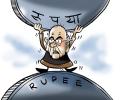
Fiscal deficit has a bearing on sovereign rating of the country as well as the debt market.

The rise in the fiscal deficit, which is a reflection of the government's borrowing, was mainly on account of subdued tax collection. The revenue deficit also rose to 3.27 per cent, up from the revised estimate of 2.4 per cent of the GDP.

The government on Friday sought Parliament's nod for an additional Rs 54,000-crore spending mainly to meet its obligation towards GST compensation to states and defence-related expenditure. Minister of State for Finance Anurag Thakur presented the second and final batch of supplementary demands for grants in the Lok Sabha.
There appears to be a growing perception among the political class that faster growth will not create jobs fast enough and, therefore, welfare spending needs to be drastically increased, says T T Ram Mohan.

Chief Economic Advisor Krishnamurthy Subramanian said China imports a lot of components, parts, assembles and integrates and then exports them.

Finance Minister Pranab Mukherjee will likely encapsulate this thinking in his Budget speech, to be finalised by March 13.

IThe fiscal deficit target for 2020-2021 was originally set at 3.5 per cent of GDP. But the government's revenues have collapsed and its expenditure burden will only increase over the Budget estimates.' With the government having already planned for an additional borrowing of over Rs 4 trillion, the fiscal deficit for the current year would be much higher than the Budget estimate, notes A K Bhattacharya.

Making a case for an optimal fiscal stance, the Economic Survey on Friday said growth leads to debt sustainability and not necessarily vice-versa. "This is because debt sustainability depends on the 'Interest Rate Growth Rate Differential' (IRGD) i.e. the difference between the interest rate and the growth rate in an economy. "With the Indian context of potential high growth, the interest rate on debt paid by the Indian government has been less than India's growth rate by norm, not by exception," it said.

The extra borrowing implies Jaitley will have extra spending space in the Union Budget for FY19, the last full one before the 2019 general election

BJP's reversals in rural Gujarat has prompted many policy watchers to predict that the Budget would have incentives for the agriculture sector and the rural economy.

The continued rise in interest is a pressure on fiscal, but it is not an easy way out unless the government cuts back on populist measures and sticks to fiscal prudence as laid out in the FRBM, which the government missed for the second consecutive year.
The finance ministry has agreed to furnish sovereign guarantees on loans raised by National Aviation Company India Ltd, which flies under the Air India brand name. A top source in the ministry confirmed: "Yes, we will provide sovereign guarantee to Air India on its loans. After all, it is a company owned by the government."

Kerala has seen one of the worst floods in its history during this monsoon. From August 8 to 20, nearly 223 people have lost their lives, 33 are missing and around 1.2 million individuals from 3,02,441 families are in 3,941 relief camps. Initial losses are estimated to be around Rs 200 billion (Rs 20,000 crore). With the rescue measures in its last leg, the Kerala government is looking at raising funds to rebuild the state. In an interaction with Gireesh Babu and T E Narasimhan, Kerala Finance Minister T M Thomas Isaac says he has a three-pronged strategy to raise funds. Edited Excerpts.

'We are not able to manufacture even low-end products as cheaply as China.' 'We are not buying Chinese goods today out of any love for China.'
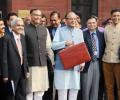
The fiscal deficit in current fiscal has been estimated at 3.9%.

The Indian economy appears to have slowed down in 2018-19 due to lower private consumption, tepid growth in fixed investment and muted exports, a finance ministry report has said.

There are various estimates of India's debt to GDP ratio, but the consensus is that that it would be over 80 per cent at the end of the current fiscal year.

'We will not compromise on it. We will not make any deferred payments or cuts.'

The government plans to raise resources to finance capital spending beyond the Rs 3.10 lakh crore budgeted for 2017-18 through higher borrowing or divestment receipts.
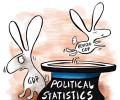
The brokerage said the consolidated fiscal deficit, including that of the Union (3.6 per cent), the states (2.6 per cent) and the off-budget borrowings which are being resorted to increasingly is a worry.
Even as the debate over off-Budget liabilities continues, former finance ministry bureaucrats and leading economists say it's time the government went beyond the targets in the Fiscal Responsibility and Budget Management Act.

''Even without major reforms, with a business as usual scenario, and with current inflation trends, we should be clocking around 11 to 12 per cent nominal growth.' 'That is not happening and is a source of worry,' Rathin Roy tells Arup Roychoudhury.

April policy could be all about RBI communication.

Finance Minister Nirmala Sitharaman has brought down the budgetary allocation for the fertiliser subsidy for FY21 to Rs 71,309 crore, from the RE of Rs 79,998 crore for FY20, while increasing food subsidy to FCI through "ways and means advance" to Rs 50,000 crore for FY21, from Rs 36,000 crore in RE for FY20, and under the National Food Security Act (NFSA) to Rs 77,982 crore, from Rs 75,000 crore.
This is because the bond market has factored in the Rs 4.88-trillion gross borrowing for April-September 2020.

'Given the 50 per cent or thereabouts increase in borrowing that has been announced, it is a reasonable estimate to say that at this time, an increase of 1.7-1.8 per cent on the 3.5 per cent budgeted fiscal deficit target is being anticipated,' Chief Economic Adviser Krishnamurthy Subramanian said on Friday.

It would also be the last policy of Rajan

He did not believe in any fiscal puritanism. In 2012, when it was almost certain that the government will breach the 2012-13 fiscal deficit target, he wrote that in abnormal times, abnormal measures are required to get back to normalcy.

Among other things, the agenda is likely to focus on increasing private investment, employment generation and giving relief to the farm sector
Booming manufacturing and services sector is likely to push up India's GDP growth to 7.7 per cent in 2006-07, but inflationary pressure may lead to hike in interest rates
The National Council of Applied Economic Research also says that the fiscal deficit will overshoot budget target to touch 4.7 per cent of GDP in 2004-05.
The power ministry is planning to start a second version of UDAY, aimed only at reducing the losses of discoms and improving the quality of power supply.
 © 2026 Rediff.com - Advertise with us - Disclaimer - Privacy Policy - Sitemap - Feedback - About us - Terms of use - Grievances