
'My suggestion to Nandan Nilekani is that it would be worthwhile for him to take a holistic review in a manner in which examination is just one critical component.'
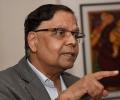
The government has extended the tenure of the 16th Finance Commission by one month till November 30. The 16th Finance Commission was constituted by the government on December 31, 2023, with former Niti Aayog vice-chairman Arvind Panagariya as its Chairman.

'Improved law and order and transparent governance have helped change UP's investment image.'
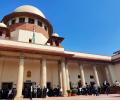
As of December 2025, India had 880 Fast-Track Courts with 1.39 million pending cases, despite disposing of 1.33 million cases during the year.

'The prohibition regime has been accompanied by concerns regarding the expansion of the illicit liquor trade, increased enforcement challenges and corruption, and the growing use of alternative intoxicants, including illicit drugs.'

Election-related freebies and populist measures are other factors crimping the revenue profile of these states.
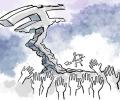
Eighteen of India's 28 states exceeded the fiscal deficit ceiling of 3 per cent of GSDP in FY25, a deterioration comparable to the Covid year of 2020-21, according to the Comptroller and Auditor General (CAG). The report also noted a decline in states reporting a revenue surplus, with Bihar, Mizoram, and Telangana moving into deficit.

Ashok Lahiri, a distinguished economist with experience in government, the private sector, and electoral politics, has been appointed as the new Vice-Chairman of NITI Aayog, tasked with strengthening India's reform trajectory and policy-making.

Kerala, Tamil Nadu and West Bengal have been fiscally stressed for a considerable period of time, and there are no easy ways to mobilise revenues to meet the cost of the promised freebies, particularly in the prevailing difficult economic scenario, points out M Govinda Rao.

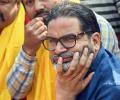
Jan Suraaj Party founder Prashant Kishor has moved to an ashram on the outskirts of Patna to continue his political activities ahead of the next assembly elections. He criticised Nitish Kumar and urged voters to prioritise their own interests.

If TVK MLAs and ministers are perceived as clean, or demonstrably cleaner than their predecessors, the credibility dividend will be enormous. The voter will feel rewarded, points out Ramesh Menon.

Amid the arithmetic of subsidies, consumption and capacity, whichever government assumes office in Tamil Nadu after May 4 is likely to inherit a growing debate over how far the state can continue to expand welfare promises without placing additional strain on public finances and the power sector.
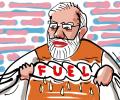
Following through announcements with enforcement of measures is key, as a run through recent Indian economic history shows, points out A K Bhattacharya.

The 16th Finance Commission, led by Arvind Panagariya, has recommended maintaining the states' share in central taxes at 41% for the five-year period starting April 1, 2026. The government has accepted this recommendation, with Rs 1.4 lakh crore allocated to states for FY 2026-27 as Finance Commission Grants.
India Ratings & Research (Ind-Ra) has projected the aggregate fiscal deficit of states to rise to 3 per cent of gross domestic product (GDP) in 2026-27 (FY27), from an estimated 2.8 per cent in 2025-26 (FY26), citing higher revenue expenditure amid election-related pressures and scheme cost-sharing requirements.
The government on Sunday appointed former Niti Aayog vice chairman Arvind Panagariya as the Chairman of the 16th Finance Commission. Joint Secretary in the finance ministry Ritvik Ranjanam Pandey will be the secretary to the commission, the government said in a notification. "The President is pleased to constitute a Finance Commission with Dr Arvind Panagariya, former Vice-Chairman, NITI Aayog and Professor, Columbia University, as the Chairman. Members of the Commission will be notified separately," it said.

On Agri Stack, Expenditure Secy V Vualnam says it's progressing well; using IT, farmers will be able to choose exact fertiliser quantities needed, reducing crowding at fertiliser outlets.
The government has proposed to lower debt-to-GDP ratio to 55.6 per cent in FY27, from 56.1 per cent in the current fiscal year, Finance Minister Nirmala Sitharaman said on Sunday.
The government has proposed to lower debt-to-GDP ratio to 55.6 per cent in FY27, from 56.1 per cent in the current fiscal year, Finance Minister Nirmala Sitharaman said on Sunday.

Governments should move away from universal subsidies towards tightly targeted transfers, backed by stricter eligibility norms, sunset clauses and periodic audits to curb leakages and improve spending efficiency, a joint study by Asian Development Bank and PwC has recommended.

The Telangana government's salary structure reveals surprising figures, with senior sweepers earning up to 2 lakh and chief engineers drawing 7 lakh monthly.

India's privatisation push, once projected as a cornerstone of economic reform, has suffered another setback, with the Centre set to call off the IDBI Bank stake sale, highlighting the political and structural constraints shaping the country's disinvestment policy, experts say.

Around 24 paise will come from borrowings and other liabilities, 10 paise from non-tax revenue like disinvestment, and 2 paise from non-debt capital receipts, the Budget documents showed.

After the last Budget's announcement of a major tax relief for those earning an annual salary of less than Rs 12 lakh, there is not much that individuals can look forward to in the forthcoming Budget, points out A K Bhattacharya.

The Union Budget for 2026-27, presented by Finance Minister (FM) Nirmala Sitharaman on Sunday, which was a first, had an excellent domestic macro backdrop. According to the first advance estimates, gross domestic product (GDP) in constant prices is projected to grow 7.4 per cent in the current financial year, against 6.5 per cent in 2024-25.

Kerala Chief Minister Pinarayi Vijayan accused Governor Rajendra Vishwanath Arlekar of omitting portions of the state cabinet-approved policy address, specifically criticizing the Union Government's fiscal policies and the pending status of state bills.
'This Budget has a one-year agenda, which you can call the sprint, and the marathon is towards Viksit Bharat.'

The forthcoming Budget could think of maintaining public capital expenditure at 3 per cent so that domestic resources are available for private investments, points out N R Bhanumurthy.
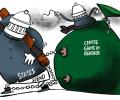
India's state-level fiscal rules have improved headline deficits, but the gains are fragile and uneven with major states still grappling with high debt levels, a World Bank report submitted to the 16th Finance Commission (FC) said. According to the report, despite nearly two decades of adoption of fiscal responsibility laws (FRLs), debt levels have not converged.

The total expenditure on the MGNREGA programme, as per the revised estimates from 2025-26, was Rs 88,000 crore, while initially, a sum of Rs 86,000 crore was allocated.
Finance Minister Nirmala Sitharaman launched a strong attack on Rahul Gandhi and the Congress party, accusing them of compromising India's interests on the world stage and selling out farmers and the poor during their time in power.

'We kept this Budget on a larger plank, rather than on one incident, however serious.'

Karnataka Governor Thaawarchand Gehlot has refused to address the joint sitting of the state legislature, prompting government intervention. The reasons are unclear, but follow similar incidents in other states.

Three laws passed in Parliament could boost central revenues, reshape GST cess flows, shift MGNREGA costs to states and create new budget headroom ahead of the 2026-2027 Union Budget, points out A K Bhattacharya.

Actor-politician Vijay held his first public meeting in Puducherry, criticising the central government for neglecting the union territory's demand for statehood and praising the local government's impartiality. He also targeted the DMK government in Tamil Nadu, suggesting they could learn from Puducherry.
The Finance Commission, which makes recommendations on sharing of tax revenues by the Centre and States, has suggested a new path for fiscal prudence in its report submitted to President Pratibha Patil on Wednesday.

'...yet struggles to convert that human capital into domestic productivity.'
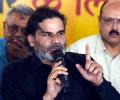
Former poll strategist Prashant Kishor's Jan Suraaj expressed disappointment over its poll debacle in the Bihar assembly elections, attributing the NDA's victory to cash transfers to women.

The best course for the government at this time would be to tighten the seat belt a little more, without compromising on its investments in creating better infrastructure and giving a push to privatisation, points out A K Bhattacharya.
