
The Indian government has expressed its disagreement with the IMF staff's 'baseline' assumption that the 50 per cent US tariffs on its goods exports 'would remain in place indefinitely', based on which the staff pegged the country's GDP growth at 6.6 per cent this year, and pared its 2026-27 projection by 20 basis points to 6.2 per cent.

With the creation of the state of Telangana, additions were made to ToRs of the 14th Finance Commission to make recommendations for the newly created states after the reorganisation of Andhra Pradesh.

The Twelfth Finance Commission is ready with its report and has sought time from the President to submit the recommendations, its chairman C Rangarajan said on Saturday.

Former chief secretary Indu Kumar Pande, the chairman of the commission, has been left with only seven months to complete the recommendations.

The Sixteenth Finance Commission Chairman, Arvind Panagariya, has highlighted the challenges faced by southern states due to falling fertility rates and the subsequent increase in dependency ratios and ageing populations. He noted that Andhra Pradesh, Assam, and Tamil Nadu have raised concerns about these demographic trends. The Commission is currently touring the states to gather feedback and is expected to submit its recommendations after completing nationwide consultations.

The commission in its report, tabled in Parliament, recommended increase in share of states to 32 per cent of central tax proceeds from the current 30.5 per cent.

Call for fiscal autonomy to Union Territories with Assemblies may get louder with 'special status' to J&K in the Finance Commission, say experts.

'Marathwada is the suicide capital of Maharashtra.' 'To stop such man-made disasters, the government should immediately come up with a rightful package, not this charitable approach to compensation.'

Brave statements such as we will continue to be the fastest growing large country are of no consolation, because the direction of trade also determines the flow of investment, points out M Govinda Rao.
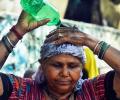
With the summer approaching sooner than scheduled, Maharashtra, Telangana, Odisha, and West Bengal have already started experiencing heat waves with temperatures soaring above 40°C.
The 12th Finance Commission on Monday held a meeting with leading economists and economic administrators in Chennai to elicit their views on current issues concerning inter-governmental resource transfers.\n\n\n\n
The government on Wednesday constituted the 13 Finance Commission, which would look into sharing of taxes between Union and the States, under the chairmanship of former finance secretary Vijay Kelkar.

This is due to the newly formed Union Territories of Jammu and Kashmir, and Ladakh, which will get funds from the Centre's share, which means devolution will be for 28 states compared to 29 earlier.

'All governments are scared of a negative image.' 'Somehow, this government has a tendency to create a narrative that things are improving.' 'When the real data gives a different picture, they are upset.'
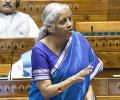
'When people have money in their hands, they make their judgment about whether they want to spend it entirely or spend some out of it.'
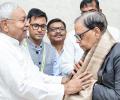
Bihar Chief Minister Nitish Kumar launched a scathing attack on his predecessor Rabri Devi, calling her appointment as Chief Minister "suspension-induced" during a heated debate in the state legislative council. The verbal sparring, marked by accusations and counter-accusations on law and order, saw Kumar accusing the RJD of being unable to handle Hindu-Muslim tensions and engaging in "mischief." Rabri Devi, in response, asserted her right to speak about her achievements during her tenure as Chief Minister. Kumar, however, retorted with a sharp, local phrase, dismissing Rabri Devi's claims. The exchange, which saw both sides engage in mudslinging, ended with the Chairman admonishing the opposition for their unruly behavior.
Panel to recommend sharing of divisible resources between states and the Centre from 2015 to 2020.

FinCom prescribes scrapping of effective revenue deficit.

'Make-in-India played a key role in India's effective action against terrorism during Operation Sindoor.'

For every rupee in the government coffer, the biggest pie of 66 paise will come from direct and indirect taxes, according to the Union Budget 2025-26 documents. Around 24 paise will come from borrowings and other liabilities, 9 paise from non-tax revenue like divestment, and 1 paise from non-debt capital receipts, the Budget documents said.

Finance Commission has got new team who are committed to growth initiatives.
With its age-old fascination for education, southern states have done better than the North. Start-ups, IT hubs, and industry majors setting up shop have changed the face of the South. Nearly 79% of global offices set up by international conglomerates in India are in the South. Almost 46% of tech unicorns are from the South. The GDP per person in the South is 4.2 times higher than the North. None of these indicators can be ignored by any central government, whatever the political compulsions, notes Ramesh Menon.

Tax devolution shares, which threaten to create a north-south divide among states, may have more to do with per capita income, and not so much with population.
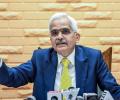
P K Mishra, a retired IAS officer of the Gujarat cadre, is currently serving as the principal secretary to the prime minister.
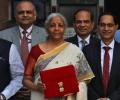
'The finance minister missed yet another opportunity to simplify the income tax structure in the Budget.' 'This was an opportune moment to get rid of the old tax system entirely and move fully to the new system,' asserts M Govinda Rao, member of the 14th Finance Commission.
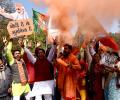
The BJP is considering having two deputy chief ministers in the new Delhi government to represent the city as a "mini" India, party leaders said. The move is aimed at accommodating MLAs from different castes, communities, and regional backgrounds. The proposal is under consideration by the national leadership, which will also decide on the chief minister and other ministers. The process of government formation is expected to gain momentum after Prime Minister Narendra Modi returns from his foreign visit over the weekend.

States are mandated to develop and implement 'heat HAPs' for prevention of heat-induced diseases. But most do not go beyond standard advisory on heat prevention.

Finance ministers of states demanded an increase in allocation under 50-year interest-free loan scheme, while fiscally stressed states like Punjab and Kerala pitched for a special package and borrowing flexibility, sources said on Friday. In a pre-budget meeting with Union Finance Minister Nirmala Sitharaman, states have also urged for higher borrowing limits to support fiscal activities, besides additional funds for Jal Jeevan Mission.

The government, in the forthcoming Budget, could consider levying higher tariffs on imports to check the significant decline in rupee value witnessed in the past few months, said EY Chief Policy Advisor DK Srivastava. The noted economist argued that higher import duties would curb the demand for dollars from importers and help arrest the sliding value of the rupee, which touched a historic low of 86.70 to a dollar on January 13.

Using the debt-to-GDP ratio as a fiscal anchor aligns with efforts to promote fiscal transparency through proper disclosure of off-budget borrowings.
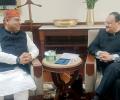
Former Leader of Opposition (LoP) in the Delhi Assembly, Vijender Gupta, has been chosen as the new Speaker of the Vidhan Sabha. Gupta, a BJP MLA from Rohini, vowed to immediately table 14 CAG reports allegedly withheld by the previous Aam Aadmi Party (AAP) government upon taking charge. His election is a foregone conclusion due to the BJP's majority in the Assembly.

The government on Saturday announced a host of measures such as setting up of a new Fund of Funds Scheme (FFS) with Rs 10,000 crore corpus; and extension of period of incorporation by five years with a view to promote growth of budding entrepreneurs.
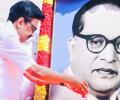
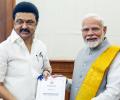
Given the possibilities that next year's assembly elections could throw up, Stalin told the state assembly that an interim report had to be submitted by January 2026. The outcomes may well find its way into the DMK's poll manifesto, thus seeking to keep the electoral focus still on the BJP-ruled Centre and Prime Minister Modi, observes N Sathiya Moorthy.

'Rates go up, revenues go up, and the need for compensation diminishes.'
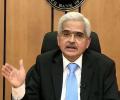
Reserve Bank Governor Shaktikanta Das on Tuesday said the fiscal-monetary coordination was at its best during the last six years even as he thanked Prime Minister Narendra Modi for giving the opportunity to head the monetary authority of the country. Das, in a series of posts on X, on his last day of his six-year term as RBI Governor, also thanked the Finance Minister, various stakeholders and his colleagues at the central bank.
In her Budget speech, Finance Minister Nirmala Sitharaman on Tuesday underlined the need for collaboration between the Centre and states to take up the next-generation reforms covering land, labour, capital and entrepreneurship. As far as revenue share goes, the government has projected to give about 32.5 per cent of central taxes to states during FY25, against the 15th Finance Commission's recommendation of 41 per cent, according to the Union Budget estimate.

The government has approved the 'Terms of Reference' for the 16 Finance Commission, which makes recommendations on sharing of tax revenues between the Centre and states. The recommendations would cover a five-year period commencing April 1, 2026, Information and Broadcasting Minister Anurag Thakur said on Wednesday, giving details about the decisions taken at the Cabinet meeting last evening. The commission would submit its report by October 31, 2025, Thakur said.

Shaktikanta Das will demit the office on Tuesday after completing six years as the 25th Governor of the Reserve Bank of India. Revenue Secretary Sanjay Malhotra will replace him as the 26th Governor. He was appointed as the Governor on December 12, 2018, after the abrupt exit of Urjit Patel.
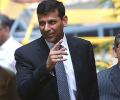
With 7 per cent economic growth, India is not creating enough jobs as reflected by the number of applicants for vacant posts in some states, Reserve Bank's former governor Raghuram Rajan said and suggested the government needs to focus on promoting labour-intensive industries to generate employment. Rajan further said some Indians, especially those at upper level, are comfortable and have high incomes, but consumption growth from the lower half of the country has still not recovered to pre-pandemic level.

'Spend, but create assets, spend but make sure that people benefit from it.' 'This has been a beautiful guiding principle. And I think as a finance minister I owe so much to the prime minister for keeping this path clear before us.'
