
The Delhi government, now led by the BJP, has withdrawn all cases filed by the previous AAP administration against the Union government, the Lieutenant Governor, and several senior bureaucrats.

The idea is to establish a robust and forward-looking legal framework that addresses the financial stress of power distribution companies, which are facing losses of over 6.9 trillion, while curbing high industrial tariffs that, according to the government, have affected competitiveness, constrained economic growth, and slowed the transition to clean energy.
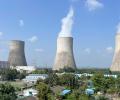
The Bill is likely to pave the way for amending two existing legislations -- the Atomic Energy Act 1962, and the Civil Liability for Nuclear Damage Act 2010.
After four failed reform drives, a new plan aims to rescue India's debt-laden power discoms through privatisation, accountability and long-term financial fixes.

CERC, which has a key role in India's power sector, has also set up a committee to gather further evidence in the matter and take suitable action.
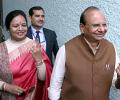
The Delhi government is embroiled in multiple litigations with the Lieutenant Governor in the Supreme Court including its plea challenging the Centre's law establishing pre-eminence of the LG over the elected dispensation in controlling services in the national capital.

Former Andhra Pradesh Chief Minister YS Jagan Mohan Reddy has strongly refuted allegations of bribery by the Adani Group for solar power purchases during his government. He claimed his name was not mentioned in a US court's indictment and that meetings with Adani Group chairman Gautam Adani were not unusual for a chief minister. Reddy said the power supply agreement was between the state's DISCOMs and SECI, with no third-party involvement. He also defended the deal, calling it 'historic' and highlighting the cost savings for the state. Meanwhile, former CM N Chandrababu Naidu has alleged irregularities in the deal and promised to act upon the alleged charges.

The Centre has granted absolute powers to the Delhi lieutenant governor to constitute any authority, board and commission such as the Delhi Commission for Women and the Delhi Electricity Regulatory Commission.
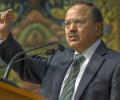
The government on Thursday reappointed former IPS officer Ajit Doval as the National Security Adviser (NSA), according to an official order.

As the political uncertainty settles down, investors are reviewing their assumptions about the power sector. Demand here is likely to continue to grow strongly in the long-term at around 5-6 per cent CAGR (compounded annual growth rate) during the next 6-7 years. Given policy continuity, several trends will persist.
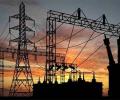
As Mumbai's real estate and electric vehicle penetration grows, two of the city's private power distribution companies, Adani Electricity and Tata Power, are eyeing a bigger business pie, particularly betting on high-value customers. Adani Electricity Mumbai (AEML), the subsidiary which houses Adani Energy Solutions' Mumbai distribution business, recorded a six per cent growth in total units sold in the financial year 2023-24 (FY24), the company's presentation shows. This gain came at over 13 per cent growth in the year-ago period.

Power Grid Corporation (PGCIL) intends to ramp up its capex substantially through the next two financial years. The Public Sector Undertaking (PSU) utility posted flat consolidated revenues of Rs 10,700 crore in the third quarter of the current financial year (Q3FY24) and reported 7 per cent year on year (Y-o-Y) growth in net profit to Rs 4,000 crore. The Q3FY24 capex stood at Rs 3,440 crore and capitalisation at Rs 1,780 crore, taking the 9MFY24 total to Rs 8,700 crore capex and Rs 5,800 crore capitalisation, respectively.

In a setback to Tata Power, the Supreme Court on Wednesday dismissed the company's challenge to the Maharashtra Electricity Regulatory Commission's (MERC's) decision to award a Rs 7,000-crore transmission project near Mumbai on a nomination basis to Adani Electricity. The court upheld the order by the Appellate Tribunal for Electricity (APTEL) in this case and directed all State Electricity Regulatory Commissions to frame guidelines on tariff determination in accordance with Section 61 of the Electricity Act and the national policy. The verdict has implications for the Mumbai power market, said Ashok Pendse, an energy expert based in the city.
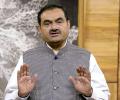
The Supreme Court has dismissed an appeal filed the customs department against Adani Power Maharashtra Limited (APML), Adani Power Rajasthan Limited (APRL) and others in a case pertaining to alleged over-valuation of imported goods. "We have heard Balbir Singh, Additional Solicitor General appearing for the appellant(s), and Mukul Rohatgi, senior counsel appearing for the respondents, at length. "We are of the considered opinion that the matters are concluded by the findings of fact recorded by the authorities below and the impugned order(s) does not require any interference at our behest.
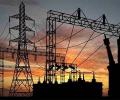
The government has asked the officials concerned to take all necessary steps to ensure normal supply of electricity in the state.

The Supreme Court on Tuesday deferred the oath taking of Delhi Electricity Regulatory Commission (DERC) chairperson-designate Justice (retd) Umesh Kumar, while deciding to examine the constitutional validity of a provision of the Centre's recent ordinance governing such an appointment.

Power Minister P M Sayeed on Tuesday assured full autonomy to electricity regulatory commissions and said he would talk to state governments for providing administrative and infrastructure support to the regulators.
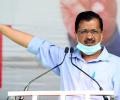
According to sources at the LG office, chief secretary Naresh Kumar has been asked to conduct an inquiry and submit a report within a week.

The Supreme Court on Monday asked Delhi Chief Minister Arvind Kejriwal and Lieutenant Governor V K Saxena to rise above 'political bickering' and discuss who could head the national capital's power regulator Delhi Electricity Regulatory Commission (DERC), saying the two constitutional functionaries should get down to 'serious work of governance' away from glare of publicity.
The monthly electricity bills of the majority of domestic consumers in Delhi -- who use more than 200 units and up to 600 units -- will be hiked by up to Rs 265 due to an increase in the power purchase adjustment cost (PPAC) levied by discoms in the city, officials said on Monday.
The Maharashtra Electricity Regulatory Commission has restrained Mumbai-based power utility and Reliance group company BSES from disconnecting supply to consumers for non-payment of additional security deposit.
The Delhi Electricity Regulatory Commission has suggested a number of measures to safeguard customers and ensure compensation for them.

The court's direction came after being informed that the Ministry of Defence has granted the approval for electricity connections to the migrants living in north Delhi's Adarsh Nagar area.

Maharashtra deputy Chief Minister Devendra Fadnavis, who also holds the energy portfolio, held a meeting with trade union representatives and later said the government had no intention to privatise state-run power utilities.

Power generating companies (gencos) that use imported coal to produce electricity, may find it difficult to switch on their idle units immediately in the wake of high fuel costs, several players have told Business Standard. Recently, the Union power ministry had invoked Section 11 of the Electricity Act mandating all imported coal-based plants to generate power at full capacity. However, some generating companies that use imported coal, argue that it is simply unviable for them to produce power when the price of coal in the international market is high, while the per-unit price of power has been capped at Rs 12 per unit on the domestic power exchange.
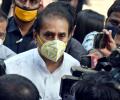
Except for the Devendra Fadnavis- led government during 2014-19, Anil Deshmukh has managed to find a berth in the state ministry irrespective of which party came to power in the last over two decades.
Last month, then Delhi Chief Minister Arvind Kejriwal had ordered a CAG scrutiny of private power distribution companies.

The "load shedding", which entails compulsory power cuts in select areas, will be carried out both in urban and rural areas, the Maharashtra State Electricity Distribution Company said in a statement.
As the Centre pushes reforms in the power sector, especially for the beleaguered electricity distribution segment, several states, especially those ruled by Opposition parties, are clamouring against it. Maharashtra, West Bengal, Tamil Nadu, and Kerela have voiced their reservations against the proposed amendments to the Electricity Act, 2003. The irony is the states opposing the amendments on the ground of threat of privatisation already have private partnerships in power supply. The proposed Bill was slated to be placed on the floor of Parliament in the Monsoon session. But it still awaits Cabinet approval amid several states complaining that they have been not consulted on the issue.
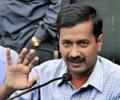
Targeting the Sheila Dikshit government, activist Arvind Kejriwal Friday alleged that power distribution companies in the capital "fudged" their records and "committed fraud" to show losses in their revenue while actually making profits.
A representative body of the electricity regulatory panels, has opposed this move
The project, with total generation capacity of 1,967 Mw, has been shut since Thursday, owing to shortage of gas.
The Delhi government on Friday rejected as 'totally baseless' Arvind Kejriwal's allegations of restraining the Delhi Electricity Regulatory Commission from passing an order in 2010 to slash tariff by 23 per cent. "The allegations are a bundle of lies," Chief Minister Sheila Dikshit's Office said.

Chief Minister Arvind Kejriwal on Tuesday gave deadline of one week to them to address the problem of outages saying government will not hesitate to cancel their licenses if they fail to comply with the directive.
The Dabhol power plant has seen power generation plunge in recent days on account of dwindling gas supplies.
The Delhi Electricity Regulatory Commission said the surcharge was for a period of three months from February 1 or until any further order.
The Central Electricity Regulatory Commission, the nation's Power regulator, has allowed Ratnagiri Gas and Power Private Ltd, the new owner of Dabhol power project, to sell electricity to Maharashtra government.

The regulatory body has said Adani's power purchase agreements with Gujarat and Haryana would be maintained.
 © 2026 Rediff.com - Investor Information - Advertise with us - Disclaimer - Privacy Policy - Sitemap - Feedback - About us - Terms of use - Grievances