
We should have anticipated it on August 5 last year, when we made the big changes in J&K. Amit Shah left nothing to chance when he told Parliament that 'we will bring back Aksai Chin even at the cost of our lives'. 'Then, there were the new maps, objections to the CPEC going through Indian territory, the weather reports.' A broad territorial status quo had existed in Ladakh-Aksai Chin since 1962. India made its intention to change this public, notes Shekhar Gupta.
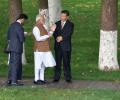
'The meeting marks the first tentative step in the effort to understand whether the two largest Asian nations can co-exist peacefully while realising their aspirations.' 'Caution and watchful wariness will dominate the effort of both sides,' says Jayadeva Ranade, former RA&W officer and China expert.

Just like China wants Trump to lose the US presidential poll, it may want Modi to lose the Lok Sabha polls. So months before the 2024 elections, China may take possession of an important area, say one of the Char Dhams, warns Sanjeev Nayyar.
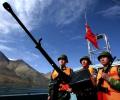
After making incursion bids in Ladakh through land route, Chinese troops have made several attempts to enter Indian waters at Pangong lake nestled in the higher reaches of Ladakh with the latest incident reported on Friday.

Major General Sujan Singh Uban, a legendary veteran of the Second World War, was a natural choice to raise, train and command the Special Frontier Force and mould them into a well oiled fighting machine, recalls his son Inspector General Gurdip Singh Uban (retd), who led SFF troops during the Kargil War.

General Zhao Zongqi is well known in India for having commanded the Chinese troops during the Dokalam episode. Zhao knows every inch and corner of the Indian border, at least the Eastern and Central sectors, including the Naku La area which witnessed fist-fights between Indian and Chinese troops in April/May. Claude Arpi introduces us to the PLA generals masterminding the Chinese aggression in Ladakh.

'The border standoff, if not properly addressed by both sides, could escalate to a conventional or sub-conventional conflict between India and China,' predicts Srikanth Kondapalli, one of India's leading China experts.

India brought in more troops after the destruction of two of its bunkers and "aggressive tactics" adopted by the Chinese People's Liberation Army

'The intrusion in Chumar, during and beyond the Chinese president's visit, is unprecedented and has qualitatively changed the tone of the India-China relationship,' says Jayadeva Ranade, a member of the National Security Advisory Board.

'The focus on countering terrorism brings to the issue Beijing's non-serious approach in this regard. India's permanent representative at the UN has raised in vain the issue of funding and the release of 26/11 suspect Zaki-ur Rehman Lakhvi. But China has blocked these objections since December 2014 at the UN even after 'highest levels' in India intervened,' notes Srikanth Kondapalli, reviewing the India-China military exercises in Kunming.

Unlike in the past, Modi made candid, frank and direct remarks on his hosts by suggesting that the Chinese side is holding back on further improving relations, says Srikanth Kondapalli.

All the three issues raised by China at the Modi-Xi meeting are either intractable or peripheral to the bilateral relations and suggest conventional methods to placate the other side without yielding much, says Srikanth Kondapalli.

As India rises, creating niche areas for itself in the Asian landscape, China and India are bound to step on each other's vital areas of importance, says Srikanth Kondapalli.
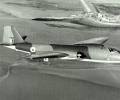
'If we had sent a few airplanes (into Tibet), we could have wiped the Chinese out.' 'And everything could have been different in the 1962 War.' 'They did not believe me there was no Chinese air force.' 'Can you imagine what would have happened if we had used the IAF at that time?' 'The Chinese would have never dared do anything down the line.'
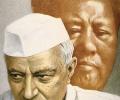
'Delhi was not concerned.' 'It would continue sleeping for several more years, with the result that Indian territory is still occupied by China today,' says Claude Arpi.

China is spending billions of dollars to improve infrastructure in Tibet and other parts of its border with India. Claude Arpi explains why New Delhi can't afford to ignore Beijing's plans.
 © 2026 Rediff.com - Investor Information - Advertise with us - Disclaimer - Privacy Policy - Sitemap - Feedback - About us - Terms of use - Grievances