
'The problem is not the performance under Vishal Sikka, but the quality of Infy's board of directors, argues Debashis Basu.
The successful implementation of the new Act will depend on a much bigger involvement of the state through a huge new superstructure of registration, certification and supervision

The insatiable greed for money and power is too large, too repugnant to thwart. And no one epitomised that better than Harshad Mehta, notes Dhruv Munjal.

We remain at the mercy of the global economic climate.

'The finance ministry and public sector banks have tried to keep the names of wilful defaulters secret.' 'Secrecy and concealing information are inbred among banks and even the RBI,' observes Debashis Basu, editor, www.moneylife.in.

Instead of condemning all businessmen, the PM may like to listen to some of them.

'When fund managers talk of being bullish for the long term, they assume strong economic growth.' 'That is what they have assumed every year, naively believing the pronouncements and promises of ministers.' 'Unfortunately, they have been wrong year after year,' observes Debashis Basu, editor, www.moneylife.in.

Govt must introduce automated investment scheme for poor.

The problem is with the broking model and what brokers are allowed to do, notes Debashis Basu.

Mr Modi can create a small temporary team in the PMO whose only job would be to listen to businessmen's mann ki baat referring to global best practices.
Lack of decisiveness and courage to deal with PSBs may turn out be the biggest impediment to the Modi government's economic initiatives, says Debashis Basu.
Nobody is clear what 'minimum government maximum governance' means.

Mudra Bank will be a Rs 20,000-crore institution, which would "primarily be responsible for refinancing all micro-finance institutions.

NSE's own handle @nseindia was content tweeting out the press release in seven tweets.

Here is a look at some of Aseem Chhabra's favourite memories of 2020 in Hindi cinema, performances by well-known and new actors, special moments in films and shows.

The govt has incentivised the worst of investment products.
Moneylife's victory against NSE shows good journalism does not need to fear deep pockets of big corporations
.jpg)
The Sensex was around 18,600 by the end of August.

'We are probably working with flawed data on household finance.'

Each scam that comes out in the open shows the regulators to be miles behind.

The RBI has created a stunted business model by which payment banks are supposed to shoulder the noble objective of financial inclusion without being able to make much money.

This mindless medley of products does not create choice.

If the government seriously keeps out of business, the business world will know about it at a lightning speed; there would be no need for rock show-like events.

The single most important issue in Public Sector Banks is corruption.

Today, the single most popular route of laundering is the stock market platform, notes Debashis Basu.

Traditional plans are the biggest area of concern for consumers.

The completely avoidable mess that the finance ministry found itself in was rather surprising, says Debashis Basu.

Private-equity funds made an average annual return of just 7 per cent between January 2007 and December 2013 while the Sensex was up 11 per cent.

My sense is that we are in a situation similar to 2011-13, notes Debashis Basu.
The new tax regime proposed by the Modi government may not have acceptance from all corners.

'Mr Modi has inherited a system that taxes businessmen and fritters the money away over ministries.'
The best investment schemes fail if they don't offer incentives to intermediaries to push investors.
Like Indira Gandhi, even Narendra Modi seems to be relying on directing public-sector banks through ministry of finance supported by party cadres, says Debashis Basu.
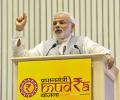
Even if Mudra steps in to play its main role of refinancing at some stage, the responsibility for the bad loans remains with the banks.

Public sector banks are inefficient, poorly governed and beset by largescale corruption.

There are millions of taxpayers, all of whom are susceptible to this frustrating situation.

The three main regulators have different approaches to grievance redressal and different standards to stop harmful from coming pitched at the consumer.
 © 2026 Rediff.com - Investor Information - Advertise with us - Disclaimer - Privacy Policy - Sitemap - Feedback - About us - Terms of use - Grievances