
As part of the procedure, the law minister writes to the CJI to name his or her successor.

Union Law Minister Kiren Rijiju on Friday said formalities are being carried out ahead of the appointment of the next chief justice of India and hoped that everything will go smoothly because the government is "always particular" about rules and conventions.

Justices Rajesh Bindal and Aravind Kumar were administered oath during a swearing-in ceremony held in the Supreme Court premises.

He would have a tenure of two years and is due to retire on November 10, 2024.

Outgoing Chief Justice of India Uday Umesh Lalit turned nostalgic on Monday as he recalled his journey of nearly 37 years in the Supreme Court, saying he enjoyed his stint both as a lawyer and a judge.

We must heed what the CJI has said. Challenging every judgment of the central government is inviting chaos, asserts Shreekant Sambrani.

Chief Justice of India (CJI) D Y Chandrachud on Tuesday said the greatest challenge before the Indian judiciary is to eliminate barriers to accessing justice and make sure that the judiciary is inclusive and accessible to the last person in the line.

Justice Ramana, who had taken over as head of the Indian judiciary from predecessor SA Bobde on April 24, 2021 as the 48th CJI, is scheduled to demit office on August 26 after a tenure of over 16 months.

Chief Justice of India N V Ramana on Thursday set in motion the process of appointment of his successor by recommending the name of Justice Uday Umesh Lalit, the most senior judge, to the Centre.

Law Minister Kiren Rijiju on Saturday claimed that a few retired judges and some activists who are 'part of the anti-India gang' are trying to make the Indian judiciary play the role of the opposition party.

Chief Justice of India D Y Chandrachud on Friday said truth has become a "victim" in the age of false news and with the spread of social media, something which is said as a seed germinates into virtually a whole theory that can never be tested on the anvil of rational science.
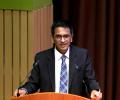
The CJI said the higher judiciary is getting 'flooded' with bail matters because of the reluctance at the grassroots level to grant bail.

The bench said states can make laws to give preferential treatment by subclassifying caste within SC/STs.

The minister said the Constitution of India is a 'religious document' for everyone, especially the government, and 'anything which is alien to the Constitution merely because of the decision taken by the courts or some judges, how do you expect that the decision will be backed by the country'.

Terming pendency of cases a 'huge challenge', Chief Justice of India N V Ramana on Friday expressed regret for not being able to pay much attention to issues of listing and posting of matters for hearing in the Supreme Court.
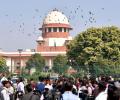
Besides the CJI, the seniormost judge, Justice N V Ramana, and justices R F Nariman, U U Lalit, A M Khanwilkar, D Y Chandrachud, Ashok Bhushan and L Nageswara Rao would deal with the PILs and social justice matters, usually involving the Centre and the states, and their instrumentalities as opposite parties.

Inaugurating the 39th chief justices' conference in New Delhi, which is being held after a gap of six years, the CJI outlined the agenda of the meeting and said the 'aim and object of today's conference is to discuss and identify the problems that are affecting the administration of justice'.
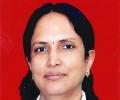
Last month, the Supreme Court collegium had withdrawn its approval to a proposal for the appointment of additional judge, Justice Ganediwala as a permanent judge of the court following her two controversial verdicts.

Chief Justice of India-designate Justice U U Lalit on Friday highlighted three areas on which he intends to work during his 74-day tenure as the head of the judiciary and said he would strive hard to ensure that at least one Constitution bench is functioning in the Supreme Court throughout the year.
Chief Justice of India Uday Umesh Lalit Thursday said media reports claiming that a Supreme Court bench has criticised the new system of listing of cases are 'not correct' and all judges of the apex court are on the same page.

President Droupadi Murmu administered him the oath at a brief ceremony held at the Rashtrapati Bhavan.

Justice Pushpa Ganediwala recently acquitted a man accused of groping a 12-year-old girl's breast because he did not make skin-to-skin contact and days earlier, ruled that holding the hands of a five-year-old girl and unzipping the trousers do not amount to "sexual assault" under the POCSO Act.

Vice President Dhankar's and Law Minister Rijuju's recent interventions have the danger of destabilising the Constitutional equilibrium, cautions N Sathiya Moorthy.

It is for the first time in the history of the apex court that nine judges took oath of office at one go.


The CJI also said the ancient Indian text "Nyayshastra" is "not a bit" inferior to Aristotle and the Persian system of logic, and "there is no reason why we should forsake, overlook, and not benefit from the geniuses of our ancestors".
Senior advocate and SCBA president Dushyant Dave Wednesday shot off a letter to the Chief Justice of India expressing disappointment at being allegedly deprived of an opportunity to speak at the farewell ceremony of Justice Arun Mishra. Dave wrote to the Chief Justice S A Bobde expressing "strong disappointment and condemnation" and said he will never again participate in any function being organised by the Supreme Court till his term as Supreme Court Bar Association president is over in December.

Justice J Chelameswar, who courted controversy by virtually revolting against Chief Justice of India Dipak Misra, also said that impeachment cannot be an answer to every problem and there was need to correct the system.

The Supreme Court on Friday termed as "virtually infructuous" a petition filed by a group of lawyers opposing the elevation of Justice J S Khehar as next the Chief Justice of India, observing that the President of India has already issued a notification in this regard.
A five-judge Constitution bench headed by Chief Justice Ranjan Gogoi upheld the 2010 Delhi high court verdict and dismissed three appeals filed by Secretary General of the Supreme Court and the Central Public Information officer of the apex court.

Justice Ranjan Gogoi, who will demit office as the Chief Justice of India in a week's time, has etched his name in the annals of history by giving finality to one of the most politically and religiously sensitive cases, the Ayodhya land dispute, which dates back to even before the Supreme Court came into existence in 1950.
Justice Karnan claimed that the seven judges of the bench have insulted him 'wantonly and deliberately and with mala fide intention'.

Justice Bobde, 63, also rued the criticism of judges on social media for their judicial actions and said most of the judges, who are not "thick skinned", get perturbed.

A bench comprising Chief Justice Ranjan Gogoi and justices L N Rao and Dinesh Maheshwari said it was only going into the aspect of security of the two women and would not like to entertain any other prayer made in the petition.

Earlier, the top court said it had been "taken for a ride" by the Sahara group by its past conduct and asked it to submit a roadmap for paying the balance amount
The apex court, which has been mulling over the issue in its meetings held at the residence of Chief Justice of India S A Bobde on Thursday and Friday, took note of the government's March 5 advisory cautioning against mass gatherings in view of the fact that the World Health Organisation has declared COVID-19 a 'global pandemic'.

In the plea, one of the women, who had been attacked by her mother-in-law following her entry into the hilltop shrine, has sought security for both the women.

"We will work out the parameters then we will see as to how mentioning will be done," he said.

Right to privacy as a fundamental right and granting 'third gender' status to transgenders were heavily relied upon by the SC while giving judgment.
During the hearing in CJI's court No 1, an unfazed Justice Gogoi said the allegations are unbelievable.
 © 2026 Rediff.com - Investor Information - Advertise with us - Disclaimer - Privacy Policy - Sitemap - Feedback - About us - Terms of use - Grievances