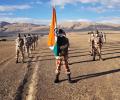
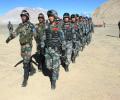
Twenty personnel of the India-China LAC guarding Indo-Tibetan Border Police (ITBP) force, who displayed bravery during the violent clashes and ongoing military standoff between the two countries in the eastern Ladakh region in May-June 2020, were on Sunday decorated with police gallantry medals.
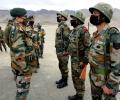
India, China have agreed to hold another round of talks soon.
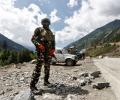
The top military brass reviewed the situation in eastern Ladakh and deliberated on key issues to be flagged at the talks on Monday, the sources said. Army Chief General M M Naravane and several top military officials were present in the meeting.

The current fleet of BMP-2/2Ks was first inducted into the Army in 1985 and it has been the mainstay of the mechanised infantry since then.

The Chinese admitted that they had suffered the maximum casualties fighting in the first battle on October 20, 1962, and these casualties had been inflicted mostly by 2 Rajput. Claude Arpi salutes Major B K Pant and his fighting force of 112 men, 82 of whom lost their lives in the Battle of Namkha Chu, and whose courage must never ever be forgotten by a grateful country for who they laid down their lives.
Twenty personnel of the India-China LAC guarding Indo-Tibetan Border Police (ITBP) force have been awarded gallantry medals for displaying bravery during standoff and clashes between militaries of the two countries in the eastern Ladakh region last year.

Although the latest aggression by China has caught the attention of the nation, the countrymen have been kept in the dark about their ongoing numerous such transgressions, says R N Ravi

'We are also capable of giving a befitting response to any attempt of aggression,' Kovind said.
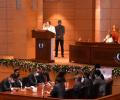
China routinely objects to Indian leaders' visits to Arunachal Pradesh to buttress its stand.

The youths were handed over to the Indian Army by the PLA after completing necessary formalities, Tezpur-based defence spokesperson Lieutenant Colonel Harsh Warrdhan Pande said.

The incident came to light when two members from the group of youths, who went hunting in the jungle, returned home and informed the families of the five that they were whisked away by the Chinese troops from Sera-7, an Army patrol zone located about 12 km further north of Nacho.

The high-level talks came a week after 20 Indian Army personnel were killed in a violent clash between the two sides in Galwan Valley.

The Indian Army had said the Chinese soldier had "strayed" across the LAC in Demchok sector.

Corporal Wang Ya Long was handed over to the Chinese military on Tuesday night at Chushul-Moldo border point in eastern Ladakh, the sources said in New Delhi.
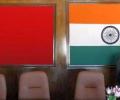
The sources said the focus of the talks was to take forward the disengagement process in friction points like Hot Springs, Gogra and Depsang in eastern Ladakh.
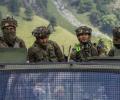
India and China on Saturday held another round of military talks with a focus on taking forward the disengagement process in Hot Springs, Gogra and Depsang in eastern Ladakh and bring down the tensions in the region, official sources said.

Indian Army chief General Manoj Mukund Naravane on Tuesday said that as far as the western front was concerned, there is an increase in the concentration of terrorists in various launch pads and there have been repeated attempts of infiltration across the Line of Control.
The 60-metre bridge is around four kilometres east of the confluence of Shyok and Galwan rivers, and links the narrow mountainous region to the Shyok-Daulat Beg Oldi road.

'We have not had one discussion on the border incursions or the subsequent report of the building of Chinese villages on Indian territory in Arunachal Pradesh.'

The two sides held talks on Tuesday as well but it could not produce any tangible outcome, the sources said.
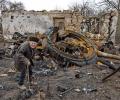
Any Indian government at this juncture would have voted and spoken exactly this way. It isn't just about the vast Indian dependence on Russian-origin military equipment. It is also about trust, asserts Shekhar Gupta.

Tawang wears its history -- and also its present -- with ease. The flourishing town, with restaurants selling everything from noodles to dosas and locals returning home to new business prospects, shows little sign of the tension building up at the border about 40 km away to the north.
Hours after withdrawing from the Chumar region in Ladakh, Chinese People's Liberation Army soldiers were on Friday reported to have crossed into Indian territory again and stationed themselves on a hillock.
After frequent incursions in Ladakh area, Chinese People's Liberation Army troops have been spotted at forward posts along the Line of Control on the Pakistani side of Kashmir, ringing alarm bells in the security grid.

Sources indicated that during Saturday's talks, India will insist on a faster disengagement process in remaining areas to bring down tension in the region, which has witnessed a tense standoff between the two militaries for over nine months.
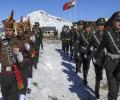
The focus of the deliberations was on finalising modalities for disengagement of troops in eastern Ladakh.

The use of firearms along the LAC marks a serious escalation in border tensions as the previous instance of shots being fired at the de-facto border was in 1975.

Sources said the Indian delegation was warmly greeted by senior officials of the Chinese Army before the talks began.

He said there were no signs of an "overt collusion" between China and Pakistan during the Ladakh standoff but India also caters to a long term strategy for not a two, but a two-and-half front war. With the half front, he was referring to the internal security.

The Chinese military is now desperately attempting to give "ex post facto strategic meaning" to its actions in eastern Ladakh.
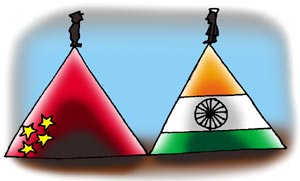
A new Border Personnel Meeting point was on Saturday operationalised at Daulat Beg Oldie along the Line of Actual Control in Ladakh sector, which would serve as the northern-most meeting point between armies of India and China.

Official sources said withdrawal of tanks and other armoured elements from certain friction points is nearing completion while pulling back of troops from the North bank areas is being undertaken.

As per the agreement reached by the two sides, India and China will withdraw the forward deployment in a phased and coordinated manner, the defence minister said.
The clear assertion by New Delhi came ahead of a fresh round of Lt General-level talks between the Indian army and the Chinese PLA which government sources said is set to take place within the next two days.
During the course of the intense and complex negotiations between senior commanders of the two armies that ended at 2 am on Wednesday, the Indian delegation also apprised the Chinese PLA about the "red lines" and conveyed that the onus was largely on China to improve the overall situation in the region, the sources said.

The incident took place on Wednesday afternoon in Demchok sector, located 250 km east of Leh, where the work for linking a village with 'hot spring' was being undertaken under the MNREGA.

India must break out of this strategic triangulation between China and Pakistan. We need to settle our issues with one of the two, notes Shekhar Gupta.

The standoff in Chumar region in Ladakh worsened on Saturday after a second intrusion by Chinese army personnel in two days was reported at another point after they had withdrawn from the same area.
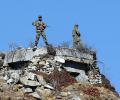
Chinese army on Wednesday reportedly made a fresh incursion in Chumar area and refused to return even as a flag-meeting between the two sides is believed to have made no headway in breaking the deadlock.
The first priority for the new Tibetan administration in Dharamsala should be to look at Tibetan recruitment in the PLA, suggests Claude Arpi.
 © 2026 Rediff.com - Advertise with us - Disclaimer - Privacy Policy - Sitemap - Feedback - About us - Terms of use - Grievances