
'India's move has grossly violated China's territorial sovereignty, seriously violated relevant agreements, protocols and important consensus reached between the two countries'

The MEA said China has undertaken such infrastructure construction in the past several years and the government too has stepped up border infrastructure which has provided much-needed connectivity to the local population.
'Which will not happen.' 'Foreign Minister S Jaishankar has expressly refuted Beijing's statement that normalcy was returning to Sino-Indian relations.'

Singh also assured the opposition that the central government will not keep Parliament or anyone in the dark about developments on the border and will share details at an appropriate time.
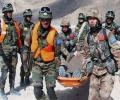
This is the first such incident along the border with China that Indian armed forces personnel have been killed after a gap of nearly 45 years.

Amid tensions over build-up by the Chinese across the Line of Actual Control (LAC) in Eastern Ladakh and reluctance to resolve remaining issues between the two countries, Indian Air Force (IAF) chief Air Chief Marshal VR Chaudhari is visiting forward areas in Ladakh to review the operational preparedness of troops deployed there.

"Today when there is so much anger over Chinese intrusion, the prime minister should come out and tell the nation how the Chinese managed to commit this act of aggression," Gandhi said in a video message.
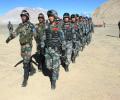
Indian and Chinese troops remained engaged in an eyeball-to-eyeball situation in several disputed areas.
The 60-metre bridge is around four kilometres east of the confluence of Shyok and Galwan rivers, and links the narrow mountainous region to the Shyok-Daulat Beg Oldi road.
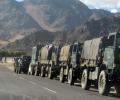
According to estimates, both India and China have deployed more than 50,000 troops in the Eastern Ladakh sector opposite each other despite the limited disengagement in the Pangong lake sector by both sides earlier this year.

"Rahul Gandhi does not attend a single meeting of Standing Committee on Defence. But sadly, he continues to demoralise the nation, question the valour of our armed forces and do everything that a responsible opposition leader should not do," the BJP president said.
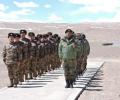
At present, the Chinese Army has diverted its troops carrying out a massive exercise on their side of the LAC and deployed them at short notice across the Line of Actual Control in the areas under the Indian Army's 81 and 114 Brigades deployed to counter the Chinese assertions from Daulat Beg Oldie and adjoining areas.

Weidong said India and China "should live in peace and avoid conflicts."

The Chinese admitted that they had suffered the maximum casualties fighting in the first battle on October 20, 1962, and these casualties had been inflicted mostly by 2 Rajput. Claude Arpi salutes Major B K Pant and his fighting force of 112 men, 82 of whom lost their lives in the Battle of Namkha Chu, and whose courage must never ever be forgotten by a grateful country for who they laid down their lives.

'This was Indian land the PLA advanced on and occupied.' 'The Chinese then 'negotiated' a pullback of their troops a small distance on Indian territory even as Indian jawans draw back further into India from the forward position.' 'An apparently satisfied Indian government says this is a great move for peace! How great is that for China!'

India on Wednesday delivered a strong message to China that the 'unprecedented' incident in the Galwan Valley will have a 'serious impact' on the bilateral relationship and held the 'pre-meditated' action by Chinese army directly responsible for the violence that left 20 Indian Army personnel dead.

Army chief General Naravane said the ongoing dialogue will sort out all the perceived differences between the two countries.
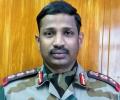
Colonel Santosh Babu who hailed from Suryapet district in Telangana, was serving in the 16 Bihar regiment as Commanding Officer.

Defence Minister Rajnath Singh held two-back-to-back meetings with top military brass on Tuesday deliberating on the situation in eastern Ladakh after an Indian Army officer and two soldiers were killed in a violent clash with Chinese troops in Galwan Valley.

The disengagement of troops of the Indian Army and China's People's Liberation Army from the Line of Actual Control was reached after sustained negotiations at the military and diplomatic level, said the ministry of external affairs last week.

A start-up firm in Noida said soon after the Galwan Valley clash, it was tasked by the Indian security forces to provide them equipment to be able to tackle the Chinese and they have provided them solutions in the form of non-lethal weapons inspired by the traditional Indian weapons like the 'Trishul' of Lord Shiva.
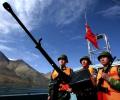
Both the Indian and Chinese armies have brought in more troops in sensitive locations like Demchok, Daulat Beg Oldie and areas around Galwan river as well as Pangong Tso lake in Ladakh, the sources said. The area around Galwan has been a point of friction between the two sides for over six decades.

The experts also said China's military 'misadventure' may have been driven in part by President Xi Jinping's attempt to show 'gains somewhere" after the growing global criticism against his country over the origin of COVID-19.
The document, which was uploaded on the defence ministry's website, was removed on Thursday morning following publication of a media report based on it.

"How dare China kill our soldiers? How dare they take our land?" he said.
In separate statements, the Chinese foreign and the defence ministries, however, repeated Beijing's stand that India was responsible for the June 15 violent face-off in eastern Ladakh. Defence Ministry Spokesman Col Wu Qian said the two defence ministers are negotiating on the phone.
Indian Army Chief General M M Naravane had said on Wednesday that India was hopeful of resolving issues related to disengagement at Patrolling Point 15 (Hot Springs) in eastern Ladakh in the 14th round of talks.
Indian military sources said no firearms were used in the clashes and that most of the injuries were sustained following stone-pelting and use of rods by the Chinese side.

In the review meeting, Singh told the top military brass to continue to deal with the situation in eastern Ladakh and other areas with "firmness".
....a long-term boundary agreement is reached between the two countries.
The Indian Army has been pitching for a faster disengagement process in areas like Hot Springs, Gogra and Depsang to bring down tension in the mountainous region.
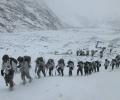
The Indian side has an edge over their Chinese counterparts in terms of battling the weather as a large number of them have already done duty in the Ladakh sector, including the Siachen glacier or other high altitude positions, sources said.
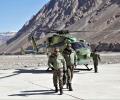
'This reluctance to respond forcefully to Chinese PLA provocations and outright aggression has as much to do with Prime Minister Modi personally, as with the institutional mindset of the MEA or even the Indian Army.' 'They are scarred by the 1962 War and are still cowed by China.'
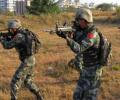
This is the first time China has commented on the casualties. Though China has not revealed its casualty figure, there were reports that a commanding officer of the Chinese army was among those killed in the clashes. There is no official confirmation about it.

'There was a wrong policy of government during the Congress regime. They didn't construct roads up to the border which left a buffer zone of 3-4 km which China occupied. Construction of new villages isn't a new thing, it's all inherited from Congress'
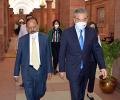
What is it that China seeks and why has the Ladakh border become and remained hot for two years and what is going on in Arunachal Pradesh?, asks Aakar Patel.

The visit is also aimed at boosting morale of the army personnel engaged in the seven-week bitter border faceoff with the Chinese troops in the region, sources added.
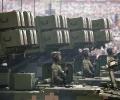
China hiked its annual defence budget by 7.1 per cent.

The deployment of strategic bomber aircraft is also still on by the Chinese

It is learnt that the face-off took place after a Chinese patrol tried to enter Indian territory and the troops of China's People's Liberation Army were forced back.
 © 2026 Rediff.com - Investor Information - Advertise with us - Disclaimer - Privacy Policy - Sitemap - Feedback - About us - Terms of use - Grievances