
CGST Gurugram busts a large-scale fake GST registration racket operating in North Delhi, involving fraudulent invoices and ITC availment.

UltraTech Cement on Saturday said it has received a GST demand notice for a total payment of Rs 782.2 crore, which it plans to contest before the appropriate forum.

In a development that may encourage increased investment in commercial real estate, the Supreme Court on Thursday gave the industry relief by permitting input tax credit (ITC) on construction expenses for buildings meant to be leased. "If the construction of a building was essential for carrying out the activity of supplying services, such as renting or giving on lease or other transactions in respect of the building or a part thereof, which are covered by clauses (2) and (5) of Schedule II of the CGST (Central Goods and Services Tax) Act, the building could be held to be a plant," said Justice Abhay S Oka and Justice Sanjay Karol.

Patanjali Foods has been served a show cause notice by the GST intelligence department, asking the company to explain why input tax credit worth Rs 27.46 crore should not be recovered from it. The yoga guru Ramdev-led Patanjali Ayurved Group firm, which is mainly into the edible oil business, has received the notice from the Directorate General of GST Intelligence, Chandigarh Zonal Unit, according to a regulatory filing made by the company on April 26.

Among parties, the NCP stood out with five of its MPs raising an average of 410 questions each. On the other hand, two Apna Dal (Soneylal) raised only five questions each on average.

'We have now drastically simplified it, primarily to two rates in long-term capital gains: 20% and the applicable rates. Similarly, in short-term capital gains.' 'For listed shares, there is a slight increase, but for unlisted shares, where indexation benefits are removed, there is a reduction in rates, benefiting unlisted companies, venture capital firms, etc.' 'Similarly, in real estate, wherever returns are higher, the new structure is beneficial. In very few cases, returns are lower, and those are more of an exception.'

On the back of robust tax collection, the ratio of direct taxes to gross domestic product (GDP) this financial year is likely to be the highest in this century so far. This, along with strong goods and services tax (GST) collection, may drive up receipts from central taxes as a proportion of GDP to the highest level or close to the highest since 2008-09 despite subdued excise and customs duty receipts. This will be due also to lower nominal GDP projected in the first advance estimates for 2023-24.
'We crossed Rs 1.7 trillion in three months this financial year.'

Besides the bills, the government has listed the first batch of supplementary demands for grants for 2023-24 for presentation, discussion and voting during the session.

The MPs suspended on Tuesday include National Conference's Farooq Abdullah and Congress leaders Shashi Tharoor and Manish Tewari.

While recalling the order, the bench agreed to the contention of the law officer that there was a "breach of principle of natural justice" as the government department was not accorded the hearing.
India's gross tax revenue, comprising both direct and indirect taxes between April and July, reported a growth rate of merely 2.8 per cent to Rs 8.9 trillion compared to the same period a year ago, as shown by government data on Thursday. This growth was dampened by direct tax figures, offsetting the healthy growth in goods and services tax collections and Customs duties. While net tax revenue contracted by 12.6 per cent to Rs 5.8 trillion up to July, accounting for 25 per cent of the Rs 23.3 trillion full-year target, this could be attributed to the increased tax devolution to states during the period.

The deficit stood over Rs 8 trillion in the first seven months of the current financial year. Non-tax revenues, comprising transfers from the RBI and dividends of the public sector units, shored up the Centre's revenues.
GST taxpayers will be required to reverse by November 30 the input tax credit (ITC) claimed in the last fiscal in case their suppliers fail to deposit the due tax by September 30, the finance ministry has said. The taxpayers, however, can reclaim the ITC later following the deposit of taxes by the supplier. The ministry has inserted Rule 37A in Central Goods and Services Tax rules to give effect to the new provision.
The Centre is staring at a combined shortfall of up to Rs 1 trillion in excise and Customs revenues in the current financial year (FY23) compared to the Budget estimates (BE), mainly because of duty cuts on edible oil and petroleum products. The government set a target of Rs 3.35 trillion for excise and Rs 2.13 trillion for Customs mop-up for FY23 while presenting the Budget in February. "As excise duty collection is mainly driven by diesel volumes, we might see a clear gap in the level budgeted for FY23, following the reduction in cesses on petrol and diesel in May. We are expecting somewhere between Rs 80,000 crore and Rs 1 trillion dip in excise and customs duty collections," a senior government official told Business Standard.
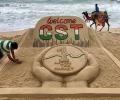
Goods and Services Tax (GST) collections jumped to over Rs 1.31 lakh crore in November, the second highest since its implementation in July 2017, in line with the trend in economic recovery, the finance ministry said on Wednesday. "The gross GST revenue collected in the month of November 2021 is Rs 1,31,526 crore of which CGST is Rs 23,978 crore, SGST is Rs 31,127 crore, IGST is Rs 66,815 crore (including Rs 32,165 crore collected on import of goods) and Cess is Rs 9,606 crore (including Rs 653 crore collected on import of goods)," the ministry said in a statement. CGST refers to Central Goods and Services Tax, SGST (State Goods and Service Tax) and IGST (Integrated Goods and Services Tax).

The revenues for August are 88 per cent of the GST collected in the same month last year.
India's Goods and Services Tax (GST) collection surged to Rs 1.30 lakh crore in October, the second highest since its implementation in July 2017, indicating economic recovery from the COVID-19 pandemic and impact of festive demand, a finance ministry statement said on Monday. The highest GST collection of Rs 1.41 lakh crore was recorded in April 2021. This is the fourth time in a row when the GST collection was upwards of Rs 1 lakh crore. The collection from GST was Rs 1.17 lakh crore in September, 2021.

According to reports, eight hours have been allocated by the speaker for discussion on the tax reform bill.
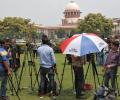
The Supreme Court Monday said the Centre was testing its "patience" and "emasculating" tribunals by not appointing officials to the quasi-judicial bodies which are facing severe crunch of presiding officers as well as judicial and technical members and sought action on the matter by September 13.

The data primarily pertains to activities in March, which had only a few days under the Covid-19 lockdown. For April , hence, CGST collections could be much lower, fear analysts.

The mop-up could have been much higher, but tax on imports fell 2 per cent y-o-y.

Experts said this will mean that companies, which have offices in multiple states, will have to raise Goods and Services Tax invoice for functions performed by employees in head office that has helped branches in other states.

Businesses with more than Rs 10 lakh turnover may end up paying the central goods and services tax, with the Centre not agreeing to states' suggestion of keeping the threshold at Rs 1.5 crore.
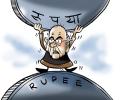
For the first eight months of the current financial year, the figure stood at Rs 7.17 trillion.
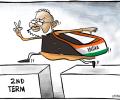
'If the current mood in North Block, headquarters of the finance ministry, is anything to go by, the government will now keep a closer watch on all kinds of schemes and projects undertaken by different central ministries. 'The next six months will determine which central schemes will have to be wound up and which ones will survive the axe,' says A K Bhattacharya.

The deposit has been made on account of the rate reductions approved by the GST Council in its November. The rate was reduced on items including shampoo, detergents, chocolates, beauty products, sanitary ware, leather clothing, cookers, stoves, after-shave, deodorant, detergent and washing power. Companies found it difficult to pass on the benefits to consumers immediately at the time of GST rate reduction owing to logistical issues.
A well-established tax system would have a predictable buoyancy - how fast the collections grow as a proportion to the growth of the economy. But that is not the case with GST. It is still undergoing substantial changes as the government responds to structural as well as administrative glitches.

Expecting fireworks in both Houses during the Winter Session of Parliament starting from Wednesday -- with the opposition planning to target the government on several issues, including demonetisation -- the Bharatiya Janata Party Parliamentary Party Executive will go into a huddle on Monday to chalk out strategy to counter the opposition which is divided over how to take on the government on the issue.

GST compensation law allows for imposition of cess on certain luxury goods like tobacco, high-end cars and aereated drinks to create a corpus for compensating states for any loss of revenue in the first five years

These have to be passed in this session to meet the September 15 deadline for switching over to the new indirect tax regime, Jaitley said.

For the government to meet its GST roll-out deadline of April 1, 2017, the states will have to ratify the Bill before Parliament's winter session, starting November.

It's an undeniable fact that after enactment of GST, buying insurance will become a little expensive impacting your term plans, health plans and motor insurance plans the most. But you should not ignore the importance of insuring your life, health, vehicle, says Harjot Singh Narula

Indian states are preparing for a Rs 1.9 lakh crore (Rs 1.9 trillion) tax windfall this fiscal year.

The Budget decides to take the lead in revving up infrastructure.

Criticising various provisions in the proposed GST regime, Moily said it will be a "technological nightmare" and the anti-profiteering provisions in it are "far too draconian."
 © 2026 Rediff.com - Investor Information - Advertise with us - Disclaimer - Privacy Policy - Sitemap - Feedback - About us - Terms of use - Grievances